Thank you for visiting SNEWPapers!
Sign up free
The Rhode Island American, And General Advertiser
Providence, Providence County, Rhode Island
What is this article about?
In this satirical letter to President Jefferson (circa 1807), 'Mucius' critiques the congressional handling of the Smith-Jackson affair amid tensions with Britain after the Chesapeake incident, warns against war to cover official corruption by the 'family compact,' and vows to expose their schemes. He urges pragmatic foreign policy over rigid legalism.
Merged-components note: Continuation of the same letter to the President across page break, sequential reading order.
Clippings
1 of 2
OCR Quality
Full Text
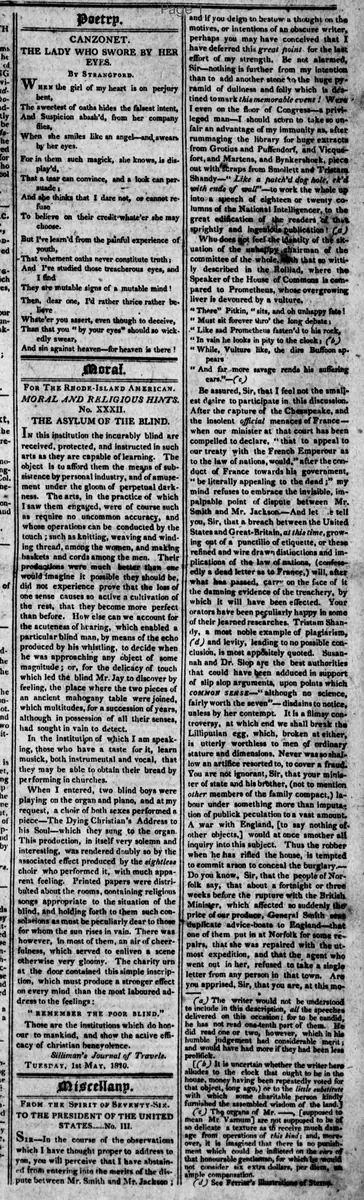
From the SPirit of Seventy-Six.
TO THE PRESIDENT OF THE UNITED STATES......No. III.
SIR--In the course of the observations which I have thought proper to address to you, you will perceive that I have abstained from entering into the merits of the dispute between Mr. Smith and Mr. Jackson; and if you deign to bestow a thought on the motives, or intentions of an obscure writer, perhaps you may have conceived that I have deferred this great point for the last effort of my strength. Be not alarmed, Sir-nothing is further from my intention than to add another stone to the huge pyramid of dullness and folly which is destined to mark this memorable event! Were I even on the floor of Congress-a privileged man-I should scorn to take so unfair an advantage of my immunity as, after rummaging the library for huge extracts from Grotius and Puffendorf, and Vattel, and Martens, and Bynkershoek, piece out with Scraps from Smollett and Tristam Shandy-"Like a patch'd dog hole ek'd with ends of wall" to work the whole up into a speech of eighteen or twenty columns of the National Intelligencer, to the great edification of the readers of that sprightly and ingenious publication! (a)
Who does not feel the identity of the situation of the unhappy chairman of the committee of the whole, than that so wittily described in the Rolliad, where the Speaker of the House of Commons is compared to Prometheus, whose overgrowing liver is devoured by a vulture.
"There" Pitkin, "sits, and oh unhappy fate!
Must sit forever thro' the long debate;
Like sad Prometheus fasten'd to his rock,
In vain he looks in pity to the clock; (b)
While, Vulture like, the dire Buffoon appears
And far more savage rends his suffering ears."-(c)
Be assured, Sir, that I feel not the smallest desire to participate in. this discussion. After the capture of the Chesapeake, and the insolent official menaces of France-when our minister at that court has been compelled to declare, "that to appeal to our treaty with the French Emperour as to the law of nations, would " after the conduct of France towards his government, " be literally appealing to the dead;" my mind refuses to embrace the invisible, impalpable point of dispute between Mr Smith and Mr. Jackson.--And let me tell you, Sir, that a breach between the United States and Great-Britain, at this time, growing out of a punctilio of etiquette, or these refined and wire drawn distinctions and implications of the law of nations, (confessedly a dead letter as to France,) will, after what has passed, carry on the face of it the damning evidence of the treachery, by which it will have been effected. Your orators have been peculiarly happy in some of their learned researches. Tristam Shandy, a most noble example of plagiarism, (d) and levity, leading to no possible conclusion, is most appositely quoted. Susannah and Dr. Slop are the best authorities that could have been adduced in support of slip slop arguments, upon points which COMMON SENSE-"although no science, fairly worth the seven"- disdains to notice unless by her contempt. It is a fimsy controversy, at which end we shall break the Lilliputian egg, which, broken at either is utterly worthless to men of ordinary stature and dimensions. Never was so shallow an artifice resorted to, to cover a fraud.
You are not ignorant, Sir, that your minister of state and his brother, (not to mention other members of the family compact,) labour under something more than imputation of publick peculation to a vast amount. A war with England, [to say nothing of other objects,] would at once smother all inquiry into this subject. Thus the robber when he has rifled the house, is tempted to commit arson to conceal the burglary.-- Do you know, Sir, that the people of Norfolk say, that about a fortnight or three weeks before the rupture with the British Minister, which affected' so suddenly the price of our produce, General Smith sent duplicate advice-boats to England that one of them put in at Norfolk for some repairs, that she was repaired with the utmost expedition, and that the agent who went out in her, refused to take a single letter from any person in that town. Are you apprised, Sir, that you are, at this moment
(a) The writer would not be understood to include in this description, all the speeches delivered on this occasion; for to be candid. he has not read one-tenth part of them. He did read one or two, however, which in his humble judgement had considerable merit and would have had more if they had been less prolifick.
(b) It is uncertain whether the writer here alludes to the clock that ought to be in the house, money having been repeatedly voted for that object, long ago,) or to the little substitute with which some charitable person kindly furnished the assembled wisdom of the land.
(c) The organs of Mr. -a, [supposed to mean Mr. Varnum] are not supposed to be of so delicate a texture as to receive much damage from operations of this kind; and, moreover, it is imagined that there is no punishment which could be inflicted on the ears of that honourable gentleman, for which he would not consider six extra dollars, per diem, an ample compensation.
(d) See Ferriar's illustrations of Sterne.
ment a prisoner of state in your own palace? That consultations are held upon you by the Smiths, the Giles's and the Leibs, in which your present interest and future fame are alike disregarded? Are you astonished when you behold the description of men by whom you are surrounded? When you contemplate the character of the avowed supporters of your government in Congress, and the composition of that body! That profound statesman, Chancellor Oxenstiorn, reared in the school of Gustavus Adolphus, has indeed declared, "that 'tis inconceivable with how small a portion of wisdom the affairs of states and empires are conducted; but even he admits they require some. And the portion that would seem small indeed in the eyes of an Oxenstiern; how vast; how exhaustless does it appear in those of your simpering, self-applauding Secretary. This is a mournful subject. To what cause, I pray you, Sir, are we to ascribe this dearth of talents in our publick councils-this general decline of character in our publick men; whether for ability or integrity? Why is it, Sir, that you look around in vain for successors worthy of your old contemporaries. In whatever cause the solution of this melancholy problem shall be found, the fact is not the less humiliating and alarming. Retire into your own bosom, and ask yourself if with such a Congress, scarcely capable of conducting the affairs of the country in time of peace, you would trust yourself to carry on war with any power superiour to the corsairs of Barbary? Shall we look to the State Legislatures for the supply of those abilities of which Congress is destitute. Alas! so far as my observation extends, we shall cast our eyes in vain to that quarter for assistance. The same dull, spiritless incapacity seems to pervade every department of the State. Time-serving, and electioneering, and jobbing, and chaffering, and bargaining for offices and contracts, are the order of the day. But be assured, Sir, that whatever be the case with their Representatives, the people have not degenerated. They will never embark their lives-(this no empty profession as it respects them)-their fortunes and their sacred honour in a war entered into to screen the embezzlers of their substance, to achieve the guilty purposes of the blackest ambition. When the hopes which the friends of freedom once entertained from the French revolution were quenched, forever. When in Great-Britain we beheld the freest government in Europe, connected with us not more by language than by commerce; sentiments as well as policy would seem to dictate a preference for her cause in the mind of every genuine friend of liberty. I speak not of that spurious liberty, whose votaries are enrolled in the code of the conscription; who rejoice in the subjugation of Switzerland and the Tyrol, who exult in the overthrow of the Spanish patriots, and offer up their daily vows at the shrine of the grim Moloch of French ambition.
"besmeared with blood"
"Of human sacrifice and parent's tears!" (f)
It were devoutly to be wished that the terrifick power of the modern Zingis rested on no firmer basis than the prayers of his Gallo-American votaries; but the talents which he has embodied in his service are not less appalling than the tremendous physical force which he wields. When he employs blockheads, 'it is not in his own councils, but in those of other nations. He would spurn with contempt from his presence forever the spiritless creatures, with their absurd, imbecile measures, who have so long figured as leaders in our legislative councils. The blunt untamable honesty of Macon would as soon find employment in his service, as the pert loquacity of the frothy nonsense of , or the impenetrable stupidity of −.(g) And yet, these are the statesmen on whom we are to rely to cope with Bonaparte, when every obstacle to his power shall have been removed! Alas! Sir, his Talleyrands, and Champagnys, and Berthiers, and Lefebvres, and Neys, and Soults, opposed to our Doc-(e) The writer would by no means wish to be understood as casting an indiscriminate censure on the members of the two Houses of Congress. There are men as he believes of ability and worth in both; but in what ranks will they be found? Certainly not under the banners of the family compact. It would be invidious to mention any particular persons. It would be uncandid too, to deny that the present Congress is greatly superiour to its predecessor the "embargo" or "lack-learning" Congress. There has been a considerable accession of talent since the last election, but not on the ministerial side; which exhibits a bleak and barren prospect of utter sterility of intellect.-Connecticut, however, proudly adheres to her "steady habits." But to the exertions of two gentlemen, of the old republican school-one of them in the Senate, from Georgia, the other in the House of Representatives, from North-Carolina, it is probably owing, that the United States have not been already plunged into a war. (f) And yet these men call themselves republicans! The holy fathers of the inquisition called themselves Christians. (g) There can be no difficulty in filling the blanks without going into a committee of the whole House.
Although in the courteous style; but not dear which our patriotic legislators have heaped, on the belligerents, they seem to have availed themselves of the famous precedent of the sage and pious Eroulphus;(h) yet, to their astonishment and dismay, neither words, nor proclamations nor resolutions, however angry, or undignified, or scurrilous, have brought those great offenders to a just sense of their transgressions. What then remains to be done?
Without pretending to instruct, much less to dictate or prescribe to you, Sir, may I be permitted to suggest whether the most lofty language and pretensions comport with the resources of second and third-rate powers; whether circumstances ought not, and will not, (in spite of all we can do,) govern us, instead of our governing them; whether there are or can be any rights so absolute as not to be limited and modified by the posture of affairs and the existing state of things? In other words, Sir, whether in the "direction" of our concerns with the other nations of the earth, we should look to our own resources and to theirs; to the actual situation of the world; or turn to the statute book, or to the musty authorities on national law, for our rule of conduct? And on this subject, Sir, if you will pardon the liberty, I will relate one other anecdote.
An irritable Virginia gentleman arrived one dark and cold winter's night, at a ferry on James river. The boat was kept on the other side, and our impatient squire vociferated most loudly for the ferryman. Unluckily it was Saturday night, and Charon had gone about a mile off to the next plantation, to assist at a dance. A boy, however, was despatched for him, but the very circumstance which aggravated the gentleman's impatience, viz. the darkness and coldness of the night-served but to retard, instead of accelerating the movements of poor Charon. At last, however, with slow and reluctant steps, he came. when, as he was loosing the boat from her moorings, our unfortunate traveller saluted him with a volley of curses, as choice as Eroulphus himself could have coined-threatening him with instant chastisement as soon as he should reach the opposite shore. Our hero was a justice of the peace-he well knew what were the rights of a Virginia colonel, and what the rights of a poor black ferryman. Like some of our members of Congress, he was too magnanimous to consider the real state of things.-- Like Sterne's judicious critick he thought only of the stop-watch. Meanwhile it occurred to poor Charon, (for even slaves will sometimes reason.) that if he was to get a severe drubbing-the cudgel should come to him'; that he would not go to the cudgel; and this determination he announced in the most positive terms to his "massa." Our traveller now began to perceive that he had not managed this matter quite so well; that there are circumstances which have no respect for the rights and menaces even of a Virginian colonel; that it would have been prudent to husband his threats until he was in some condition to execute them. He began therefore to give Charon fairer words.-- On the faith of a gentleman, "and the honour of a soldier" he promised the poor object of his rage, oblivion for the past and security for the future. Charon was as inexorable as his name sake, the old ferryman of Styx. Our gentleman now began to be alarmed lest he should perish with cold before he could reach the next house. He opened his budget of indemnities; he offered Charon an extra half bitt, a pistareen, a half dollar! a dollar!! and a bottle of rum!!! Charon, who thought the terms of this arrangement too liberal to be adhered to with good faith on the part of the high contracting power on the other side of the water, had rejected all these splendid pecuniary offers under a suspicion of a "disavowal of the arrangement," when the state of things should be changed, out he could not resist the bottle of rum. He thought it impossible that ill faith could exist in a shape so alluring. After much time spent in the negotiation, in repeating in distinct terms the articles of agreement and exchanging ratifications, Charon pushed off; wafted our unhappy wight over the river; took him on his back, (for by this time he was unable to walk,) to his miserable hut, and laid him by the fire. where he left the poor unhappy frostbitten traveller, (while he set out to the next store for his bottle of rum,) to ruminate on the converse of a famous precept, and silently resolving never again "to feel right and forget power."
Nothing could have induced me to address a personage of your dignity in a style thus familiar, and, (as I had thought,) unbecoming, but my having perceived that Roderick Random and Tristam Shandy and Shakespeare's motley fool, with his (h) Captain Weasel-a redoubtable hero of Smollett's Roderick Random, lately lugged into a speech in the House of Representatives, with as little ceremony as he was lugged from under the seat of the state waggon, to the great amazement and admiration of Hugh Strap the shaver! i) Another great modern authority See Tristam Shandy. "lie circumstantial and countercheck quarrelsome." are at the top of the fashion, in the first political circle in the country standard authorities on the floor of Congress.
At length, too, I perceive it has been discovered by some of those who do not talk always but think sometimes, that, even in national affairs, circumstances ought to be taken into account, and that the United States-are not irretrievably disgraced because their gun-boats are not a match for the British navy, and General Wilkinson and his army not quite equal to Bonaparte at the head of his legions. This was reckoned a damnable heresy a few years ago; but like other heresies it appears to begin to thrive by persecution, and it seems now to be agreed, that we may, and ought to pursue our interest, in the most practicable way, and that really there is no absolute necessity for hanging ourselves, (like Jack in the Tale of the Tub,) out of spite, because we are thwarted in argument. But I have been too long diverted from the subject which prompted me to address you-the immediate object of my solicitude; on which I have bestowed many an anxious thought: to which, (with the blessing of God!) it is my firm unalterable purpose to devote many an hour of labour, I mean the history, character and connexions of the "family compact." These I shall endeavour to trace through, all their ramifications, and I shall present you with such a body of evidence in relation to these people and their designs, as no man claiming the character of common prudence, or foresight, ever ventured to resist.
MUCIUS.
What sub-type of article is it?
What themes does it cover?
What keywords are associated?
What entities or persons were involved?
Letter to Editor Details
Author
Mucius.
Recipient
The President Of The United States
Main Argument
the author warns the president against entering a war with britain, which would be manipulated by corrupt officials like the smiths to cover embezzlement, criticizes the trivial congressional debates on the smith-jackson dispute, and promises to expose the 'family compact' influencing the administration.
Notable Details