Thank you for visiting SNEWPapers!
Sign up free
Story
January 22, 1805
The Enquirer
Richmond, Henrico County, Virginia
What is this article about?
James Woodhouse provides a recipe for indelible ink superior to imported versions, using nitrate of silver, galls infusion, and pearl-ash solution, with chemical explanation, published in the Philadelphia Medical Museum.
Clipping
OCR Quality
98%
Excellent
Full Text
MISCELLANEOUS.
[The following is extracted from the second number of "The Philadelphia Medical Museum," conducted by John Redman Coxe, M. D. of Philadelphia, and just published by Mr. Thomas Dobson, at No. 41, South Second-street.]
To the Editor of the Philadelphia Medical Museum.
Dear SIR,
According to my promise, I send you a receipt for making an indelible ink, superior to that imported from London, considerable quantities of which, have lately been sold in Philadelphia.
I am, Sir, with respect,
Your humble servant,
JAMES WOODHOUSE.
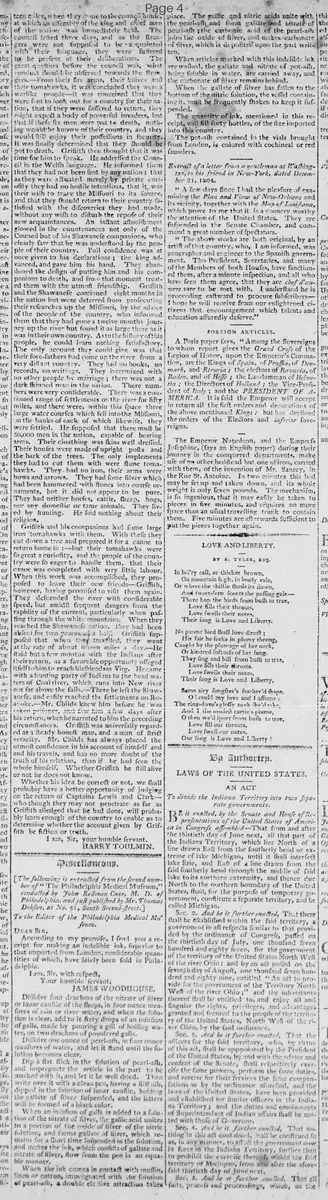
Dissolve four drachms of the nitrate of silver or lunar caustic of the shops, in four ounce measures of rain or river water, and when the solution is clear, add to it sixty drops of an infusion of galls, made by pouring a gill of boiling water, on two drachms of powdered galls.
Dissolve one ounce of pearl-ash, in four ounce measures of water, and let it stand until the solution becomes clear.
Dip a flat stick in the solution of pearl-ash, and impregnate the article in the part to be marked with it, and let it be well dried. Then write over it with a clean pen, having a stiff nib, dipped in the solution of lunar caustic, holding the gallate of silver suspended, and the letters will be formed of a black color.
When an infusion of galls is added to a solution of the nitrate of silver, the gallic acid unites to a portion of the oxide of silver of the nitric solution, and forms gallate of silver, which remains for a short time suspended in the solution, and makes the ink. which consists of gallate and nitrate of silver, flow from the pen in an equable manner.
When the ink comes in contact with muslin. linen or cotton, impregnated with the solution of pearl-ash, a double elective attraction takes place. The gallic and nitric acids unite with the pearl-ash and form gallate and nitrate of pearl-ash: the carbonic acid of the pearl-ash joins the oxide of silver, and makes carbonate of silver, which is deposited upon the part written.
When articles marked with this indelible ink are washed, the gallate and nitrate of pot-ash. being soluble in water. are carried away, and the carbonate of silver remains behind.
When the gallate of silver has fallen to the bottom of the nitric solution, the vessel containing it. must be frequently shaken to keep it suspended.
The quantity of ink, mentioned in this receipt, will fill forty bottles, of the size imported into this country.
The pot-ash contained in the vials brought from London, is colored with cochineal or red saunders.
[The following is extracted from the second number of "The Philadelphia Medical Museum," conducted by John Redman Coxe, M. D. of Philadelphia, and just published by Mr. Thomas Dobson, at No. 41, South Second-street.]
To the Editor of the Philadelphia Medical Museum.
Dear SIR,
According to my promise, I send you a receipt for making an indelible ink, superior to that imported from London, considerable quantities of which, have lately been sold in Philadelphia.
I am, Sir, with respect,
Your humble servant,
JAMES WOODHOUSE.
Dissolve four drachms of the nitrate of silver or lunar caustic of the shops, in four ounce measures of rain or river water, and when the solution is clear, add to it sixty drops of an infusion of galls, made by pouring a gill of boiling water, on two drachms of powdered galls.
Dissolve one ounce of pearl-ash, in four ounce measures of water, and let it stand until the solution becomes clear.
Dip a flat stick in the solution of pearl-ash, and impregnate the article in the part to be marked with it, and let it be well dried. Then write over it with a clean pen, having a stiff nib, dipped in the solution of lunar caustic, holding the gallate of silver suspended, and the letters will be formed of a black color.
When an infusion of galls is added to a solution of the nitrate of silver, the gallic acid unites to a portion of the oxide of silver of the nitric solution, and forms gallate of silver, which remains for a short time suspended in the solution, and makes the ink. which consists of gallate and nitrate of silver, flow from the pen in an equable manner.
When the ink comes in contact with muslin. linen or cotton, impregnated with the solution of pearl-ash, a double elective attraction takes place. The gallic and nitric acids unite with the pearl-ash and form gallate and nitrate of pearl-ash: the carbonic acid of the pearl-ash joins the oxide of silver, and makes carbonate of silver, which is deposited upon the part written.
When articles marked with this indelible ink are washed, the gallate and nitrate of pot-ash. being soluble in water. are carried away, and the carbonate of silver remains behind.
When the gallate of silver has fallen to the bottom of the nitric solution, the vessel containing it. must be frequently shaken to keep it suspended.
The quantity of ink, mentioned in this receipt, will fill forty bottles, of the size imported into this country.
The pot-ash contained in the vials brought from London, is colored with cochineal or red saunders.
What sub-type of article is it?
Curiosity
What keywords are associated?
Indelible Ink
Nitrate Of Silver
Pearl Ash
Galls Infusion
Chemical Reaction
What entities or persons were involved?
James Woodhouse
John Redman Coxe
Thomas Dobson
Where did it happen?
Philadelphia
Story Details
Key Persons
James Woodhouse
John Redman Coxe
Thomas Dobson
Location
Philadelphia
Story Details
James Woodhouse shares a recipe for indelible ink using nitrate of silver, galls, and pearl-ash, explaining the chemical process that makes markings permanent after washing.