Thank you for visiting SNEWPapers!
Sign up free
Editorial
September 6, 1803
The New Hampshire Gazette
Portsmouth, Rockingham County, New Hampshire
What is this article about?
An editorial critiquing General Burgoyne's Manifesto from the Revolutionary War, portraying it as tyrannical and insulting, while celebrating American fortitude and victory that led to independence and current prosperity.
Clipping
OCR Quality
95%
Excellent
Full Text
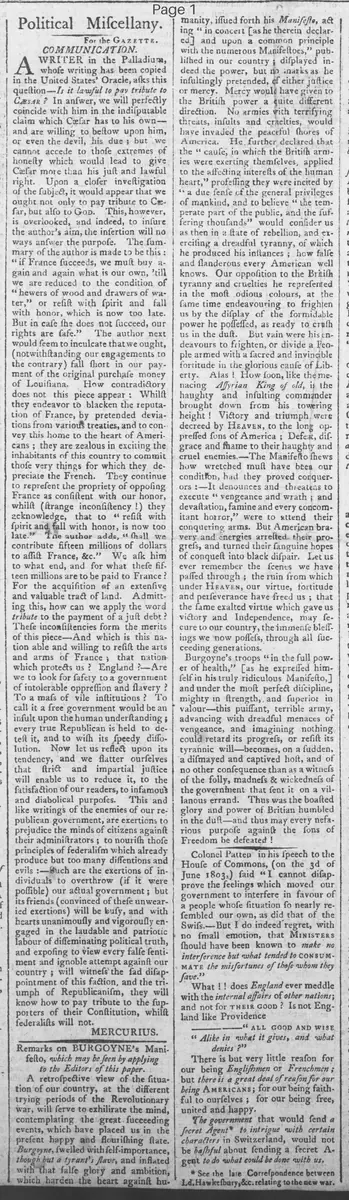
Remarks on BURGOYNE's Manifesto, which may be seen by applying to the Editors of this paper.
A retrospective view of the situation of our country, at the different trying periods of the Revolutionary war, will serve to exhilarate the mind, contemplating the great succeeding events, which have placed us in the present happy and flourishing state. Burgoyne, swelled with self-importance, though but a tyrant's slave, and inflated with that false glory and ambition, which harden the heart against humanity, issued forth his Manifesto, acting "in concert [as he therein declared] and upon a common principle with the numerous Manifestoes," published in our country; displayed indeed the power, but no marks as he insultingly pretended, of either justice or mercy. Mercy would have given to the British power a quite different direction. No armies with terrifying threats, insults and cruelties, would have invaded the peaceful shores of America. He further declared that the "cause, in which the British armies were exerting themselves, applied to the affecting interests of the human heart," professing they were incited by "a due sense of the general privileges of mankind, and to believe" the temperate part of the public, and the suffering thousands" would consider us as then in a state of rebellion, and exercising a dreadful tyranny, of which he produced his instances: how false and slanderous every American well knows. Our opposition to the British tyranny and cruelties he represented in the most odious colours, at the same time endeavouring to frighten us by the display of the formidable power he possessed, as ready to crush us in the dust. But vain were his endeavours to frighten, or divide a People armed with a sacred and invincible fortitude in the glorious cause of Liberty. Alas! How soon, like the menacing Assyrian King of old, is the haughty and insulting commander brought down from his towering height! Victory and triumph were decreed by Heaven, to the long oppressed sons of America; Defeat, disgrace and shame to their haughty and cruel enemies.—The Manifesto shows how wretched must have been our condition, had they proved conquerors:—It denounces and threatens to execute "vengeance and wrath; and devastation, famine and every concomitant horror,"
were to extend their conquering arms. But American bravery and energies arrested their progress, and turned their sanguine hopes of conquest into black despair. Let us ever remember the scenes we have passed through; the ruin from which under Heaven, our virtue, fortitude and perseverance have freed us: that the same exalted virtue which gave us victory and Independence, may ensure to our country, the immense blessings we now possess, through all succeeding generations.
Burgoyne's troops "in the full power of health," as he expressed himself in his truly ridiculous Manifesto, and under the most perfect discipline, mighty in strength, and superior in valour—this puissant, terrible army, advancing with dreadful menaces of vengeance, and imagining nothing could retard its progress, or resist its tyrannic will—becomes, on a sudden, a dismayed and captivated host, and of no other consequence than as a witness of the folly, madness & wickedness of the government that sent it on a villanous errand. Thus was the boasted glory and power of Britain humbled in the dust—and thus may every nefarious purpose against the sons of Freedom be defeated!
A retrospective view of the situation of our country, at the different trying periods of the Revolutionary war, will serve to exhilarate the mind, contemplating the great succeeding events, which have placed us in the present happy and flourishing state. Burgoyne, swelled with self-importance, though but a tyrant's slave, and inflated with that false glory and ambition, which harden the heart against humanity, issued forth his Manifesto, acting "in concert [as he therein declared] and upon a common principle with the numerous Manifestoes," published in our country; displayed indeed the power, but no marks as he insultingly pretended, of either justice or mercy. Mercy would have given to the British power a quite different direction. No armies with terrifying threats, insults and cruelties, would have invaded the peaceful shores of America. He further declared that the "cause, in which the British armies were exerting themselves, applied to the affecting interests of the human heart," professing they were incited by "a due sense of the general privileges of mankind, and to believe" the temperate part of the public, and the suffering thousands" would consider us as then in a state of rebellion, and exercising a dreadful tyranny, of which he produced his instances: how false and slanderous every American well knows. Our opposition to the British tyranny and cruelties he represented in the most odious colours, at the same time endeavouring to frighten us by the display of the formidable power he possessed, as ready to crush us in the dust. But vain were his endeavours to frighten, or divide a People armed with a sacred and invincible fortitude in the glorious cause of Liberty. Alas! How soon, like the menacing Assyrian King of old, is the haughty and insulting commander brought down from his towering height! Victory and triumph were decreed by Heaven, to the long oppressed sons of America; Defeat, disgrace and shame to their haughty and cruel enemies.—The Manifesto shows how wretched must have been our condition, had they proved conquerors:—It denounces and threatens to execute "vengeance and wrath; and devastation, famine and every concomitant horror,"
were to extend their conquering arms. But American bravery and energies arrested their progress, and turned their sanguine hopes of conquest into black despair. Let us ever remember the scenes we have passed through; the ruin from which under Heaven, our virtue, fortitude and perseverance have freed us: that the same exalted virtue which gave us victory and Independence, may ensure to our country, the immense blessings we now possess, through all succeeding generations.
Burgoyne's troops "in the full power of health," as he expressed himself in his truly ridiculous Manifesto, and under the most perfect discipline, mighty in strength, and superior in valour—this puissant, terrible army, advancing with dreadful menaces of vengeance, and imagining nothing could retard its progress, or resist its tyrannic will—becomes, on a sudden, a dismayed and captivated host, and of no other consequence than as a witness of the folly, madness & wickedness of the government that sent it on a villanous errand. Thus was the boasted glory and power of Britain humbled in the dust—and thus may every nefarious purpose against the sons of Freedom be defeated!
What sub-type of article is it?
War Or Peace
What keywords are associated?
Burgoyne Manifesto
Revolutionary War
American Victory
British Tyranny
Liberty
Independence
What entities or persons were involved?
Burgoyne
British Armies
Americans
Editorial Details
Primary Topic
Critique Of Burgoyne's Manifesto
Stance / Tone
Patriotic Defense Of American Liberty And Celebration Of Victory
Key Figures
Burgoyne
British Armies
Americans
Key Arguments
Burgoyne's Manifesto Displays Power But Lacks Justice Or Mercy
British Cause Falsely Claims To Protect Mankind's Privileges
American Opposition To British Tyranny Is Just, Not Rebellion
British Threats And Cruelties Failed Against American Fortitude
Heaven Decreed Victory To Americans And Defeat To British
Manifesto Reveals Horrors That Would Have Followed British Conquest
American Bravery Turned British Hopes Into Despair
British Army's Defeat Witnesses Folly Of Their Government