Thank you for visiting SNEWPapers!
Sign up free
The Massachusetts Spy, And Worcester County Advertiser
Worcester, Worcester County, Massachusetts
What is this article about?
Medical advice from Dr. Barlow in Dr. Armstrong's papers recommends flannel next to skin by day for temperature uniformity and skin health to prevent phthisis, but not at night to avoid perspiration and susceptibility; two phthisis-like cases cured by other diseases.
Clipping
OCR Quality
Full Text
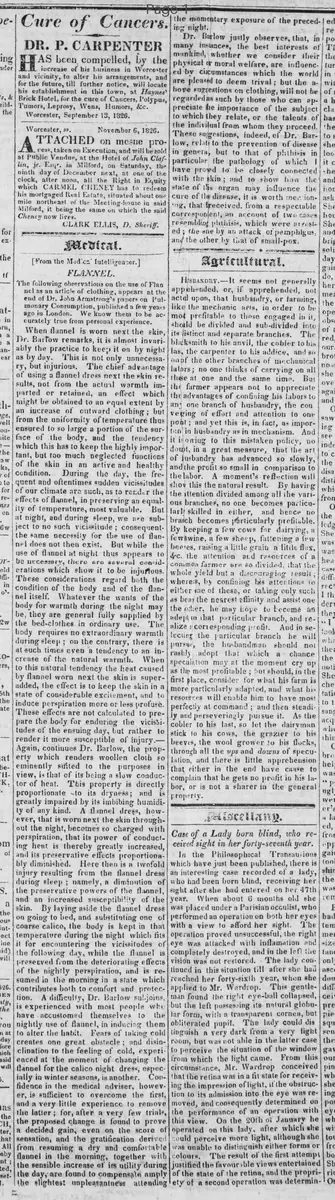
FLANNEL.
The following observations on the use of Flannel as an article of clothing, appears at the end of Dr. John Armstrong's papers on Pulmonary Consumption, published a few years ago in London. We know them to be accurately true from personal experience.
When flannel is worn next the skin, Dr. Barlow remarks, it is almost invariably the practice to keep it on by night as by day. This is not only unnecessary, but injurious. The chief advantage of using a flannel dress next the skin results, not from the actual warmth imparted or retained, an effect which might be obtained to an equal extent by an increase of outward clothing; but from the uniformity of temperature thus ensured to so large a portion of the surface of the body, and the tendency which this has to keep the highly important, but too much neglected functions of the skin in an active and healthy condition. During the day, the frequent and oftentimes sudden vicissitudes of our climate are such, as to render the effects of flannel, in preserving an equality of temperature, most valuable. But at night, and during sleep, we are subject to no such vicissitude; consequently the same necessity for the use of flannel does not then exist. But while the use of flannel at night thus appears to be unnecessary, there are several considerations which show it to be injurious. These considerations regard both the condition of the body and of the flannel itself. Whatever the wants of the body for warmth during the night may be, they are generally fully supplied by the bed-clothes in ordinary use. The body requires no extraordinary warmth during sleep; on the contrary, there is at such times even a tendency to an increase of the natural warmth. When to this natural tendency the heat caused by flannel worn next the skin is superadded, the effect is to keep the skin in a state of considerable excitement, and to induce perspiration more or less profuse. These effects are not calculated to prepare the body for enduring the vicissitudes of the ensuing day, but rather to render it more susceptible of injury.
Again, continues Dr. Barlow, the property which renders woollen cloth so eminently suited to the purposes in view, is that of its being a slow conductor of heat. This property is directly proportionate to its dryness; and is greatly impaired by its imbibing humidity of any kind. A flannel dress, however, that is worn next the skin throughout the night, becomes so charged with perspiration, that its power of conducting heat is thereby greatly increased, and its preservative effects proportionably diminished. Here then is a twofold injury resulting from the flannel dress during sleep ; namely, a diminution of the preservative powers of the flannel, and an increased susceptibility of the skin. By laying aside the flannel dress on going to bed, and substituting one of coarse calico, the body is kept in that temperature during the night which fits it for encountering the vicissitudes of the following day, while the flannel is preserved from the deteriorating effects of the nightly perspiration, and is resumed in the morning in a state which contributes both to comfort and protection. A difficulty, Dr. Barlow subjoins, is experienced with most people who have accustomed themselves to the nightly use of flannel, in inducing them to alter the habit. Fears of taking cold creates one great obstacle; and disinclination to the feeling of cold, experienced at the moment of changing the flannel for the calico night dress, especially in winter seasons, is another. Confidence in the medical adviser, however, is sufficient to overcome the first, and a very little experience to remove the latter; for, after a very few trials, the proposed change is found to prove a decided gain, even on the score of sensation, and the gratification derived from resuming a dry and comfortable flannel in the morning, together with the sensible increase of its utility during the day, are found to compensate amply the slightest unpleasantness attending the momentary exposure of the preceding night.
Dr. Barlow justly observes, that, in many instances, the best interests of mankind, whether we consider their physical or moral welfare, are influenced by circumstances which the world are pleased to deem trivial; but the above suggestions on clothing, will not be regarded as such by those who can appreciate the importance of the subject to which they relate, or the talents of the individual from whom they proceed. These suggestions, indeed, of Dr. Barlow, relate to the prevention of disease in general, but to that of phthisis in particular the pathology of which I have proved to be closely connected with the skin; and to show how the state of this organ may influence the cure of this disease, it is worth mentioning, that I received, from a respectable correspondent, an account of two cases resembling phthisis, which were arrested; the one by an attack of pemphigus, and the other by that of small-pox.
What sub-type of article is it?
What keywords are associated?
What entities or persons were involved?
Domestic News Details
Key Persons
Outcome
two cases resembling phthisis were arrested; one by an attack of pemphigus, and the other by small-pox.
Event Details
Dr. Barlow's observations, from Dr. John Armstrong's papers on Pulmonary Consumption, advise wearing flannel next to the skin during the day for uniform temperature and healthy skin function, but not at night to avoid excessive warmth, perspiration, and reduced flannel efficacy; substitute with coarse calico at night for better preparation against daily climate changes.