Thank you for visiting SNEWPapers!
Sign up free
The New York Packet
New York, New York County, New York
What is this article about?
A vivid narrative depicts a slave caravan marching to ships on the African coast, with an African guide explaining the captives' tragic origins: war prisoners, convicts, raided villagers, and kidnapped individuals. Translated from a 1785 Cambridge prize-winning Latin dissertation on the African slave trade.
Merged-components note: The image overlaps spatially with the literary text (bbox overlap in y-range 412-658 within 226-4853) and is likely an illustration for the essay on the African slave trade; merged into the dominant literary component.
Clipping
OCR Quality
Full Text
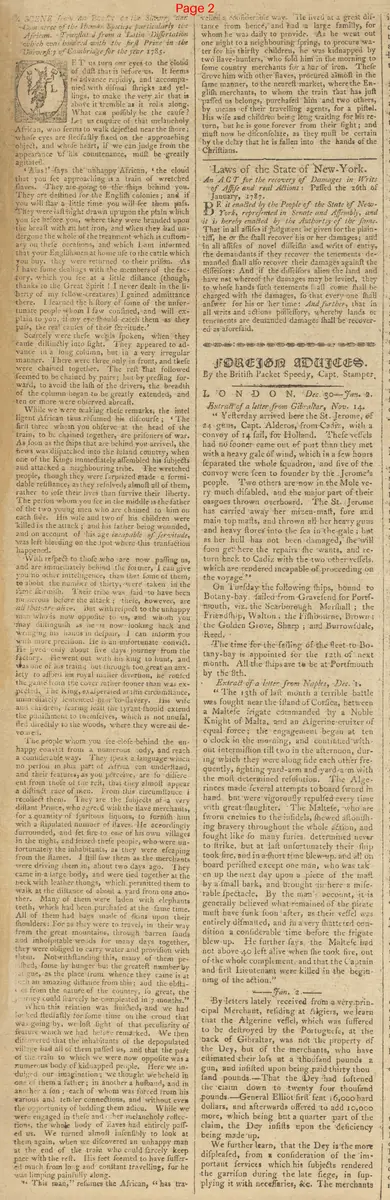
Let us turn our eyes to the cloud of dust that is before us. It seems to advance rapidly, and accompanied with dismal shrieks and yellings, to make the very air that is above it tremble as it rolls along.
What can possibly be the cause?
Let us enquire of that melancholy African, who seems to walk dejected near the shore; whose eyes are steadfastly fixed on the approaching object, and whose heart, if we can judge from the appearance of his countenance, must be greatly agitated.
Alas! says the unhappy African, the cloud that you see approaching is a train of wretched slaves. They are going to the ships behind you. They are destined for the English colonies; and if you will stay a little time you will see them pass.
They were last night drawn up upon the plain which you see before you, where they were branded upon the breast with a hot iron, and when they had undergone the whole of the treatment which is customary on these occasions, and which I am informed that your Englishmen at home use to the cattle which you buy, they were returned to their prison. As I have some dealings with the members of the factory, which you see at a little distance (though, thanks to the Great Spirit! I never dealt in the liberty of my fellow-creatures) I gained admittance there. I learned the history of some of the unfortunate people whom I saw confined, and will explain to you, if my eye should catch them as they pass, the real causes of their servitude.
Scarcely were these words spoken, when they came distinctly into sight. They appeared to advance in a long column, but in a very irregular manner. There were three only in front, and these were chained together. The rest that followed seemed to be chained by pairs; but by pressing forward, to avoid the lash of the drivers, the breadth of the column began to be greatly extended, and ten or more were observed abreast.
While we were making these remarks, the intelligent African thus resumed his discourse; The first three whom you observe at the head of the train, to be chained together, are prisoners of war. As soon as the ships that are behind you arrived, the news was dispatched into the inland country, when one of the Kings immediately assembled his subjects and attacked a neighbouring tribe. The wretched people, though they were surprised made a formidable resistance, as they resolved, almost all of them, rather to lose their lives than survive their liberty.
The person whom you see in the middle is the father of the two young men who are chained to him on each side. His wife and two of his children were killed in the attack; and his father being wounded, and on account of his age incapable of servitude, was left bleeding on the spot where this transaction happened.
With respect to those who are now passing us, and are immediately behind the former, I can give you no other intelligence, than that some of them are about the number of thirty, were taken in the same skirmish. Their tribe was said to have been numerous before the attack; these, however, are all that are alive. But with respect to the unhappy man who is now opposite to us, and whom you may distinguish as he is now looking back and wringing his hands in despair, I can inform you with more precision. He is an unfortunate convict. He lived only about five days journey from the factory. He went out with his king to hunt, and was one of his train; but through too great an anxiety to afford his royal master diversion, he roused the game from the cover rather sooner than was expected. The King, exasperated at this circumstance, immediately sentenced him to slavery. His wife and children, fearing lest the tyrant should extend the punishment to themselves, which is not unusual, fled directly to the woods, where they were all devoured.
The people whom you see close behind the unhappy convict from a numerous body, and reach a considerable way. They speak a language which no person in this part of Africa can understand, and their features, as you perceive, are so different from those of the rest, that they almost appear a distinct race of men. From this circumstance I recollect them. They are the subjects of a very distant Prince, who agreed with the slave merchants, for a quantity of spirituous liquors, to furnish him with a stipulated number of slaves. He accordingly surrounded, and set fire to one of his own villages in the night, and seized these people, who were unfortunately the inhabitants, as they were escaping from the flames. I still saw them as the merchants were driving them in, about two days ago. They came in a large body, and were tied together at the neck with leather thongs, which permitted them to walk at the distance of about a yard from one another. Many of them were laden with elephants teeth, which had been purchased at the same time. All of them had bags made of skins upon their shoulders: For as they were to travel, in their way from the great mountains, through barren sands and inhospitable woods for many days together, they were obliged to carry water and provision with them. Notwithstanding this, many of them perished, some by hunger but the greatest number by fatigue, as the place from whence they came is at such an amazing distance from this; and the obstacles from the nature of the country, so great, the journey could scarcely be completed in 7 months.
When this relation was finished, and we had looked steadfastly for some time on the crowd that was going by, we lost sight of that peculiarity of feature which we had before remarked. We then discovered that the inhabitants of the depopulated village had all of them passed us, and that the part of the train to which we were now opposite was a numerous body of kidnapped people. Here we indulged our imagination; we thought we beheld in one of them a father; in another a husband, and in another a son; each of whom was forced from his various and tender connections, and without even the opportunity of bidding them adieu. While we were engaged in these and other melancholy reflections, the whole body of slaves had entirely passed us. We turned almost insensibly to look at them again, when we discovered an unhappy man at the end of the train who could scarcely keep pace with the rest. His feet seemed to have suffered much from long and constant travelling, for he was limping painfully along.
This man, resumes the African, has travelled a considerable way. He lived at a great distance from hence, and had a large family, for whom he was daily to provide. As he went out one night to a neighbouring spring, to procure water for his thirty children, he was kidnapped by two slave-hunters, who sold him in the morning to some country merchants for a bar of iron. These drove him with other slaves, procured almost in the same manner, to the nearest market, where the English merchants, to whom the train that has just passed us belongs, purchased him and two others, by means of their travelling agents, for a pistol. His wife and children being long waiting for his return, but he is gone forever from their sight; and must now be disconsolate, as they must be certain by the delay that he is fallen into the hands of the Christians.
What sub-type of article is it?
What themes does it cover?
What keywords are associated?
What entities or persons were involved?
Literary Details
Title
A Scene From An African Coast. The Commerce Of The Human Species, Particularly The African.
Author
Translated From A Latin Dissertation Which Was Honored With The First Prize In The University Of Cambridge For The Year 1785.
Key Lines