Thank you for visiting SNEWPapers!
Sign up free
Editorial
July 23, 1806
Virginia Argus
Richmond, Virginia
What is this article about?
Philosophical reflection on the value of domestic happiness as the true measure of a person's virtue and felicity, contrasting it with public splendor and pretense.
Clipping
OCR Quality
98%
Excellent
Full Text
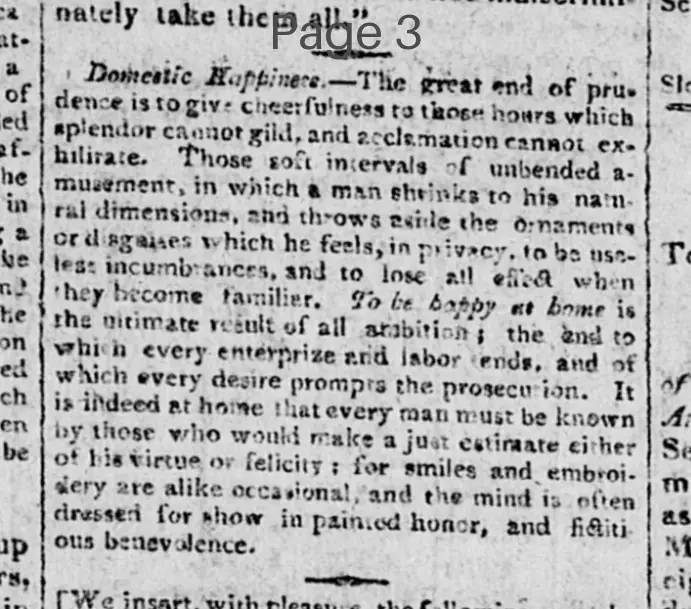
Domestic Happiness.—The great end of prudence is to give cheerfulness to those hours which splendor cannot gild, and acclamation cannot exhilarate. Those soft intervals of unbendend amusement, in which a man shrinks to his natural dimensions, and throws aside the ornaments or disguises which he feels, in privacy, to be useless incumbrances, and to lose all effect when they become familiar. To be happy at home is the ultimate result of all ambition; the end to which every enterprise and labor ends, and of which every desire prompts the prosecution. It is indeed at home that every man must be known by those who would make a just estimate either of his virtue or felicity: for smiles and embroidery are alike occasional, and the mind is often dressed or shown in painted honor, and fictitious benevolence.
What sub-type of article is it?
Moral Or Religious
What keywords are associated?
Domestic Happiness
True Virtue
Private Life
Public Pretense
Personal Felicity
Editorial Details
Primary Topic
Domestic Happiness As True Felicity
Stance / Tone
Philosophical Exhortation
Key Arguments
Prudence Aims To Bring Cheerfulness To Private Hours Beyond Public Splendor.
Domestic Happiness Is The Ultimate Goal Of All Ambition And Labor.
True Virtue And Felicity Are Judged At Home, Not In Occasional Public Displays.
Public Smiles And Honors Are Often Fictitious.