Thank you for visiting SNEWPapers!
Sign up free
Story
September 13, 1881
Daily Los Angeles Herald
Los Angeles, Los Angeles County, California
What is this article about?
Article from the Santa Barbara Press evaluates the engineering feasibility of a coastal railroad route from Ventura to Santa Cruz, detailing surveyed paths, grades, and minimal difficulties compared to interior routes, emphasizing its advantages for travel.
Clipping
OCR Quality
95%
Excellent
Full Text
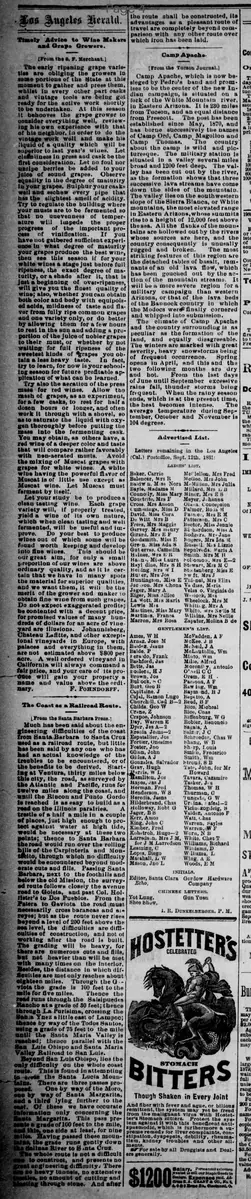
The Coast as a Railroad Route.
From the Santa Barbara Press.
Much has been said about the engineering difficulties of the coast from Santa Barbara to Santa Cruz used as a railroad route, but little has been said by any one who has an actual knowledge of the troubles to be encountered, or of the benefits to be derived. Starting at Ventura, thirty miles below this city, the road, as surveyed by the Atlantic and Pacific, runs for twelve miles along the coast, and until the Rincon and Punto Gordo is reached is as easy to build as a road on the Illinois prairies. A trestle of a half a mile in a couple of places, just high enough to protect against water at high tide, would be necessary at these two points; thence to Santa Barbara the road would run over the rolling hills of the Carpinteria and Montecito, through which no difficulty would be encountered beyond moderate cuts and fills. Passing Santa Barbara, next to the foothills and below the old Mission, the surveyed route follows closely the avenue road to Goleta, and past Col. Holister's to Dos Pueblos. From the Rincon to Gaviota the road must necessarily cross barrancas and alamos; but as the route never rises beyond a level of 200 feet above the sea level, the difficulties are difficulties of construction, and not of working after the road is built.
The grading will be heavy, for there are numerous cuts and fills, but not heavier than will be met with many times on the interior. Besides, the distance in which difficulties are met only reaches about eighteen miles. Through the Gaviota the grade is 100 feet to the mile for five miles.
Thence the road runs through the Salsipuedes Rancho at a grade of 30 feet; thence through La Purisima, crossing the Santa Ynez a little east of Lompoc; thence by way of the Todos Santos, moving a grade of 75 feet to the mile until the Santa Maria Valley is reached; thence parallel with the San Luis Obispo and Santa Maria Valley Railroad to San Luis.
Beyond San Luis Obispo, lies the only difficulty on the whole coast route. This is found in attempting to cross the Santa Lucia Mountains.
There are three passes proposed. One by way of the Moro, one by way of Santa Margarita, and a third lying further to the north.
Of these we have accurate formation only concerning the Santa Margarita. This pass presents a grade of 100 feet to the mile, thin, one side at least, for nine miles.
Having passed these mountains, the grade runs gently down Salinas River to Santa Cruz.
The whole route is not a difficult one to construct, and presents no engineering difficulty. There are no heavy tunnels, no extensive trestles, no amount of cutting and filling through stone. And after the route shall be constructed, its advantages as a pleasant route of travel are completely beyond comparison with any other route over which iron has been laid.
From the Santa Barbara Press.
Much has been said about the engineering difficulties of the coast from Santa Barbara to Santa Cruz used as a railroad route, but little has been said by any one who has an actual knowledge of the troubles to be encountered, or of the benefits to be derived. Starting at Ventura, thirty miles below this city, the road, as surveyed by the Atlantic and Pacific, runs for twelve miles along the coast, and until the Rincon and Punto Gordo is reached is as easy to build as a road on the Illinois prairies. A trestle of a half a mile in a couple of places, just high enough to protect against water at high tide, would be necessary at these two points; thence to Santa Barbara the road would run over the rolling hills of the Carpinteria and Montecito, through which no difficulty would be encountered beyond moderate cuts and fills. Passing Santa Barbara, next to the foothills and below the old Mission, the surveyed route follows closely the avenue road to Goleta, and past Col. Holister's to Dos Pueblos. From the Rincon to Gaviota the road must necessarily cross barrancas and alamos; but as the route never rises beyond a level of 200 feet above the sea level, the difficulties are difficulties of construction, and not of working after the road is built.
The grading will be heavy, for there are numerous cuts and fills, but not heavier than will be met with many times on the interior. Besides, the distance in which difficulties are met only reaches about eighteen miles. Through the Gaviota the grade is 100 feet to the mile for five miles.
Thence the road runs through the Salsipuedes Rancho at a grade of 30 feet; thence through La Purisima, crossing the Santa Ynez a little east of Lompoc; thence by way of the Todos Santos, moving a grade of 75 feet to the mile until the Santa Maria Valley is reached; thence parallel with the San Luis Obispo and Santa Maria Valley Railroad to San Luis.
Beyond San Luis Obispo, lies the only difficulty on the whole coast route. This is found in attempting to cross the Santa Lucia Mountains.
There are three passes proposed. One by way of the Moro, one by way of Santa Margarita, and a third lying further to the north.
Of these we have accurate formation only concerning the Santa Margarita. This pass presents a grade of 100 feet to the mile, thin, one side at least, for nine miles.
Having passed these mountains, the grade runs gently down Salinas River to Santa Cruz.
The whole route is not a difficult one to construct, and presents no engineering difficulty. There are no heavy tunnels, no extensive trestles, no amount of cutting and filling through stone. And after the route shall be constructed, its advantages as a pleasant route of travel are completely beyond comparison with any other route over which iron has been laid.
What sub-type of article is it?
Historical Event
What themes does it cover?
Exploration
Triumph
What keywords are associated?
Railroad Route
Coast Survey
Engineering Difficulties
Santa Barbara
Santa Cruz
Santa Lucia Mountains
What entities or persons were involved?
Col. Holister
Where did it happen?
California Coast From Ventura To Santa Cruz
Story Details
Key Persons
Col. Holister
Location
California Coast From Ventura To Santa Cruz
Story Details
Surveyed railroad route by the Atlantic and Pacific from Ventura along the coast through Santa Barbara, Gaviota, San Luis Obispo, over Santa Lucia Mountains via passes like Santa Margarita, to Santa Cruz, with manageable grades and construction challenges, offering superior travel advantages.