Thank you for visiting SNEWPapers!
Sign up free
San Antonio Daily Light
San Antonio, Bexar County, Texas
What is this article about?
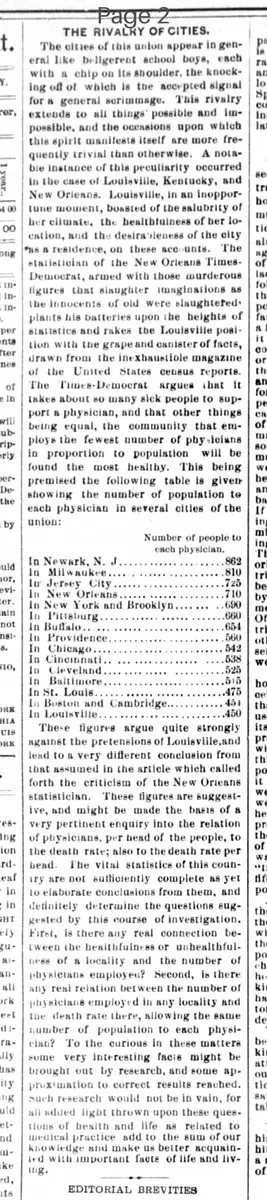
Article discusses rivalry between U.S. cities, exemplified by Louisville boasting its healthy climate, countered by New Orleans statistician using census data on physicians per population to argue otherwise. Includes table ranking cities by people per physician, suggesting Louisville's lower ratio indicates poorer health.
Clipping
OCR Quality
Full Text
The cities of this union appear in general like belligerent school boys, each with a chip on its shoulder, the knocking off of which is the accepted signal for a general scrimmage. This rivalry extends to all things possible and impossible, and the occasions upon which this spirit manifests itself are more frequently trivial than otherwise. A notable instance of this peculiarity occurred in the case of Louisville, Kentucky, and New Orleans. Louisville, in an inopportune moment, boasted of the salubrity of her climate, the healthfulness of her location, and the desirability of the city as a residence, on these accounts. The statistician of the New Orleans Times-Democrat, armed with those murderous figures that slaughter imaginations as the innocents of old were slaughtered, plants his batteries upon the heights of statistics and rakes the Louisville position with the grape and canister of facts, drawn from the inexhaustible magazine of the United States census reports. The Times-Democrat argues that if it takes about so many sick people to support a physician, and that other things being equal, the community that employs the fewest number of physicians in proportion to population will be found the most healthy. This being premised the following table is given showing the number of population to each physician in several cities of the union:
Number of people to each physician.
In Newark, N. J. 862
In Milwaukee 810
In Jersey City 725
In New Orleans 710
In New York and Brooklyn 690
In Pittsburg 660
In Buffalo 654
In Providence 560
In Chicago 542
In Cincinnati 538
In Cleveland 525
In Baltimore 515
In St. Louis 475
In Boston and Cambridge 454
In Louisville 450
These figures argue quite strongly against the pretensions of Louisville, and lead to a very different conclusion from that assumed in the article which called forth the criticism of the New Orleans statistician. These figures are suggestive, and might be made the basis of a very pertinent enquiry into the relation of physicians per head of the people, to the death rate: also to the death rate per head. The vital statistics of this country are not sufficiently complete as yet to elaborate conclusions from them, and definitely determine the questions suggested by this course of investigation. First, is there any real connection between the healthfulness or unhealthfulness of a locality and the number of physicians employed? Second, is there any real relation between the number of physicians employed in any locality and the death rate there, allowing the same number of population to each physician? To the curious in these matters some very interesting facts might be brought out by research, and some approximation to correct results reached. Such research would not be in vain, for all added light thrown upon these questions of health and life as related to medical practice add to the sum of our knowledge and make us better acquainted with important facts of life and living.
What sub-type of article is it?
What themes does it cover?
What keywords are associated?
Where did it happen?
Story Details
Location
Louisville, Kentucky; New Orleans; Various U.S. Cities
Story Details
Louisville boasts healthy climate; New Orleans statistician uses U.S. census data on physicians per population to refute claim, showing Louisville has fewest people per physician among listed cities, implying poorer health; suggests further inquiry into health and death rates.