Thank you for visiting SNEWPapers!
Sign up free
People And Patriot
Concord, Merrimack County, New Hampshire
What is this article about?
Mrs. D. A. Lincoln, principal of the Boston Cooking School and author of the Boston Cook Book, gave two demonstration lectures on practical cooking in Concord's Board of Trade hall on March 9 and the following Wednesday, teaching fire management, breakfast dishes like eggs and toast, white sauce, Italian eggs, omelet, browned bananas, wheat gems, corn cake, rye short cake, Dutch apple cake, lemon sauce, and coffee to audiences of 53 and 73 enthusiastic women.
Clipping
OCR Quality
Full Text
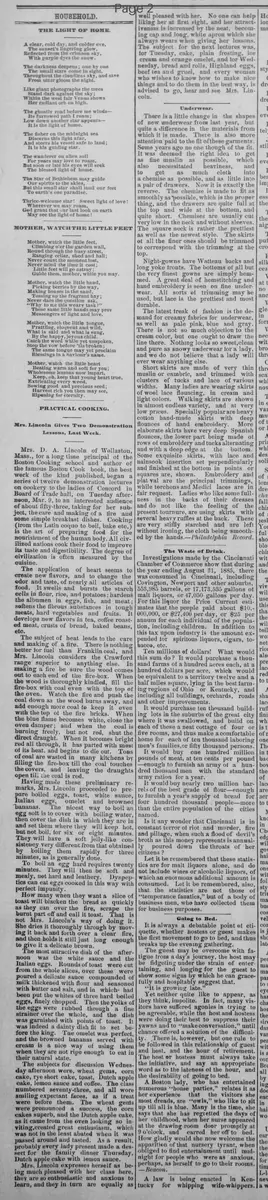
Mrs. Lincoln Gives Two Demonstration Lessons Last Week.
Mrs. D. A. Lincoln of Wollaston, Mass., for a long time principal of the Boston Cooking school and author of the famous Boston Cook Book, the best work of the kind published, began a series of twelve demonstration lectures on cookery to the ladies of Concord in Board of Trade hall, on Tuesday afternoon, Mar. 9, to an interested audience of about fifty-three, taking for her subject, the care and making of a fire and some simple breakfast dishes. Cooking (from the Latin coquo to boil, bake etc.) is the art of preparing food for the nourishment of the human body. All civilized nations cook their food to improve its taste and digestibility. The degree of civilization is often measured by the cuisine.
The application of heat seems to create new flavors, and to change the odor and taste, of nearly all articles of food. It swells and bursts the starch cells in flour, rice, and potatoes: hardens the albumen in eggs, fish, and meat; softens the fibrous substances in tough meats, hard vegetables and fruits. It develops new flavors in tea, coffee roasted meat, crusts of bread, baked beans, etc.
The subject of heat leads to the care and making of a fire. There is nothing better for fuel than Franklin coal, and Mrs. Lincoln considers the Crawford range superior to anything else. In making a fire be sure the wood comes out to each end of the fire-box. When the wood is thoroughly kindled, fill the fire-box with coal even with the top of the oven. Watch the fire and push the coal down as the wood burns away, and add enough more coal to keep it even with the top of the fire bricks. When the blue flame becomes white, close the oven damper; and when the coal is burning freely, but not red, shut the direct draught. When it becomes bright red all through, it has parted with most of its heat, and begins to die out. Tons of coal are wasted in many kitchens by filling the fire-box till the coal touches the covers, and leaving the draughts open till the coal is red.
Having made these preliminary remarks, Mrs. Lincoln proceeded to prepare boiled eggs, toast, white sauce, Italian eggs, omelet and browned bananas. The nicest way to boil an egg soft is to cover with boiling water, then cover the dish in which they are in and set them where they will keep hot, but not boil, for six or eight minutes. They will have a soft jelly-like consistency very different from that obtained by boiling them rapidly for three minutes, as is generally done. To boil an egg hard requires twenty minutes. They will then be soft and mealy, not hard and leathery. Dyspeptics can eat eggs cooked in this way with perfect impunity.
How many when they want a slice of toast will blacken the bread as quickly as they can over the fire, scrape the burnt part off and call it toast. That is not Mrs. Lincoln's way of doing it. She dries it thoroughly through by moving it back and forth over a clear fire, and then holds it still just long enough to give it a delicate brown.
The most attractive dish of the afternoon was the white sauce and the Italian eggs. Rounds of toast were cut from the whole slices, over these were poured a delicate sauce compounded of milk thickened with flour and seasoned with butter and salt, and in which had been put the whites of three hard boiled eggs, finely chopped. Then the yolks of the eggs were rubbed through a fine strainer over the whole, and the dish was garnished with points of toast. It was indeed a dainty dish fit to set before the king. The omelet was perfect, and the browned bananas served with cream is a nice way of using them when they are not ripe enough to eat in their natural state.
The subjects for discussion Wednesday afternoon were, wheat gems, corn cake, rye short cake, toast, Dutch apple cake, lemon sauce and coffee. The class numbered seventy-three, and all wore smiling expectant faces, as if a treat were before them. The wheat gems were pronounced a success, the corn cakes superb, and the Dutch apple cake, as it came from the oven looking so inviting, created great enthusiasm, which was not in the least abated when it was passed around and tasted. As a result, probably every lady present made a dessert for the family dinner Thursday, Dutch apple cake with lemon sauce.
Mrs. Lincoln expresses herself as being much pleased with her class here, they are so enthusiastic and anxious to learn, and they in turn are equally as well pleased with her. No one can help liking her at first sight, and her attractiveness is increased by the neat, becoming cap and long, white apron which she always wears when giving her lessons.
The subject for the next lectures was, for Tuesday, cake, plain frosting, ice cream and orange omelet, and for Wednesday, bread and rolls, Highland eggs, beef tea and gruel, and every woman who wishes to know how to make nice things and to do them in the best way, is advised to go, hear and see Mrs. Lincoln.
What sub-type of article is it?
What themes does it cover?
What keywords are associated?
What entities or persons were involved?
Where did it happen?
Story Details
Key Persons
Location
Board Of Trade Hall, Concord
Event Date
Mar. 9
Story Details
Mrs. D. A. Lincoln began a series of twelve demonstration lectures on cookery in Concord, covering fire care, breakfast dishes on Tuesday March 9 to 53 attendees, and wheat gems, corn cake, rye short cake, toast, Dutch apple cake, lemon sauce, coffee on Wednesday to 73 attendees, with enthusiastic response and plans for future lessons on cake, frosting, ice cream, orange omelet, bread, rolls, Highland eggs, beef tea, gruel.