Thank you for visiting SNEWPapers!
Sign up free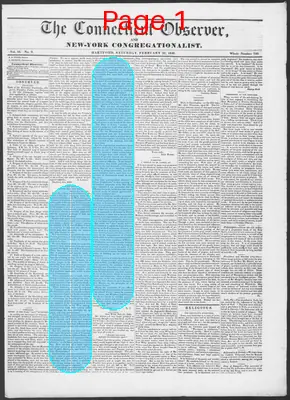
Letter to Editor
February 29, 1840
The Connecticut Observer, And New York Congregationalist
Hartford, Hartford County, Connecticut
What is this article about?
A letter from Detroit defends New England ministers against accusations of imposing Presbyterianism in the West for power, explaining the flexible Plan of Union adapts Congregational principles to diverse populations for harmonious church organization.
Clipping
OCR Quality
98%
Excellent
Full Text
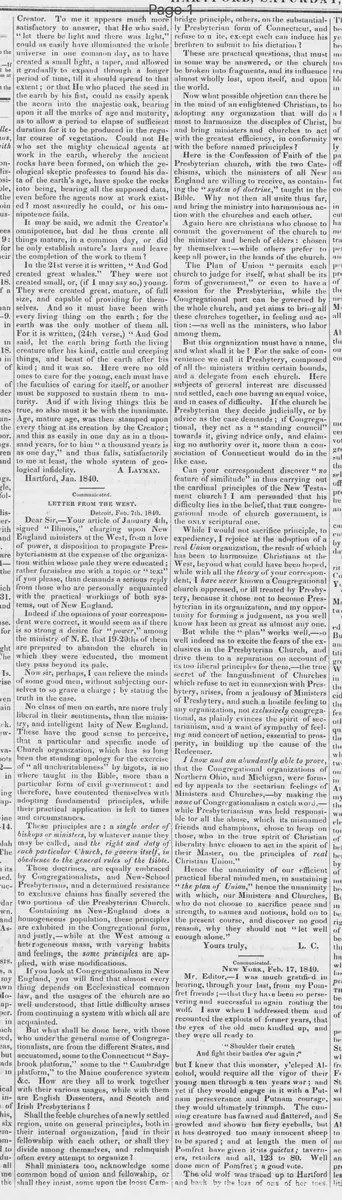
Communicated.
LETTER FROM THE WEST.
Detroit, Feb. 7th, 1840.
Dear Sir,—Your article of January 4th, signed "Illinois," charging upon New England ministers at the West, from a love of power, a disposition to propagate Presbyterianism at the expense of the organization within whose pale they were educated; rather furnishes me with a topic or "text" if you please, than demands a serious reply from those who are personally acquainted with the practical workings of both systems, out of New England.
Indeed if the opinions of your correspondent were correct, it would seem as if there is so strong a desire for "power," among the ministry of N. E. that 19-20ths of them are prepared to abandon the church in which they were educated, the moment they pass beyond its pale.
Now sir, perhaps, I can relieve the minds of some good men, without subjecting ourselves to so grave a charge; by stating the truth in the case.
No class of men on earth, are more truly liberal in their sentiments, than the ministry, and intelligent laity of New England. These have the good sense to perceive, that a particular and specific mode of Church organization, which has so long been the standing apology for the exercise of all uncharitableness by bigots, is no where taught in the Bible, more than a particular form of civil government: and therefore, have contented themselves with adopting fundamental principles, while their practical application is left to times and circumstances.
These principles are: a single order of bishops or ministers, by whatever name they may be called, and the right and duty of each particular Church, to govern itself, in obedience to the general rules of the Bible. These doctrines, are equally embraced by Congregationalists, and New-School Presbyterians, and a determined resistance to exclusive claims has finally severed the two portions of the Presbyterian Church. Containing as New-England does a homogeneous population, these principles are exhibited in the Congregational form, and justly,—while at the West among a heterogeneous mass, with varying habits and feelings, the same principles are applied, with wise modifications.
If you look at Congregationalism in New England, you will find that almost every thing depends on Ecclesiastical common law, and the usages of the church are so well understood, that little difficulty arises from continuing a system with which all are acquainted.
But what shall be done here, with those who under the general name of Congregationalists, are from the different States, and accustomed, some to the Connecticut "Saybrook platform," some to the "Cambridge platform," to the Maine conference system &c. How are they all to work together with their various usages, while with them are English Dissenters, and Scotch and Irish Presbyterians?
Shall the feeble churches of a newly settled region, unite on general principles, both in their internal organization, and in their fellowship with each other, or shall they divide among themselves, and relinquish often every attempt to organize?
Shall ministers too, acknowledge some common bond of union and fellowship, or shall they insist, some upon the loose Cambridge principle, others, on the substantially Presbyterian form of Connecticut, and refuse to unite, except each can induce his brethren to submit to his dictation?
These are practical questions, that must in some way be answered, or the church be broken into fragments, and its influence almost wholly lost, upon itself, and upon the world.
Now what possible objection can there be in the mind of an enlightened Christian, to adopting any organization that will do most to harmonize the disciples of Christ. and bring ministers and churches to act with the greatest efficiency, in conformity with the before named principles?
Here is the Confession of Faith of the Presbyterian church, with the two Catechisms, which the ministers of all New England are willing to receive, as containing the "system of doctrine," taught in the Bible. Why not then all unite thus far, and bring the ministry into harmonious action with the churches and each other.
Again here are christians who choose to commit the government of the church to the minister and bench of elders: chosen by themselves:—while others prefer to keep all power, in the hands of the church. The Plan of Union "permits each church to judge for itself, what shall be its form of government," or even to have a session for the Presbyterian, while the Congregational part can be governed by the whole church, and yet aims to bring all these churches together, in feeling and action:—as well as the ministers, who labor among them.
But this organization must have a name, and what shall it be? For the sake of convenience we call it Presbytery, composed of all the ministers within certain bounds, and a delegate from each church. Here subjects of general interest are discussed and settled, each one having an equal voice, and in cases of difficulty. If the church be Presbyterian they decide judicially, or by advice as the case demands; if Congregational, they act as a "standing council" towards it, giving advice only, and claiming no authority over it, more than a consociation of Connecticut would do in the like case.
Can your correspondent discover "no feature of similitude" in thus carrying out the cardinal principles of the New Testament church? I am persuaded that his difficulty lies in the belief, that the congregational mode of church government, is the only scriptural one.
While I would not sacrifice principle, to expediency, I rejoice at the adoption of a real Union organization, the result of which has been to harmonize Christians at the West, beyond what could have been hoped, while with all the theory of your correspondent, I have never known a Congregational church oppressed, or ill treated by Presbytery, because it chose not to become Presbyterian in its organization, and my opportunity for forming a judgment, as you well know has been as great as almost any one.
But while the "plan" works well,—so well indeed as to excite the fears of the exclusives in the Presbyterian Church, and drive them to a separation on account of its too liberal principles for them, the true secret of the languishment of Churches which refuse to act in connexion with Presbytery, arises, from a jealousy of Ministers of Presbytery, and such a hostile feeling to any organization, not exclusively congregational, as plainly evinces the spirit of sectarianism, and a want of sympathy of feeling and concert of action, essential to prosperity, in building up the cause of the Redeemer.
I know and am abundantly able to prove, that the Congregational organizations of Northern Ohio, and Michigan, were formed by appeals to the sectarian feelings of Ministers and Churches,—by making the name of Congregationalism a catch word,-while Presbyterianism was held responsible for all the abuse, which its misnamed friends and champions, chose to heap on those, who in the true spirit of Christian liberality have chosen to act in the spirit of their Master, on the principles of real Christian Union.
Hence the unanimity of our efficient practical liberal minded men, in sustaining "the plan of Union," hence the unanimity with which, our Ministers and Churches, who do not choose to sacrifice peace and strength, to names and notions, hold on to the present course, and discover no good reason, why they should not "let well enough alone."
Yours truly,
L. C.
LETTER FROM THE WEST.
Detroit, Feb. 7th, 1840.
Dear Sir,—Your article of January 4th, signed "Illinois," charging upon New England ministers at the West, from a love of power, a disposition to propagate Presbyterianism at the expense of the organization within whose pale they were educated; rather furnishes me with a topic or "text" if you please, than demands a serious reply from those who are personally acquainted with the practical workings of both systems, out of New England.
Indeed if the opinions of your correspondent were correct, it would seem as if there is so strong a desire for "power," among the ministry of N. E. that 19-20ths of them are prepared to abandon the church in which they were educated, the moment they pass beyond its pale.
Now sir, perhaps, I can relieve the minds of some good men, without subjecting ourselves to so grave a charge; by stating the truth in the case.
No class of men on earth, are more truly liberal in their sentiments, than the ministry, and intelligent laity of New England. These have the good sense to perceive, that a particular and specific mode of Church organization, which has so long been the standing apology for the exercise of all uncharitableness by bigots, is no where taught in the Bible, more than a particular form of civil government: and therefore, have contented themselves with adopting fundamental principles, while their practical application is left to times and circumstances.
These principles are: a single order of bishops or ministers, by whatever name they may be called, and the right and duty of each particular Church, to govern itself, in obedience to the general rules of the Bible. These doctrines, are equally embraced by Congregationalists, and New-School Presbyterians, and a determined resistance to exclusive claims has finally severed the two portions of the Presbyterian Church. Containing as New-England does a homogeneous population, these principles are exhibited in the Congregational form, and justly,—while at the West among a heterogeneous mass, with varying habits and feelings, the same principles are applied, with wise modifications.
If you look at Congregationalism in New England, you will find that almost every thing depends on Ecclesiastical common law, and the usages of the church are so well understood, that little difficulty arises from continuing a system with which all are acquainted.
But what shall be done here, with those who under the general name of Congregationalists, are from the different States, and accustomed, some to the Connecticut "Saybrook platform," some to the "Cambridge platform," to the Maine conference system &c. How are they all to work together with their various usages, while with them are English Dissenters, and Scotch and Irish Presbyterians?
Shall the feeble churches of a newly settled region, unite on general principles, both in their internal organization, and in their fellowship with each other, or shall they divide among themselves, and relinquish often every attempt to organize?
Shall ministers too, acknowledge some common bond of union and fellowship, or shall they insist, some upon the loose Cambridge principle, others, on the substantially Presbyterian form of Connecticut, and refuse to unite, except each can induce his brethren to submit to his dictation?
These are practical questions, that must in some way be answered, or the church be broken into fragments, and its influence almost wholly lost, upon itself, and upon the world.
Now what possible objection can there be in the mind of an enlightened Christian, to adopting any organization that will do most to harmonize the disciples of Christ. and bring ministers and churches to act with the greatest efficiency, in conformity with the before named principles?
Here is the Confession of Faith of the Presbyterian church, with the two Catechisms, which the ministers of all New England are willing to receive, as containing the "system of doctrine," taught in the Bible. Why not then all unite thus far, and bring the ministry into harmonious action with the churches and each other.
Again here are christians who choose to commit the government of the church to the minister and bench of elders: chosen by themselves:—while others prefer to keep all power, in the hands of the church. The Plan of Union "permits each church to judge for itself, what shall be its form of government," or even to have a session for the Presbyterian, while the Congregational part can be governed by the whole church, and yet aims to bring all these churches together, in feeling and action:—as well as the ministers, who labor among them.
But this organization must have a name, and what shall it be? For the sake of convenience we call it Presbytery, composed of all the ministers within certain bounds, and a delegate from each church. Here subjects of general interest are discussed and settled, each one having an equal voice, and in cases of difficulty. If the church be Presbyterian they decide judicially, or by advice as the case demands; if Congregational, they act as a "standing council" towards it, giving advice only, and claiming no authority over it, more than a consociation of Connecticut would do in the like case.
Can your correspondent discover "no feature of similitude" in thus carrying out the cardinal principles of the New Testament church? I am persuaded that his difficulty lies in the belief, that the congregational mode of church government, is the only scriptural one.
While I would not sacrifice principle, to expediency, I rejoice at the adoption of a real Union organization, the result of which has been to harmonize Christians at the West, beyond what could have been hoped, while with all the theory of your correspondent, I have never known a Congregational church oppressed, or ill treated by Presbytery, because it chose not to become Presbyterian in its organization, and my opportunity for forming a judgment, as you well know has been as great as almost any one.
But while the "plan" works well,—so well indeed as to excite the fears of the exclusives in the Presbyterian Church, and drive them to a separation on account of its too liberal principles for them, the true secret of the languishment of Churches which refuse to act in connexion with Presbytery, arises, from a jealousy of Ministers of Presbytery, and such a hostile feeling to any organization, not exclusively congregational, as plainly evinces the spirit of sectarianism, and a want of sympathy of feeling and concert of action, essential to prosperity, in building up the cause of the Redeemer.
I know and am abundantly able to prove, that the Congregational organizations of Northern Ohio, and Michigan, were formed by appeals to the sectarian feelings of Ministers and Churches,—by making the name of Congregationalism a catch word,-while Presbyterianism was held responsible for all the abuse, which its misnamed friends and champions, chose to heap on those, who in the true spirit of Christian liberality have chosen to act in the spirit of their Master, on the principles of real Christian Union.
Hence the unanimity of our efficient practical liberal minded men, in sustaining "the plan of Union," hence the unanimity with which, our Ministers and Churches, who do not choose to sacrifice peace and strength, to names and notions, hold on to the present course, and discover no good reason, why they should not "let well enough alone."
Yours truly,
L. C.
What sub-type of article is it?
Persuasive
Informative
Religious
What themes does it cover?
Religion
What keywords are associated?
Plan Of Union
Presbyterianism
Congregationalism
New England Ministers
Church Organization
West
Sectarianism
Christian Union
What entities or persons were involved?
L. C.
Dear Sir
Letter to Editor Details
Author
L. C.
Recipient
Dear Sir
Main Argument
new england ministers at the west adopt the plan of union not for power but to flexibly apply biblical church principles, harmonizing diverse congregationalists and presbyterians in heterogeneous frontier settings without imposing any specific form.
Notable Details
References To Plan Of Union
New School Presbyterians
Saybrook Platform
Cambridge Platform
Maine Conference System