Thank you for visiting SNEWPapers!
Sign up free
Staunton Spectator, And General Advertiser
Staunton, Virginia
What is this article about?
Report of election fraud in Plaquemines Parish, Louisiana, during the 1844 presidential election, where Locofoco (Democratic) supporters allegedly imported voters from New Orleans, enabling double voting and resulting in an improbable 1,196 majority for Polk over Clay in a parish with under 500 voters.
Merged-components note: Merge story on Louisiana election fraud with adjacent table showing anomalous vote increases; table provides supporting evidence for the fraud described.
Clipping
OCR Quality
Full Text
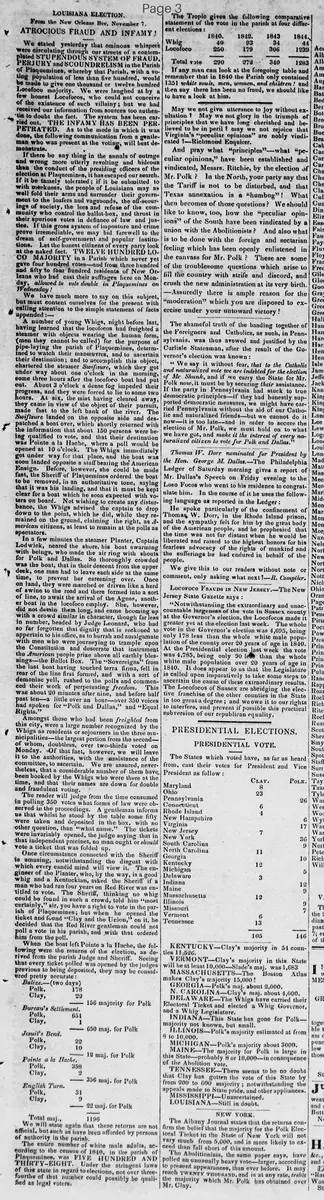
We stated yesterday that ominous whispers were circulating through our streets of a contemplated STUPENDOUS SYSTEM OF FRAUD, PERJURY and SCOUNDRELISM in the Parish of Plaquemines, whereby that Parish, with a voting population of less than five hundred, would be made to give one thousand or twelve hundred Locofoco majority. We were laughed at by a few honest Locofocos, who could not conceive of the existence of such villainy; but we had received our information from sources too authentic to doubt the fact. The system has been carried out. THE INFAMY HAS BEEN PERPETRATED. As to the mode in which it was done, the following communication from a gentleman who was present at the voting, will best demonstrate.
If there be anything in the annals of outrage and wrong more utterly revolting and hideous than the conduct of the presiding officers of the election at Plaquemines, it has escaped our search. If it be tamely tolerated; if it be submitted to with meekness, the people of Louisiana may as well fold their arms and surrender their government to the loafers and vagabonds, the off-scourings of society, the lees and refuse of the community who control the ballot-box, and thrust in their spurious votes in defiance of law and justice. If this gross system of imposture and crime prove irremediable, we may bid farewell to the dream of self-government and popular institutions. Let the honest citizens of every party look at the naked fact. TWELVE HUNDRED LOCOFOCO MAJORITY in a Parish which never yet gave four hundred votes—and from three hundred and fifty to four hundred residents of New Orleans who had cast their suffrages here on Monday, allowed to vote double in Plaquemines on Wednesday!
We have much more to say on this subject, but must content ourselves for the present with calling attention to the simple statement of facts appended:
A number of young Whigs, night before last, having learned that the locofocos had freighted a steamer with objects wearing the human form, (men they cannot be called) for the purpose of pipe-laying the parish of Plaquemines, determined to watch their manoeuvres, and to ascertain their destination; and to accomplish this object, chartered the steamer Swiftsure, which they got under way about one o'clock in the morning, some three hours after the locofoco boat had put out. About 3 o'clock a dense fog impeded their progress, and they were forced to lie to some two hours. At six, the mist having cleared away, they came in view of the object of their pursuit, made fast to the left bank of the river. The Swiftsure landed on the opposite side and despatched a boat over, which shortly returned with the information that about 150 persons were being qualified to vote, and that their destination was Pointe a la Hache, where a poll would be opened at 10 o'clock. The Whigs immediately got under way for that place, and the boat was soon landed opposite a staff bearing the American Ensign. Before, however, she could be made fast, the Sheriff of Plaquemines ordered the boat to be removed, in an authoritative tone, saying that it was his landing, and that it must be kept clear for a boat which he soon expected with voters on board. Not wishing to create any disturbance, the Whigs advised the captain to drop down to the point, which he did, while they remained on the ground, claiming the right, as American citizens, at least to remain at the polls as spectators.
In a few minutes the steamer Planter, Captain Lodwick, neared the shore, his boat swarming with beings, who made the air ring with shouts for Polk and Dallas. So thoroughly crowded was the boat, that in their descent from the upper deck, one man had to leave each side at the same time, to prevent her careening over. Once on land, they were marched or driven like a herd of swine to the road and there formed into a sort of line, to await the arrival of the Agnes, another boat in the locofoco employ. She, however, did not detain them long, and came booming up with a crowd similar in character, though far less in number, headed by Judge Leonard, who had so far forgotten that dignity that is reckoned to appertain to his office, as to hurrah and amalgamate with men who were journeying to trample upon the Constitution and desecrate that instrument the American people prize above all earthly blessings—the Ballot Box. The "Sovereigns" from the last boat having touched terra firma, fell in rear of the line first formed, and with a sort of demoniac yell, rushed to the polls and commenced their work of perpetuating freedom.
This was about 20 minutes after nine, and before half past ten—a little over an hour—over 350 voices had spoken for "Polk and Dallas," and "Equal Rights."
Amongst those who had been freighted from this city, were a large number recognized by the Whigs as residents or sojourners in the three municipalities—the largest portion from the second—of whom, doubtless, over two-thirds voted on Monday. Of that fact, however, we will leave it to the authorities, with the assistance of the committee, to ascertain. We are assured, nevertheless, that a considerable number of them have been booked by the Whigs who were there at the time, and that their names are down for double and fraudulent voting.
The reader will judge from the time consumed in polling 350 votes what forms of law were observed in the proceedings. A gentleman informs us that whilst he stood by the table some fifty were taken and deposited in the box, with no other question, than "what name." The tickets were invariably opened, the judge saying that in that independent precinct, no man ought or should vote a ticket that was folded up.
One circumstance connected with the Sheriff is amusing, notwithstanding the disgust with which every candid mind will view it. The engineer of the Planter, who, by the way, is a good whig and a Kentuckian, asked the Sheriff if a man who had run four years on Red River was entitled to vote. The Sheriff, thinking no whig could be found in such a crowd, told him "most certainly," sir, you have a right to vote in the parish of Plaquemines; but when he opened the ticket and found "Clay and the Union," on it, he decided that the Red River gentleman could not poll a vote in his parish, and with that ordered him from the poll.
When the boat left Pointe a la Hache, the following were the returns of the election, as derived from the parish Judge and Sheriff. Seeing that every ticket polled was opened by the judges previous to being deposited, they may be considered pretty accurate:
Balize.—(two days) Polk, 178; Clay, 22—156 majority for Polk.
Buras's Settlement. Polk, 651; Clay, 1—650 maj. for Polk.
Jesuit's Bend, Polk, 22; Clay, 10—12 maj. for Polk.
Pointe a la Hache, Polk, 358; Clay, 2—356 maj. for Polk.
English Turn, Polk, 31; Clay, ?—22 maj. for Polk.
Total maj., 1196.
We will state again that these returns are not official, but such as have been afforded by persons of authority in the parish.
The entire number of white male adults, according to the census of 1840, in the parish of Plaquemines, was FIVE HUNDRED AND THIRTY-EIGHT. Under the stringent laws of this state in regard to elections, not over three-fourths of that number could possibly be qualified as legal voters.
| Whig | 1840. | 1842. | 1843 | 1844. |
| Locofoco | 40 | 93 | 34 | 44 |
| 250 | 179 | 306 | 1239 |
What sub-type of article is it?
What keywords are associated?
What entities or persons were involved?
Where did it happen?
Domestic News Details
Primary Location
Plaquemines Parish, Louisiana
Event Date
1844 Election (Wednesday After Monday Voting In New Orleans)
Key Persons
Outcome
locofoco (polk) majority of 1,196 in parish with under 500 voters; allegations of double voting by 350-400 new orleans residents; unofficial returns show overwhelming polk wins at various precincts; historical voting data shows locofoco votes jumping to 1,239 in 1844 from prior lows.
Event Details
Locofoco supporters transported voters from New Orleans via steamers Planter and Agnes to Pointe a la Hache and other precincts in Plaquemines Parish; Whigs attempted to monitor but were obstructed; presiding officers allowed rapid, irregular voting including opened tickets and minimal qualification; many voters recognized as recent New Orleans participants; one Whig voter rejected after ticket inspection.