Thank you for visiting SNEWPapers!
Sign up free
The Enquirer
Richmond, Henrico County, Virginia
What is this article about?
Wilson C. Nicholas, Virginia Congressman, addresses constituents defending the U.S. administration's embargo policy against British and French violations of neutral rights. He critiques opposition, explains embargo's partial failure due to intrigues and evasions, and urges resistance, potentially war, to protect commerce and honor.
Merged-components note: Continuation of Wilson C. Nicholas's political address to constituents across pages.
Clippings
1 of 2
OCR Quality
Full Text
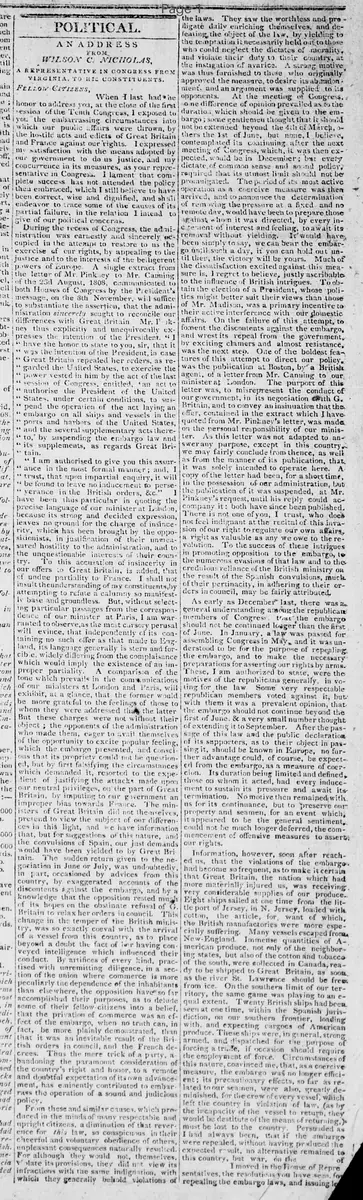
AN ADDRESS FROM WILSON C. NICHOLAS,
A REPRESENTATIVE IN CONGRESS FROM VIRGINIA, TO HIS CONSTITUENTS.
FELLOW CITIZENS,
When I last had the honor to address you, at the close of the first session of the Tenth Congress, I exposed to you the embarrassing circumstances into which our public affairs were thrown, by the hostile acts and edicts of Great Britain and France against our rights. I expressed my satisfaction with the means adopted by our government to do us justice. and my concurrence in its measures, as your representative in Congress. I lament that complete success has not attended the policy then embraced, which I still believe to have been correct. wise and dignified, and shall endeavor to trace some of the causes of its partial failure. in the relation I intend to give of our political concerns.
During the recess of Congress, the administration was earnestly and sincerely occupied in the attempt to restore to us the exercise of our rights, by appealing to the justice and to the interests of the belligerent powers of Europe. A single extract from the letter of Mr. Pinkney to Mr. Canning of the 23d August, 1808, Communicated to both Houses of Congress by the President's message, on the 3d November. will suffice to substantiate the assertion, that the administration sincerely sought to reconcile our differences with Great Britain Mr. Pinkney thus explicitly and unequivocally expresses the intention of the President. " I have the honor to state to you, sir, that it was the intention of the President, in case Great Britain repealed her orders. as regarded the United States. to exercise the power vested in him by the act of the last session of Congress, entitled, 'an act to authorize the President of the United States, under certain conditions, to suspend the operation of the act laying an embargo on all ships and vessels in the ports and harbors of the United States, and the several supplementary acts thereto,' by suspending the embargo law and its supplements, as regards Great Britain.
" I am authorised to give you this assurance in the most formal manner; and, I trust, that upon impartial enquiry, it will be found to leave no inducement to perseverance in the British orders. &c." I have been thus particular in quoting the precise language of our minister at London, because its strong and decided expression, leaves no ground for the charge of insincerity, which has been brought by the oppositionists. in justification of their unmeasured hostility to the administration, and to the unquestionable interests of their country. To this accusation of insincerity in our offers to Great Britain, is added, that of undue partiality to- France. I shall not insult the understanding of my constituents, by attempting to refute a calumny so manifestly base and groundless. But, without selecting particular passages from the correspondence of our minister at Paris, I am warranted to observe, as the most cursory perusal will evince, that independently of its containing no such offer as that made to England, its language generally is stern and forcible, widely differing from the complaisance which would imply the existence of an improper partiality. A comparison of the tone which prevails in the communications of our ministers at London and Paris, will exhibit, at a glance, that the former would be more grateful to the feelings of those to whom they were addressed than the latter.
But these charges were not without their object ; the opponents of the administration who made them, eager to avail themselves of the opportunity to excite popular feeling, which the embargo presented, and conscious that its propriety could not be questioned, but by first falsifying the circumstances which demanded it, resorted to the expedient of justifying the attacks made upon our neutral privileges, on the part of Great Britain, by imputing to our government an improper bias towards France. The ministers of Great Britain did not themselves, pretend to view the subject of our differences in this light, and we have information that, but for suggestions of this nature, and the convulsions of Spain, our just demands would have been yielded to by Great Britain. The sudden return given to the negociation in June or July, was undoubtedly. in part, occasioned by advices from this country, by exaggerated accounts of the discontents against the embargo, and by a knowledge that the opposition rested much of its hopes on the obstinate refusal of G. Britain to relax her orders in council. This change in the temper of the British ministry, was so exactly coeval with the arrival of a vessel from this country, as to place beyond a doubt the fact of its having conveyed intelligence which influenced their conduct. By artifices of every kind, practised with unremitting diligence, in a section of the union where commerce is more peculiarly the dependence of the inhabitants than elsewhere, the opposition have so far accomplished their purposes, as to delude some of their fellow-citizens into a belief. that the privation of commerce was an effect of the embargo, when no truth can, in fact, be more plainly demonstrated, than that it was an inevitable result of the British orders in council, and the French decrees. Thus the mere trick of a party, abandoning the paramount consideration of the country's rights and honor, to a remote and doubtful expectation of its own advancement, has eminently contributed to embarrass the operation of a sound and judicious policy.
From these and similar causes, which produced in the minds of many respectable and upright citizens. a diminution of that reverence for this law, so conspicuous in the cheerful and voluntary obedience of others. unpleasant consequences naturally resulted.
For although they would not, themselves. violate its provisions, they did not view its infractions with the same indignation, with which they generally behold violations of the laws. They saw the worthless and profligate daily enriching themselves, and defeating the object of the law, by yielding to the temptation it necessarily held out to those who could neglect the dictates of morality. and violate their duty to their country, at the instigation of avarice. A strong motive was thus furnished to those who originally approved the measure, to desire its abandonment. and an argument was supplied to its opponents. At the meeting of Congress.
One difference of opinion prevailed as to the duration. which should be given to the embargo; some gentlemen thought that it should not be extended beyond the 4th of March, others the 1st of June, but none, I believe, contemplated its continuing after the next meeting of Congress, which, it was then expected, would be in December; but every dictate of common sense and sound policy. required that its utmost limit should not be promulgated. The period of its most active operation as a coercive measure was then arrived, and to announce the determination of removing the pressure at a fixed and no remote day, would have been to prepare those against whom it was directed, by every inducement of interest and feeling, to await its removal without yielding. It would have been simply to say, we can bear the embargo until such a day, if you can hold out until then. the victory will be yours. Much of the dissatisfaction excited against this measure is, I regret to believe, justly ascribable to the influence of British intrigues. To obtain the election of a President, whose politics might better suit their views than those of Mr. Madison, was a primary incentive to their active interference with our domestic affairs. On the failure of this attempt, to foment the discontents against the embargo. and wrest its repeal from the government, by exciting clamors and almost resistance. was the next step. One of the boldest features of this attempt to direct our policy. was the publication at Boston, by a British agent. of a letter from Mr. Canning to our minister at London. The purport of this letter was, to misrepresent the conduct of our government, in its negociation with G. Britain, and to convey an insinuation that the offer, contained in the extract which I have. quoted from Mr. Pinkney's letter, was made on the personal responsibility of our minister. As this letter was not adapted to answer any purpose, except in this country— we may fairly conclude from thence, as well as from the manner of its publication, that it was solely intended to operate here. A copy of the letter had been, for a short time, in the possession of our administration, but the publication of it was suspended, at Mr. Pinkney's request, until his reply could accompany it: both have since been published.
There is not one of you, I trust, who does not feel indignant at the recital of this invasion of our right to regulate our own affairs, a right as valuable as any we owe to the revolution. To the success of these intrigues in promoting opposition to the embargo, to the numerous evasions of that law and to the credulous reliance of the British ministry on the result of the Spanish convulsions, much of their pertinacity, in adhering to their orders in council, may be fairly attributed.
As early as December last, there was a general understanding among the republican members of Congress. that the embargo should not be continued longer than the first of June. In January. a law was passed for. assembling Congress in May, and it was understood to be for the purpose of repealing the embargo, and to make the necessary preparations for asserting our rights by arms.
These, I am authorized to state, were the motives of the republicans generally, in voting for the law Some very respectable republican members voted against it, but with them it was a prevalent opinion, that. the embargo should not continue beyond the first of June. & a very small number thought of extending it to September. After the passage of this law and the public declaration of its supporters, as to their object in passing it, should be known in Europe, no further advantage could, of course, be expected from the embargo, as a measure of coercion. Its duration being limited and defined, those on whom it acted, had every inducement to sustain its pressure and await its termination. No motive then remained with. us for its continuance, but to preserve our property and seamen, for an event which, it appeared to be the general sentiment. could not be much longer deferred, the commencement of offensive measures to assert our rights.
Information, however, soon after reached us, that the violations of the embargo: had become so frequent, as to make it certain that Great Britain, the nation which had more materially injured us, was receiving very considerable supplies of our produce. Eight ships sailed at one time from the little port of Jersey, in N. Jersey, loaded with cotton, the article, for. want of which, the British manufactories were more especially suffering. Many vessels escaped from. New-England. Immense quantities of American produce, not only of the neighboring states, but also of the cotton and tobacco of the south, were collected in Canada, ready to be shipped to Great Britain, as soon. as the river St. Lawrence should be free from ice. On the southern limit of our territory, the same game was playing to an equal extent. Twenty British ships had been seen at one time, within the Spanish jurisdiction, on our southern frontier, loading with. and expecting cargoes of American produce. These ships were, in general, strong armed, and dispatched for the purpose of forcing a trade, if occasion should require the employment of force. Circumstances of this nature, convinced me, that, as a coercive measure, the embargo was no longer efficient: its precautionary effects, so far as related to our seamen, were also, greatly diminished, for the crew of every vessel, which left the country in violation of law, (as by the incapacity of the vessel to return, they would be destitute of the means of returning,) must be lost to the country. Persuaded as I had always been, that if the embargo were repealed, without having produced the expected result, no alternative remained to this country, but war, on the
I moved in the House of Representatives, the resolutions you have seen. for repealing the embargo laws, and issuing letters of marque and reprisal.
Letters of marque and reprisal against Great Britain and France. Prior to my having made this motion, Mr. Bacon, a respectable republican member from Massachusetts, who had voted for the embargo, announced in his place, a determination to move for the repeal of the embargo laws, with the further intention of passing a law to allow merchant vessels to arm in their defence. I then believed, and subsequent events have confirmed the opinion, that this motion would have prevailed, unless some other measure, connected with the repeal of the embargo, by that Congress, should be proposed and adopted. I believe, and still think, that a majority was then determined to repeal the laws before the end of the session.
Permit me to refer you to a speech I had prepared in support of my resolution, but which I was prevented, by indisposition, from delivering during the discussion. I publish it now as it was then written, that you may judge of the motives which governed my conduct. That member of the resolution which authorised the issue of letters of marque and reprisal was rejected by a great majority. The member, which related to the repeal of the embargo, was retained, and the blank which I had intended to fill with the 1st of June was filled with the 4th of March. Instead of adopting my proposition to grant letters of marque and reprisal, it was proposed to permit merchants to arm in their own defence; and another proposal was submitted, authorising merchant ships to recapture vessels which might be taken.
In my former letter I stated some objections to the propriety of arming merchantmen, when the nation was not avowedly at war, and there are additional considerations of great weight, which confirm my original opinions on that subject. It would not only put it in the power of individuals to involve us in war with the nation, against which their prejudices might more particularly prevail, but this power, from the unhappy facility (incidental to all commercial states) with which foreigners can avail themselves of the use of our flag, be extended to persons, not citizens of the United States. Either of the nations, whose acts we complain of, would in this manner, be furnished with ample means to embroil us with its adversary. Convinced as every man must be, that interest as well as inclination, would prompt Great Britain and France to take advantage of this state of things, to promote their several views, it cannot be doubted, but that their agents would be immediately in motion. We should then witness the degrading spectacle of the American flag, an instrument in the hands of foreigners, to effect a purpose, which should never result, but from the mature deliberation & solemn decision of the American people. Nor would it assist mercantile interest. The mere merchant would not arm to obtain a protection which he could purchase at smaller expense, and if by the payment of tribute he could pursue his commerce with more safety and with not more expense, he would not often be tempted by the consideration of national dignity, to prefer the more hazardous enterprize. By this measure our trade would be resumed with those nations whose outrages and anti-neutral restrictions we have pledged ourselves to resist, and under circumstances of great national degradation. We should virtually relinquish our national sovereignty by submitting to taxation and tribute; we should acknowledge the supremacy of nations who presume to dictate to us the manner of exercising our rights; and we should return in fact, to the condition of colonies, by surrendering the monopoly of our trade at the mandate of a foreign government.
A strong conviction that the embargo would be repealed unconditionally, or upon terms which I considered still more exceptionable than an unqualified repeal, induced me to acquiesce in the non-intercourse law. With me it was not a measure of choice, but of necessity. Deficient as it is, I believe it to be preferable to measures which would otherwise have been embraced. If it be not the most effectual kind of resistance, at least it is not submission. It reserves for the decision of the people by their representatives in the next congress, the question, of what course will most probably conduce to the maintenance of interests, deservedly most dear to them. It opens our commercial intercourse with every part of the world except France and England, their colonies and dependencies, or places in the actual possession of either. For myself, from the moment the aggressions on our commerce and sovereignty began to assume that serious aspect, which they have since borne, I have admitted but one opinion; I believed that our rights, honor and independence were assailed. As a freeman, as your representative, my determination was instantly taken, to resist to the last extremity. Three alternatives were before us, War, Embargo, or Submission. The last was spurned as unworthy a high spirited people. Embargo was resorted to as combining the effects of precaution and coercion. In its former character, we have had sufficient experience of its efficacy, to be satisfied with the consequences; in the latter, although enough was effected to evince its cogency, entire success has not attended it. You all know why and how it failed, and will not be surprised, that the men whose opposition very materially contributed to its failure, should from that circumstance, deduce an argument to prove its original incompetency.
The question, of how far our resistance to the invasion of our rights shall be carried, which is yet to be decided, does not involve the single consideration of our country's honor, but that likewise of our personal comfort and convenience to a very great extent. Our national honor and individual interest are, at present, so inseparably connected, that to abandon one would be destruction to the other. Upon every interest of the community, a restriction of our undoubted right to convey to the best markets the produce of our industry, would be attended with calamitous effects. To the agricultural interest, it would be equally, if not more injurious, than to any other. While we are excluded from the continent of Europe, the place of consumption for a very large proportion of the tobacco raised in this country, to cultivate that plant would be folly; to abandon its cultivation, situated as we are, at the arbitrary mandate of a foreign power, is an oppression not to be endured without a struggle. At present, to carry it to the continent is impossible, without encountering the formidable opposition of the navy of Great Britain, by whose laws, all property taken on a direct voyage to the continent is confiscated. We are permitted to take it to England alone, in the first instance; on paying a tax there of three dollars per hundred, it may be re-shipped to the continent, but by municipal regulations of the continent it is liable to confiscation, for having been in England. The access to the only market for the largest portion of our tobacco, is then completely shut, as far as the British navy is competent to effect that object. Were we, indeed, permitted to enter the ports of the continent, after paying a duty of three dollars per hundred in England, it is evident that no commodity could support a tax so disproportionate to its value. Cotton, whose primary market for considerable quantities, is likewise the continent of Europe, must so far be in the same situation, and it finds its ultimate market on the continent, in the form of manufactures, to a great extent. Wheat, one of the principal products of the middle states, is deprived by the British orders, of the markets of Spain and Portugal, for the recent intelligence from those countries, leaves little doubt of their being again in possession of the French, and consequently, subject to the interdiction of the orders in council. We may, it is true, continue to export flour to some of the West India Islands, and to ports of South America, but where shall we dispose of the coffee, sugar, &c. which we receive in exchange, that may remain after supplying the demand for consumption in this country? To the fisheries of the east, no better prospect is presented than to agriculture; the great market for fish is the south of Europe. Our navigating interest is injured by every cause which obstructs the unrestrained pursuit of commerce; to the loss of the carrying trade, is superadded the impossibility of transporting our native products of our own soil. For it is not to be presumed, that we will incur the idle expense of shipping produce in defiance of the conviction, that it can never reach a market where its price might remunerate us. If we submit tamely to such oppression we shall merit the disgrace and ruin in which we shall be involved. This, I will not, I cannot believe will happen; the resentment of my countrymen may be suspended—in twenty five years the American people cannot have lost all love of country, all public spirit and regard to national character. I have the utmost confidence they will assert and maintain their country's rights & independence.
There is not, I trust, an American who will tamely submit to this humiliating oppression, who will suffer the fruits of his labor to perish on his hands, or go to swell the coffers of a proud and insolent nation, without making a brave effort to repel the aggressor. If the man exists, so base and sordid as to admit the idea of averting such insolence by submission, to him I would say, submission will not save you; it will cover you with disgrace, it will overwhelm you with ruin. The implacable jealousy of our growing wealth, of our rapidly rising commerce, threatening at no distant day, to rival on her own element, the mistress of the ocean, can never be appeased by any partial sacrifice. We must immolate to the jealous terrors of Great Britain, our wealth, our industry, and above all, our enterprise; or we must resolve to defend them, like men, conscious of their inestimable value: we must not deceive ourselves with any expectation of redress from the justice of our rival. Our real offence consists in the very possession of those things of which she, as yet, pretends only to regulate the exercise; while we are industrious, commercial & enterprising, Great Britain will never cease to be our bitter foe.
These are facts of immense consequence, they ought to be well understood, an acquaintance with them should be widely diffused. The reflection that Great Britain owes to her maritime supremacy, the undue elevation she maintains among the nations of the world, her conviction that she can sustain it, but by perpetuating her monopoly of commerce, the plain evidence afforded by our rapid progress, that we are fast intruding on her dominion of the seas, are incontestable grounds of belief, that she never will patiently submit to have her power abridged by our commercial advancement. If Great Britain had not checked our career, in a few years the number of our ships, and what is still more important, the number of our seamen, would have been equal to her own. This she saw, and was determined to prevent; she availed herself of her maritime power, to crush our aspiring commerce, and we delude ourselves if we imagine she will ever suffer it to revive with her consent. It remains for us to embrace the only means by which the consequences of this interested hostility can be averted, to make a firm and manly resistance. Our evident reluctance to abandon the peaceful situation which we have maintained since the close of our revolutionary war, with equal honor and advantage, has certainly encouraged the British to persevere in a system of attack upon our rights, which might ultimately arrest the progress, whence they had reason to dread an issue unfavorable to their overweening maritime pretensions. If we shew them that our patience of injury is exhausted, and that we are, at length, determined to support our rights, by an exertion of our strength, they will be obliged to choose between a war, which will add too much to the burdens they already support, and an admission of claims whose justice they cannot contest.
Although, in the preceding sketch of our public affairs, I have shewn the intimate alliance of our honor with our interest, and that at the present crisis, to vindicate the one, is the best possible mode to advance the other, still I will not believe that my constituents require any other stimulus than their country's wrongs, to step forth with generous devotion, in her defence. The manly fortitude with which they and their fellow citizens of Virginia have borne the heavy pressure, imposed by the unexampled circumstances of the times, their firm support of their government, under privations not surpassed in any other section of the U. States, exhibit the patriotic firmness of men, in whose estimation private advantage sinks to insignificance, when compared with the common good. I am proud to have been the representative of such men in the councils of the nation; confident that they will never shrink from the maintenance of their country's rights, and from the patient obedience they have paid to the embargo, I deduce the most flattering hopes, that when exertion shall be wanting, they will be amongst the foremost. For myself, I will not hesitate to make with them, any sacrifice our country may demand. I trust, that in the discharge of my public duty, I have been so fortunate as to merit your approbation, and hope you will do me the justice to believe, that I have had no object but the public good. I pray God to avert the storm which threatens us, and to enable us to preserve the blessings he has bestowed upon our country; to direct our councils, and to inspire our people with firmness and patriotism, that the happiness, liberty and independence which they enjoy may be transmitted unimpaired to posterity.
I am with the greatest respect and Consideration,
Your humble servant,
WILSON CARY NICHOLAS.
What sub-type of article is it?
What keywords are associated?
What entities or persons were involved?
Editorial Details
Primary Topic
Defense Of Embargo Policy And Advocacy For Resistance To British And French Aggressions
Stance / Tone
Supportive Of Administration And Pro Resistance To Foreign Violations
Key Figures
Key Arguments