Thank you for visiting SNEWPapers!
Sign up free
The Daily Alaska Empire
Juneau, Juneau County, Alaska
What is this article about?
The Free French seized St. Pierre-Miquelon islands from Vichy control with British support, amid suspicions of Vichy radio aiding Axis forces. This sparked US diplomatic backlash from Secretary Hull, who favored Vichy, leading to tensions with Britain and eventual compromise efforts for Anglo-American coordination.
Merged-components note: Continuation of foreign news story on U.S.-British policy regarding Free French seizure of St. Pierre-Miquelon; relabeling the page 4 component from 'domestic_news' to 'foreign_news' due to international focus.
Clippings
1 of 2
OCR Quality
Full Text
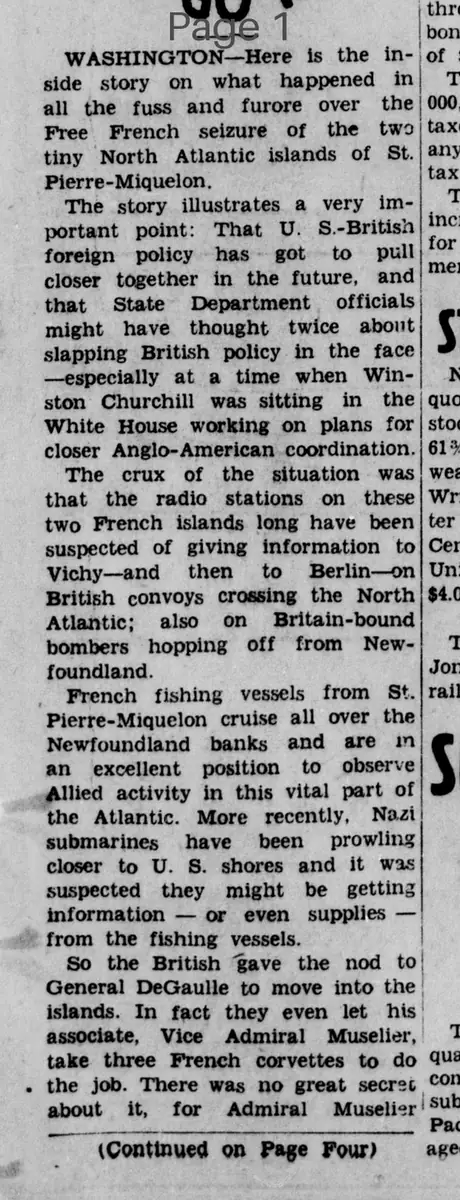
The story illustrates a very important point: That U. S.-British foreign policy has got to pull closer together in the future, and that State Department officials might have thought twice about slapping British policy in the face -especially at a time when Winston Churchill was sitting in the White House working on plans for closer Anglo-American coordination.
The crux of the situation was that the radio stations on these two French islands long have been suspected of giving information to Vichy-and then to Berlin-on British convoys crossing the North Atlantic; also on Britain-bound bombers hopping off from Newfoundland.
French fishing vessels from St. Pierre-Miquelon cruise all over the Newfoundland banks and are in an excellent position to observe Allied activity in this vital part of the Atlantic. More recently, Nazi submarines have been prowling closer to U. S. shores and it was suspected they might be getting information - or even supplies- from the fishing vessels.
So the British gave the nod to General DeGaulle to move into the islands. In fact they even let his associate, Vice Admiral Muselier, take three French corvettes to do the job. There was no great secret about it, for Admiral Muselier
(Continued on Page Four)
Washington
Merry-
Go-Round
(Continued From Page One)
stopped in Canada to talk
to Cana-
dian Naval Minister Angus Mac-
Donald, and also picked up some
American newspapermen to witness
the taking over of the two islands.
"SO-CALLED" FREE FRENCH
However, on the morning Admir-
al Muselier placed the Free French
flag on St. Pierre-Miquelon, Sec-
retary Hull, getting the news at
his breakfast table, hurried to the
State Department and
OK'd a
scathing statement, castigating the
"so-called" Free French
This upset the British consider-
ably, because they had been en-
couraging the French people
to
think of the Free French not as a
"so-called" government, but as a
government more truly free and
representative of the French peo-
ple than Vichy.
Also it upset the Jugoslavs, the
Dutch, the Greeks and a lot of
other "so-called" governments which
have been maintaining headquar-
ters in London and have been call-
ing
themselves the real govern-
ment of
their
countries- even
though in exile.
However, Secretary Hull seemed
to be even more upset than the
British. He had made a deal with
Vichy's Admiral Robert in Mar-
tinique
a
few
days
before, by
which Admiral Robert was to keep
an eye on St. Pierre-Miquelon. And
he felt this agreement should be
kept. So, his Tennessee dander up,
Mr. Hull cabled U. S. Ambassador
Winant in London to take up the
matter
with the British Govern-
ment.
Ambassador
Winant,
in turn,
go to Malcolm MacDonald, Min-
ister of Colonies, who was upset
that the United States and Britain
should be working at cross-purpos-
es, and telephoned his friend, Lord
Beaverbrook back in Washington
to have Churchill straighten the
matter out with Roosevelt.
By that time, Sam Reber, in the
State Department, had telephoned
R. E. Barclay of the British Em-
bassy wanting to know what the
British were up to, and every An-
glo-American coordinator seemed to
be in every other Anglo-American
coordinator's hair.
What the President said to his
Secretary of State is their secret,
but in the end Mr. Hull adopted a
milder tone toward the Free French
and is working out a compromise
agreement with the Canadians.
The crux of the controversy, of
course, is that Mr. Hull still be-
lieve in appeasing Vichy, and the
British gave that up long ago.
The British say that General De-
Gaulle did most of the fighting for
the Allied cause in Syria, while
Vichy, in resisting, killed many
British troops. So they are going
to stick with DeGaulle.
But whichever side is right-the
British or Secretary Hull-it might
pay to work out some teamwork in
advance.
What sub-type of article is it?
What keywords are associated?
What entities or persons were involved?
Where did it happen?
Foreign News Details
Primary Location
St. Pierre Miquelon
Key Persons
Outcome
diplomatic tensions between us and britain resolved through compromise; milder us tone toward free french; ongoing efforts for anglo-american coordination.
Event Details
British supported Free French seizure of St. Pierre-Miquelon islands due to suspicions of Vichy radio aiding Axis on Allied convoys and submarines. Admiral Muselier used three corvettes to take the islands openly. US Secretary Hull, favoring Vichy deal, issued scathing statement against 'so-called' Free French, upsetting British and exiles. Tensions escalated via cables and calls, but Hull softened stance and sought compromise with Canadians amid US-British policy differences on Vichy vs. DeGaulle.