Thank you for visiting SNEWPapers!
Sign up free
San Antonio Daily Light
San Antonio, Bexar County, Texas
What is this article about?
Coroner's inquest begins into the Chatsworth, Illinois train wreck on August 11, 1887, where a burning bridge caused derailment, killing about 80 and injuring many. Superintendent Armstrong testifies the bridge was intact hours before; suspicion of arson arises. Unclaimed bodies to be handled in Peoria.
Clipping
OCR Quality
Full Text
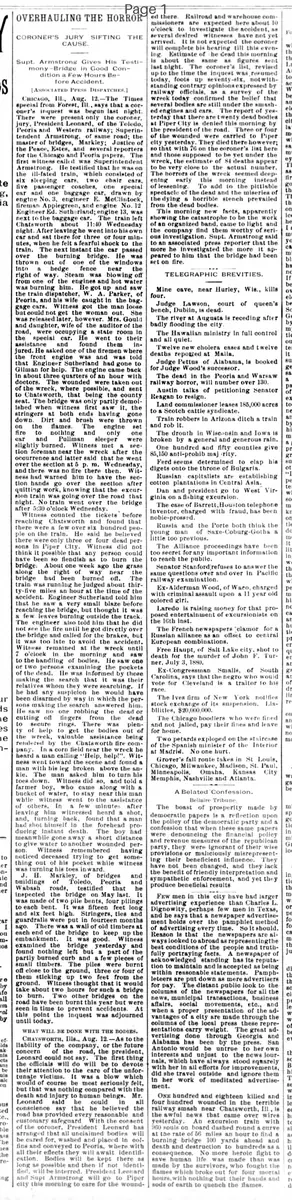
CORONER'S JURY SIFTING THE CAUSE.
Supt. Armstrong Gives His Testimony—Bridge in Good Condition a Few Hours Before Accident.
[ASSOCIATED PRESS DISPATCHES.]
CHICAGO, Ill., Aug. 12.—The Times special from Forest, Ill., says that a coroner's inquest was begun last night. There were present only the coroner, jury, President Leonard, of the Toledo, Peoria and Western railway; Superintendent Armstrong, of same road; the master of bridges, Markley; Justice of the Peace, Estes, and several reporters for the Chicago and Peoria papers. The first witness called was Superintendent Armstrong. He testified that he was on the ill-fated train, which consisted of six sleeping cars, two chair cars, five passenger coaches, one special car and one baggage car, drawn by engine No. 3, engineer E. McClintock, fireman Applegreen, and engine No. 12, Engineer Ed. Sutherland; engine 13, was next to the baggage car. The train left Chatsworth about 11:40 Wednesday night. After leaving he went into his own car and sat there for three or four minutes, when he felt a fearful shock to the train. The next instant the car passed over the burning bridge. He was thrown out of one of the windows into a hedge fence near the right of way. Steam was blowing off from one of the engines and hot water was burning him. He got up and saw the train dispatcher, W. A. Parker, of Peoria, and his wife caught in the baggage cars. Witness got the man loose but could not get the woman out. She was released later, however. Mrs. Gould and daughter, wife of the auditor of the road, were occupying a state room in the 'special car.' He went to their assistance and found them injured. He asked one of the firemen where the front engine was and was told that Engineer Sutherland had gone to Gilman for help. The engine came back in about three quarters of an hour with doctors. The wounded were taken out of the wreck, where possible, and sent to Chatsworth, that being the county seat. The bridge was only partly demolished when witness first saw it, the stringers at both ends having gone down. Dirt and brush were thrown on the flames. The engine set fire to nothing and only one car and Pullman sleeper were slightly burned. Witness met a section foreman near the wreck after the occurrence and latter said that he went over the section at 5 p. m. Wednesday, and there was no fire there then. Witness had warned him to have the section hands go over the section after quitting work, knowing that the excursion train was going over the road that night. No train went over the bridge after 5:30 o'clock Wednesday. Witness counted the tickets before reaching Chatsworth and found that there were a few over six hundred people on the train. He said he believed there were only three or four dead persons in Piper City. Witness did not think it possible that any person could have been so fiendish as to burn the bridge. About one week ago the grass along the right of way near the bridge had been burned off. The train was running he judged about thirty-five miles an hour at the time of the accident. Engineer Sutherland told him that he saw a very small blaze before reaching the bridge, but thought it was a few leaves burning outside the track. The engineer also told him that he did not see the fire until he got directly over the bridge and called for the brakes, but it was too late to avoid the accident. Witness remained at the wreck until 7 o'clock in the morning and saw to the handling of bodies. He saw one or two persons examining the pockets of the dead. He was informed by those making the search that it was their relatives whom they were searching. If he had any suspicion he would have been disarmed by way in which the persons making the search answered him. He saw no one robbing the dead or cutting off fingers from the dead to secure rings. There was plenty of help to get the bodies out of the wreck, valuable assistance being rendered by the Chatsworth fire company. In a corn field near the wreck he heard a man calling "Help, help!". Witness went toward the scene and found a man with his leg broken above the ankle. The man asked him to turn his toes down. Witness did so, and told a farmer boy, who came along with a bucket of water, to stay near this man while witness went to the assistance of others. In a few minutes after leaving him witness heard a shot, and, turning back, found that a man had shot himself in the forehead producing instant death. The boy had meanwhile gone away a short distance to give water to another wounded person. Witness remembered having noticed deceased trying to get something out of his pocket while witness was turning his toes inward.
J. H. Markley, of bridges and buildings of Toledo, Peoria and Wabash roads, testified that he inspected the bridge on May last. It was made of two pile bents, four pilings to each bent. It was fifteen feet long and six feet high. Stringers, ties and guardrails were put in fourteen months ago. There was a wall of old timbers at each end of the bridge to keep up the embankment. It was good. Witness examined the bridge yesterday and found nothing left but a part of the partly burned curb and a few pieces of small timbers. The piles were burnt off close to the ground, three or four of them sticking up two feet from the ground. Witness thought that it would take about two hours for such a bridge to burn. Two other bridges on the road have been burnt this year but were seen in time to prevent accidents. At this point the inquest was adjourned until today.
WHAT WILL BE DONE WITH THE BODIES.
CHATSWORTH, Ills., Aug. 12.—As to the liability of the company, or the future concern of the road, the president, Leonard could not say. The first thing the officials will do will be to devote their attention to the care of the unfortunate victims. It was a blow which would of course be most seriously felt, but that was nothing compared with the death and injury to human beings. Mr. Leonard said he could in all conscience say that he believed the road has provided every reasonable and customary safeguard. With the consent of the coroner, President Leonard has arranged that all unclaimed bodies will be cared for, washed and placed in coffins and conveyed to Peoria, where with all their effects they will await identification. Bodies will be kept there as long as possible and then if not identified, will be interred. President Leonard and Supt. Armstrong will go to Piper City this morning to care for the wounded.
expected there. Railroad and warehouse commissioners are expected here about 10 o'clock to investigate the accident, as several desired witnesses have not yet arrived. It is not expected the coroner will complete his hearing till this evening. Estimate of the dead this morning is about the same as figures sent last night. The coroner's list, revised up to the time the inquest was resumed today, foots up seventy-six, notwithstanding contrary opinions expressed by railway officials, as a survey of the wreck today confirmed the belief that several bodies are still under the smashed engines and cars. The report of yesterday that there are twenty dead bodies at Piper City is denied this morning by the president of the road. Three or four of the wounded were carried to Piper City yesterday. They died there however; so that with 76 on the coroner's list here and those supposed to be yet under the wreck, the estimate of 84 deaths appear to be very close to the actual number. The horrors of the wreck seemed deepening early this morning instead of lessening. To add to the pitiable spectacle of the dead and the miseries of the dying a horrible stench prevailed from the dead bodies. This morning new facts, apparently showing the catastrophe to be the work of an organized band, came to light and the company find them worthy of serious investigation. Supt. Armstrong said to an associated press reporter that the more he investigated the more it appeared to him that the bridge had been set on fire.
What sub-type of article is it?
What keywords are associated?
What entities or persons were involved?
Where did it happen?
Domestic News Details
Primary Location
Chatsworth, Ill.
Event Date
Wednesday Night, Aug. 11
Key Persons
Outcome
approximately 76-84 deaths, numerous injuries; bridge burned, train derailed and partially burned; one suicide among injured; unclaimed bodies to peoria for identification.
Event Details
Train from Chatsworth derailed after passing over burning bridge, causing wreck with over 600 passengers. Inquest testimony details train composition, speed of 35 mph, engineer's sighting of small blaze, rescue efforts, no observed looting, bridge inspection history, and suspicion of arson by organized band.