Thank you for visiting SNEWPapers!
Sign up free
National Gazette
Philadelphia, Philadelphia County, Pennsylvania
What is this article about?
Mr. Williamson's speech in the House of Representatives on Nov. 10 urges measures to increase native American seamen for commerce protection, citing incidents of British officers seizing sailors and cargo from American ships at Sierra Leona, Madeira, and Cape of Good Hope.
Clipping
OCR Quality
Full Text
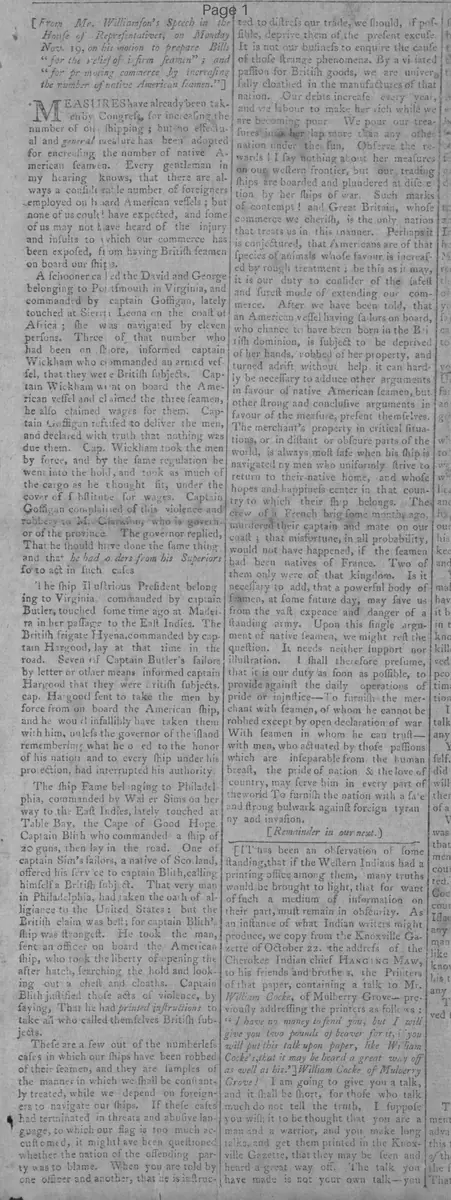
MEASURES have already been taken by Congress for increasing the number of our shipping; but no effectual and general measure has been adopted for increasing the number of native American seamen. Every gentleman in my hearing knows, that there are always a considerable number of foreigners employed on board American vessels: but none of us could have expected, and some of us may not have heard of the injury and insults to which our commerce has been exposed, from having British seamen on board our ships.
A schooner called the David and George belonging to Portsmouth in Virginia, and commanded by captain Goffigan, lately touched at Sierra Leona on the coast of Africa: she was navigated by eleven persons. Three of that number who had been on shore, informed captain Wickham who commanded an armed vessel, that they were British subjects. Captain Wickham went on board the American vessel and claimed the three seamen, he also claimed wages for them. Captain Goffigan refused to deliver the men, and declared with truth that nothing was due them. Cap. Wickham took the men by force, and by the same regulation he went into the hold, and took as much of the cargo as he thought fit, under the cover of substitute for wages. Captain Goffigan complained of this violence and robbery to Mr. Clarkson, who is governor of the province. The governor replied, That he should have done the same thing and that he had orders from his Superiors to so act in such cases.
The ship Illustrious President belonging to Virginia commanded by captain Butler, touched some time ago at Madeira in her passage to the East Indies. The British frigate Hyena, commanded by captain Hargood, lay at that time in the road. Seven of Captain Butler's sailors by letter or other means informed captain Hargood that they were British subjects. Cap. Hargood sent to take the men by force from on board the American ship, and he would infallibly have taken them with him, unless the governor of the island remembering what he owed to the honor of his nation and to every ship under his protection, had interrupted his authority.
The Ship Fame belonging to Philadelphia, commanded by Walter Simpson on her way to the East Indies, lately touched at Table Bay, the Cape of Good Hope. Captain Bligh who commanded a ship of 20 guns, then lay in the road. One of captain Sim's sailors, a native of Scotland, offered his service to captain Bligh, calling himself a British subject. That very man in Philadelphia, had taken the oath of allegiance to the United States: but the British claim was best; for captain Bligh's ship was strongest. He took the man, sent an officer on board the American ship, who took the liberty of opening the after hatch, searching the hold and looking out a chest and clothes. Captain Bligh justified those acts of violence, by saying, That he had printed instructions to take all who called themselves British subjects.
These are a few out of the numberless cases in which our ships have been robbed of their seamen, and they are samples of the manner in which we shall be constantly treated, while we depend on foreigners to navigate our ships. If these cases had terminated in threats and abusive language, to which our flag is too much accustomed, it might have been questioned whether the nation of the offending party was to blame. When you are told by one officer and another, that he is instructed to distress our trade, we should, if possible, deprive them of the present excuse.
It is not our business to enquire the cause of those strange phenomena. By a vitiated passion for British goods, we are universally clothed in the manufactures of that nation. Our debts increase every year, and we labour to make her rich while we are becoming poor. We pour our treasures into her lap more than any other nation under the sun. Observe the rewards! I say nothing about her measures on our western frontier, but our trading ships are boarded and plundered at discretion by her ships of war. Such marks of contempt! and Great Britain, whose commerce we cherish, is the only nation that treats us in this manner. Perhaps it is conjectured, that Americans are of that species of animals whose favour is increased by rough treatment; be this as it may, it is our duty to consider of the safest and surest mode of extending our commerce. After we have been told, that an American vessel having a few on board, who chance to have been born in the British dominion, is subject to be deprived of her hands, robbed of her property, and turned adrift without help, it can hardly be necessary to adduce other arguments in favour of native American seamen, but other strong and conclusive arguments in favour of the measure, present themselves.
The merchant's property in critical situations, or in distant or obscure parts of the world, is always most safe when his ship is navigated by men who uniformly strive to return to their native home, and whose hopes and happiness center in that country to which their ship belongs. The crew of a French brig some months ago, murdered their captain and mate on our coast; that misfortune, in all probability, would not have happened, if the seamen had been natives of France. Two of them only were of that kingdom. Is it necessary to add, that a powerful body of seamen, at some future day, may save us from the vast expence and danger of a standing army. Upon this single argument of native seamen, we might rest the question. It needs neither support nor illustration. I shall therefore presume, that it is our duty as soon as possible, to provide against the daily operations of pride or injustice—To furnish the merchant with seamen, of whom he cannot be robbed except by open declaration of war. With seamen in whom he can trust—with men, who actuated by those passions which are inseparable from the human breast, the pride of nation & the love of country, may serve him in every part of the world. To furnish the nation with a safe and strong bulwark against foreign tyranny and invasion.
(Remainder in our next.)
What sub-type of article is it?
What themes does it cover?
What keywords are associated?
What entities or persons were involved?
Where did it happen?
Story Details
Key Persons
Location
House Of Representatives; Sierra Leona, Africa; Madeira; Table Bay, Cape Of Good Hope
Event Date
Monday Nov. 10
Story Details
Mr. Williamson argues for increasing native American seamen to protect commerce from British impressment and plundering, citing three incidents where British officers seized sailors and cargo from American ships, and emphasizing national loyalty and security benefits.