Thank you for visiting SNEWPapers!
Sign up free
Daily National Intelligencer
Washington, District Of Columbia
What is this article about?
A Pennsylvania correspondent, signing as 'NECKAR,' critiques essays by 'A Member of Congress' for misrepresenting English corn laws as sacrificing farmers to manufacturers. He explains the protective system for agriculture, refuting claims of import bounties and highlighting fair prices and export bounties (discontinued 1814). Philadelphia, June 24.
Clipping
OCR Quality
Full Text
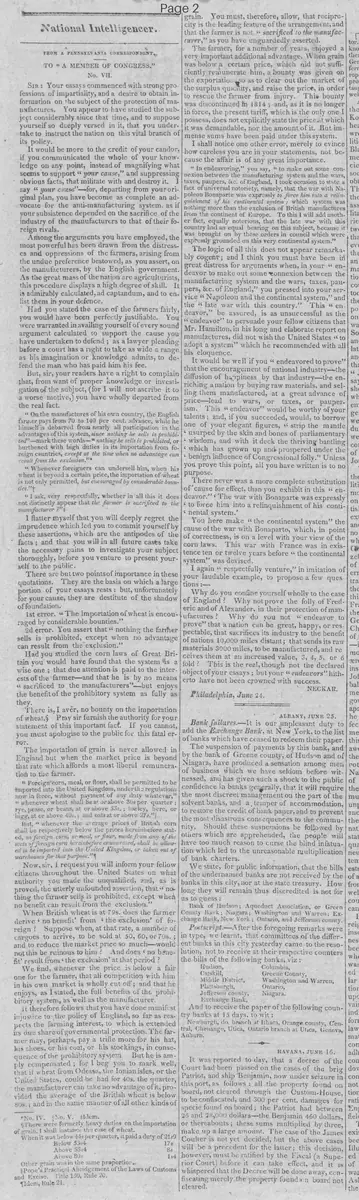
TO "A MEMBER OF CONGRESS."
No. VII.
Sir: Your essays commenced with strong professions of impartiality, and a desire to obtain information on the subject of the protection of manufactures. You appear to have studied the subject considerably since that time, and to suppose yourself so deeply versed in it, that you undertake to instruct the nation on this vital branch of its policy.
It would be more to the credit of your candor if you communicated the whole of your knowledge on any point, instead of magnifying what seems to support your cause, and suppressing obvious facts, that militate with and destroy it. I say "your cause" for, departing from your original plan, you have become as complete an advocate for the anti-manufacturing system, as if your subsistence depended on the sacrifice of the industry of the manufacturers to that of their foreign rivals.
Among the arguments you have employed, the most powerful has been drawn from the distresses and oppressions of the farmers, arising from the undue preference bestowed, as you assert, on the manufacturers, by the English government. As the great mass of the nation are agriculturists, this procedure displays a high degree of skill. It is admirably calculated, ad captandum, and to enlist them in your defence.
Had you stated the case of the farmers fairly you would have been perfectly justifiable. You were warranted in availing yourself of every sound argument calculated to support the cause you have undertaken to defend; as a lawyer pleading before a court has a right to take as wide a range as his imagination or knowledge admits, to defend the man who has paid him his fee.
But, sir, your readers have a right to complain that, from want of proper knowledge or investigation of the subject, (for I will not ascribe it to a worse motive,) you have wholly departed from the real fact.
"On the manufactures of his own country, the English farmer pays from 70 to 140 per cent. advance, while he himself is debarred from nearly all participation in the advantages of this system, since nothing he sells is prohibited"—mark these words—"nothing he sells is prohibited, or burthened with high duties in its importation from foreign countries, except at the time when no advantage can result from the exclusion."*
"Whenever foreigners can undersell him, when his wheat is beyond a certain price, the importation of wheat is not only permitted, but encouraged by considerable bounties."†
"I ask, very respectfully, whether in all this it does not distinctly appear that the farmer is sacrificed to the manufacturer?"
I flatter myself that you will deeply regret the imprudence which led you to commit yourself by these assertions, which are the antipodes of the facts; and that you will in all future cases take the necessary pains to investigate your subject thoroughly, before you venture to present yourself to the public.
There are but two points of importance in these quotations. They are the basis on which a large portion of your essays rests: but, unfortunately for your cause, they are destitute of the shadow of foundation.
1st error. "The importation of wheat is encouraged by considerable bounties."
2d error. You assert that "nothing the farmer sells is prohibited, except when no advantage can result from the exclusion."
Had you studied the corn laws of Great Britain you would have found that the system is a wise one; that due attention is paid to the interests of the farmer—and that he is by no means "sacrificed to the manufacturers"—but enjoys the benefit of the prohibitory system as fully as they.
There is, I aver, no bounty on the importation of wheat. Pray sir furnish the authority for your statement of this important fact. If you cannot, you must apologise to the public for this fatal error.
The importation of grain is never allowed in England but when the market price is beyond that rate which affords a most liberal remuneration to the farmer.
"Foreign corn, meal, or flour, shall be permitted to be imported into the United Kingdom, under the regulations now in force, without payment of any duty whatever," "whenever wheat shall be at or above 80s per quarter; rye, pease, or beans, at or above 53s.; barley, bere, or bigg, at or above 40s.; and oats at or above 27s."
But, "whenever the average prices of British corn shall be respectively below the prices hereinbefore stated, no foreign corn, or meal, or flour, made from any of the sects of foreign corn hereinbefore enumerated, shall be allowed to be imported into the United Kingdom, or taken out of warehouses for that purpose."
Now, sir, I request you will inform your fellow citizens throughout the United States on what authority you made the unqualified, and, as is proved, the utterly unfounded assertion, that "nothing the farmer sells is prohibited, except when no benefit can result from the exclusion."
When British wheat is at 79s. does the farmer derive 'no benefit' from the exclusion of foreign? Suppose when, at that rate, a number of cargoes to arrive, to be sold at 50, 60, or 70s.; and to reduce the market price so much would not this be ruinous to him? And does 'no benefit' result from 'the exclusion' at that period?
We find, whenever the price is below a fair one for the farmer, that all competition with him in his own market is wholly cut off; and that he enjoys, as I stated, the full benefits of the prohibitory system, as well as the manufacturer.
It therefore follows that you have done manifest injustice to the policy of England, so far as respects the farming interest, to which is extended its due share of governmental protection. The farmer may, perhaps, pay a trifle more for his hat, his shoes, or his coat, or his stockings, in consequence of the prohibitory system. But he is amply compensated; for I beg you to mark well, that if wheat from Odessa, the Ionian isles, or the United States, could be had for 40s. the quarter, the manufacturer can take no advantage of it, provided the average of the British wheat is below 80s.; and in the same manner of all other kinds of grain. You must, therefore, allow, that reciprocity is the leading feature of the arrangement, and that the farmer is not "sacrificed to the manufacturer," as you have unguardedly asserted.
The farmer, for a number of years, enjoyed a very important additional advantage. When grain was below a certain price, which did not sufficiently remunerate him, a bounty was given on the exportation so as to clear out the market of the surplus quantity, and raise the price, in order to rescue the farmer from injury. This bounty was discontinued in 1814; and, as it is no longer in force, the present tariff, which is the only one I possess, does not explicitly state the price, at which it was demandable, nor the amount of it. But immense sums have been paid under this system.
I shall notice one other error, merely to evince how careless you are in your statements, not because the affair is of any great importance.
"In endeavoring," you say, "to make out some connexion between the manufacturing system and the wars, taxes, paupers, &c. of England, I took occasion to state a fact of universal notoriety, namely, that the war with Napoleon Bonaparte was expressly to force him into a relinquishment of his continental system; which system was nothing more than the exclusion of British manufactures from the continent of Europe. To this I will add another fact, equally notorious, that the late war with this country had an equal bearing on this subject, because it was brought on by those orders in council which were expressly grounded on this very continental system."
The logic of all this does not appear remarkably cogent; and I think you must have been in great distress for arguments when, in your "endeavor to make out some connexion between the manufacturing system and the wars, taxes, paupers, &c. of England," you pressed into your service "Napoleon and the continental system," and the "late war with this country." This "endeavor," be assured, is as unsuccessful as the "endeavor" to persuade your fellow citizens that Mr. Hamilton, in his long and elaborate report on manufactures, did not wish the United States "to adopt a system" which he recommended with all his eloquence.
It would be well if you "endeavored to prove" that the encouragement of national industry—the diffusion of happiness by that industry—the enriching a nation by buying raw materials, and selling them manufactured, at a great advance of price—lead to wars, or taxes, or pauperism. This "endeavor" would be worthy of your talents; and, if you succeeded, would, to borrow one of your elegant figures, "strip the mantle usurped by the skin and bones of parliamentary wisdom, and with it deck the thriving bantling which has grown up and prospered under the benign influence of Congressional folly." Unless you prove this point, all you have written is to no purpose.
There never was a more complete substitution of cause for effect, than you exhibit in this "endeavor." The war with Bonaparte was expressly to force him into a relinquishment of his continental system.
You here make "the continental system" the cause of the war with Bonaparte, which, in point of correctness, is on a level with your view of the corn laws. This war with France was in existence ten or twelve years before "the continental system" was devised.
I again "respectfully venture," in imitation of your laudable example, to propose a few questions:-
Why do you confine yourself wholly to the case of England? Why not prove the folly of Frederick and of Alexander, in their protection of manufactures? Why do you not "endeavor to prove" that a nation can be great, happy, or respectable, that sacrifices its industry to the benefit of nations 10,000 miles distant; that sends its raw materials 3000 miles, to be manufactured, and receives them at an increased value, 3, 4, 5, or 6 fold? This is the real, though not the declared object of your essays; but your "endeavors" hitherto have not been crowned with success.
NECKAR.
Philadelphia, June 24.
What sub-type of article is it?
What themes does it cover?
What keywords are associated?
What entities or persons were involved?
Letter to Editor Details
Author
Neckar
Recipient
A Member Of Congress
Main Argument
criticizes 'a member of congress' for misrepresenting english corn laws as favoring manufacturers over farmers; argues that the system protects agriculture through price thresholds for imports and past export bounties, ensuring reciprocity and no sacrifice of farmers.
Notable Details