Thank you for visiting SNEWPapers!
Sign up free
The Enquirer
Richmond, Henrico County, Virginia
What is this article about?
On December 17, 1810, in Philadelphia, Colonel Hopkins presented a protest and resolutions to the Pennsylvania House of Representatives opposing the renewal of the Bank of the United States charter, arguing it violates state sovereignty and the Constitution. The legislature instructed its congressional delegation to prevent renewal unless confined to the District of Columbia.
Clipping
OCR Quality
Full Text
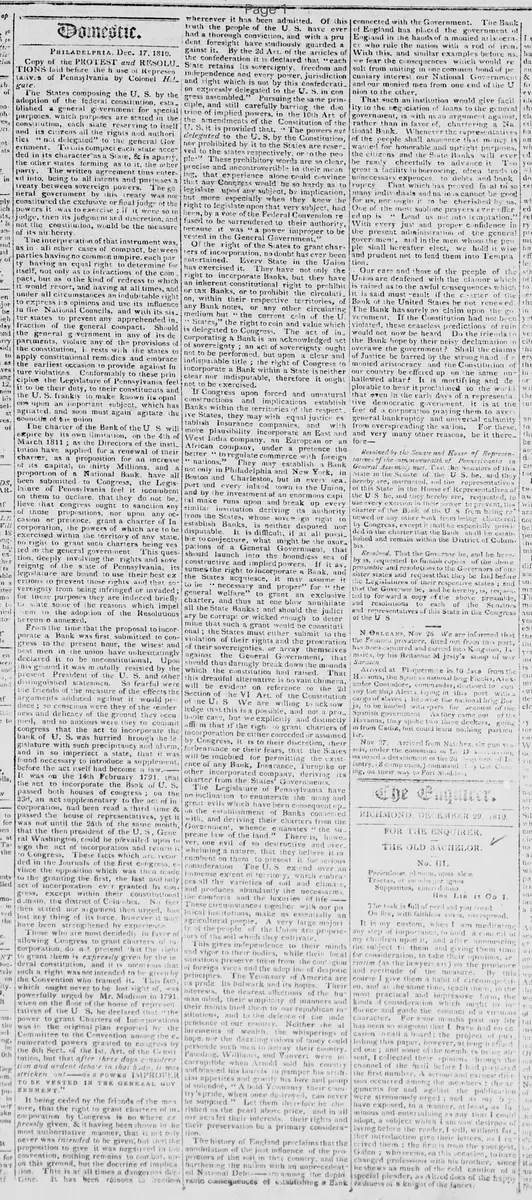
PHILADELPHIA. Dec. 17. 1810.
Copy of the PROTEST and RESOLUTIONS laid before the house of Representatives of Pennsylvania by Colonel Hopkins.
The States composing the U. S. by the adoption of the federal constitution, established a general government for special purposes, which purposes are stated in the constitution, each state reserving to itself and its citizens all the rights and authorities "not delegated" to the general Government. To this Compact each state acceded in its character as a State, &c. is a party, the other states forming as to it, the other party. The written agreement thus entered into, being to all intents and purposes a treaty between sovereign powers. The general government by this treaty was not constituted the exclusive or final judge of the powers it was to exercise; if it were so to judge, then its judgment and discretion, and not the constitution, would be the measure of its authority.
The interpretation of that instrument was, as in all other cases of compact, between parties having no common umpire, each party having an equal right to determine for itself, not only as to infractions of the compact, but as to the kind of redress to which it would resort, and having at all times, and under all circumstances an indubitable right to express its opinions and use its influence in the National Councils, and with its sister states to prevent any apprehended infraction of the general compact. Should the general government in any of its departments, violate any of the provisions of the constitution, it rests with the states to apply constitutional remedies and embrace the earliest occasion to provide against future violations. Conformably to these principles the Legislature of Pennsylvania feel it to be their duty, to their constituents and the U. S. frankly to make known its opinions upon an important subject, which has agitated, and soon must again agitate, the councils of the union.
The charter of the Bank of the U S will expire by its own limitation, on the 4th of March 1811; as the Directors of the institution have applied for a renewal of their charter, as a proposition for an increase of its capital, to thirty Millions, and a proportion of a National Bank, have all been submitted to Congress, the Legislature of Pennsylvania feel it incumbent on them to declare, that they do not believe that congress ought to sanction any of those propositions, nor upon any occasion or pretence, grant a charter of Incorporation, the powers of which are to be exercised within the territory of any state, no right to grant such charters being vested in the general government. This question, deeply involving the rights and sovereignty of the state of Pennsylvania, its legislature are bound to use their best exertions to prevent those rights and that sovereignty from being infringed or invaded; for these purposes they are induced briefly to state some of the reasons which impel them to the adoption of the Resolutions hereunto annexed.
From the time that the proposal to incorporate a Bank was first submitted to congress to the present hour, the wisest and best men in the union have unhesitatingly declared it to be unconstitutional. Upon this ground it was manfully resisted by the present President of the U. S. and other distinguished statesmen. So fearful were the friends of the measure of the effects the arguments adduced against it would produce; so conscious were they of the tenderness and delicacy of the ground they occupied, and so anxious were they to commit congress that the act to incorporate the bank of U. S. was hurried through the legislature with such precipitancy and alarm, and in so imperfect a state, that it was found necessary to introduce a supplement, before the act itself had become a law.—
It was on the 14th February 1791, that the act to incorporate the Bank of U. S. passed both houses of congress; on the 23d, an act supplementary to the act of incorporation, had been read a third time & passed the house of representatives, yet it was not until the 25th of the same month, that the then president of the U. S. General Washington, could be prevailed upon to sign the act of incorporation and return it to Congress. These facts which are recorded in the Journals of the first Congress, evince the opposition which was then made to the granting the first, the last and only act of incorporation ever granted by Congress, except within their constitutional domain, the district of Columbia. No fact then stated nor argument then urged, has lost anything of its force, however it may have been strengthened by experience.
Those who are most decided in favor of allowing Congress to grant charters of corporation, do not pretend that the right to grant them is expressly given by the federal constitution, and it is notorious that such a right was not intended to be given by the Convention who framed it. This fact, which ought never to be lost sight of, was powerfully urged by Mr. Madison in 1791 when on the floor of the house of representatives of the U S. he declared that "the power to grant Charters of Incorporations was in the original plan reported by the Committee to the Convention among the enumerated powers granted to congress by the 8th Sect. of the 1st. Art. of the Constitution, but that after three days consideration and ardent debate in that body, it was stricken out—as a power IMPROPER TO BE VESTED IN THE GENERAL GOVERNMENT."
It being ceded by the friends of the measure, that the right to grant charters of Incorporation by Congress is no where expressly given,' & it having been shown in the most authoritative manner, that it not only never was intended to be given, but that the proposition to give it was negatived in the convention, nothing remains to combat, on this ground, but the doctrine of implication. This is at all times a dangerous doctrine. it has been ruinous wherever it has been admitted. Of this truth the people of the U. S. have ever had a thorough conviction, and with a prudent foresight have studiously guarded against it. By the 2d Art. of the articles of the confederation it is declared that "each State retains its sovereignty, freedom and independence and every power, jurisdiction and right which is not by this confederation expressly delegated to the U. S. in congress assembled." Pursuing the same principle, and still carefully barring the doctrine of implied powers, in the 10th Art of the amendments of the Constitution of the U. S. it is provided that, "The powers not delegated to the U. S. by the Constitution, nor prohibited by it to the States are reserved to the states respectively, or to the people." These prohibitory words are so clear, precise and uncontrovertible in their meaning, that experience alone could convince that any Congress would be so hardy as to legislate upon any subject, by implication, but more especially when they knew the right to legislate upon that very subject, had been, by a vote of the Federal Convention refused to be surrendered to their authority, because it was "a power improper to be vested in the General Government."
Of the right of the States to grant charters of incorporation, no doubt has ever been entertained. Every State in the Union has exercised it. They have not only the right to incorporate Banks, but they have an inherent constitutional right to prohibit or tax Banks, or to prohibit the circulation, within their respective territories, of any Bank notes, or any other circulating medium but "the current coin of the U. States," the right to coin and value which is delegated to Congress. The act of incorporating a Bank is an acknowledged act of sovereignty; an act of sovereignty ought not to be performed, but upon a clear and indisputable title; the right of Congress to incorporate a Bank within a State is neither clear nor indisputable, therefore it ought not to be exercised.
If Congress upon forced and unnatural constructions and implications establish Banks within the territories of the respective States, they may with equal justice establish Insurance companies, and with more plausibility incorporate an East and West India company, an European or an African company, under a pretence the better "to regulate commerce with foreign nations." They may establish a Bank not only in Philadelphia and New York, in Boston and Charleston, but in every seaport and every inland town in the Union, and by the investment of an enormous capital make runs upon and break up every similar institution deriving its authority from the States, whose sovereign right to establish Banks, is neither disputed nor disputable. It is difficult, if at all possible, to conjecture, what might be the usurpations of a General Government, that should launch into the boundless sea of constructive and implied powers. If it assumes the right to incorporate a Bank, and the States acquiesce, it may assume it to be … necessary and proper" for "the general welfare" to grant an exclusive charter, and thus at one blow annihilate all the State Banks: and should the judiciary be corrupt or wicked enough to determine that such a grant would be constitutional; the States must either submit to the violation of their rights and the prostration of their sovereignties, or array themselves against the General Government, that should thus daringly break down the mounds which the constitution had raised. That this dreadful alternative is no vain chimera, will be evident on reference to the 2d Section of the VI Art. of the Constitution of the U. S. We are willing to acknowledge that this is a possible, and not a probable case, but we explicitly and distinctly affirm that if the right to grant charters of incorporation be either conceded or assumed by Congress, it is to their discretion, their forbearance or their fears, that the States will be indebted for permitting the existence of any Bank, Insurance, Turnpike or other incorporated company, deriving its charter from the States' Governments.
The Legislature of Pennsylvania have no inclination to enumerate the many and great evils which have been consequent upon the establishment of Banks connected with, and deriving their charters from the Government, whence emanates "the supreme law of the land." There is, however, one evil of so destructive and overwhelming a nature, that they believe it incumbent on them to present it for serious consideration. The U. S. extend over an immense extent of territory, which embraces all the varieties of soil and climate, and produces abundantly the necessaries, the comforts and the luxuries of life— These circumstances together with our political institutions, make us essentially an agricultural people. A very large majority of the people of the Union are proprietors of the soil which they cultivate. This gives independence to their minds and vigor to their bodies, while their local situations preserve them from the contagion of foreign vices and the adoption of despotic principles. The Yeomanry of America are its pride, its bulwark and its hopes. Their interests, the dearest affections of the human mind, their simplicity of manners and their habits bind them to our republican institutions, and to the defence of the independence of our country. Neither the allurements of wealth, the whisperings of hope nor the dazzling visions of fancy could persuade such men to betray their country. Paulding, Williams, and Vanwert were incorruptible when Arnold sold his country and bartered his laurels to pamper his archias appetites and gratify his love and pomp of splendor, "A bold Yeomanry, their Country's pride, when once destroyed, can never be supplied." Let them therefore be cherished as the pearl above price, and in all our acts let their interests, their rights and their preservation be a primary consideration.
The history of England proclaims that the annihilation of the just influence of the proprietors of the soil in that Country, and the burdening the nation with an unprecedented National Debt—stream among the deplorable Consequences of establishing a Bank connected with the Government. The Bank of England has placed the government of England in the hands of a monied aristocracy who rule the nation with a rod of iron. With this, and similar examples before us, we fear the consequences which would result from uniting in one common bond of pecuniary interest our National Government and our monied men from one end of the Union to the other.
That such an institution would give facility to the negociation of loans to the general government, is with us an argument against, rather than in favor of, chartering a National Bank. Whenever the representatives of the people shall announce that money is wanted for honorable and upright purposes, the citizens and the State Banks will ever be ready cheerfully to advance it. Too great a facility in borrowing, often leads to unnecessary expences, to debts and bankruptcy. That which has proved fatal to so many individuals and nations cannot be good for us, nor ought it to be cherished by us.
One of the most sublime prayers ever offered up is "Lead us not into temptation." With every just and proper confidence in the present administration of the general government, and in the men whom the people shall hereafter elect, we hold it wise and prudent not to lead them into Temptation.
Our ears and those of the people of the Union are deafened with the clamor which is raised as to the awful consequences which, it is said must result if the charter of the Bank of the United States be not renewed. The Bank has surely no claim upon the government. If the Constitution had not been violated, these ceaseless predictions of ruin would not now be heard. Do the friends to the Bank hope by their noisy declamation to overawe the government? Shall the claims of Justice be barred by the strong hand of monied aristocracy and the Constitution of our country be offered up on the same unhallowed altar? It is mortifying and deplorable to hear it proclaimed to the world that even in the early days of a representative democratic government, it is at the feet of a corporation playing them to avert general bankruptcy and universal calamity from overspreading the nation.
For these, and very many other reasons, be it therefore—
Resolved by the Senate and House of Representatives of the commonwealth of Pennsylvania in General Assembly met, That the Senators of this State in the Senate of the U S. be, and they hereby are, instructed, and the representatives of this State in the House of Representatives of the U S be, and they hereby are, requested, to use every exertion in their power to prevent, the charter of the Bank of the U S from being renewed or any other bank from being chartered by Congress, except it shall be especially provided in the charter that the Bank shall be established and remain within the District of Columbia.
Resolved, That the Governor be, and he hereby is, requested to furnish copies of the above preamble and resolutions to the Governors of our sister states and request that they be laid before the Legislatures of their respective states; and that the Governor be, and he hereby, is, requested to forward a copy of the above preamble, and resolutions to each of the Senators and representatives of this State in the Congress of the U S.
What sub-type of article is it?
What keywords are associated?
What entities or persons were involved?
Where did it happen?
Domestic News Details
Primary Location
Philadelphia, Pennsylvania
Event Date
Dec. 17, 1810
Key Persons
Outcome
the pennsylvania legislature adopted resolutions instructing its u.s. senators to oppose renewal of the bank of the united states charter and requesting the governor to distribute copies to other states and congressional delegation.
Event Details
Colonel Hopkins presented a detailed protest to the Pennsylvania House of Representatives arguing that the federal government lacks constitutional authority to charter banks within state territories, citing historical opposition, implied powers doctrine risks, threats to state sovereignty, and potential economic harms to agriculture and yeomanry. The document concludes with resolutions against renewal unless confined to the District of Columbia.