Thank you for visiting SNEWPapers!
Sign up free
Story
February 27, 1856
Washington Telegraph
Washington, Hempstead County, Arkansas
What is this article about?
Russian Lt. Wrangel discovered the open Circumpolar Sea around 1824 by sled from Siberia's northern coast to 82°N, finding shallow mud-bottom waters and milder climate; compared to Dr. Kane's sighting.
Clipping
OCR Quality
98%
Excellent
Full Text
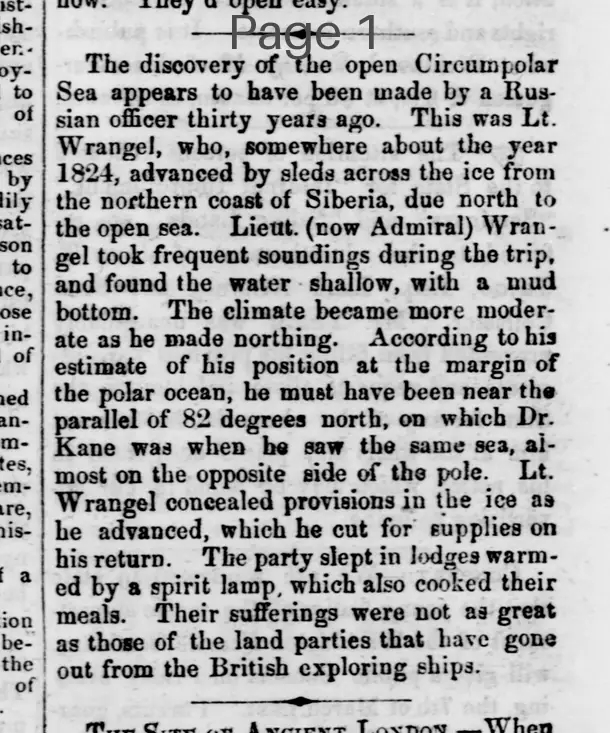
The discovery of the open Circumpolar Sea appears to have been made by a Russian officer thirty years ago. This was Lt. Wrangel, who, somewhere about the year 1824, advanced by sleds across the ice from the northern coast of Siberia, due north to the open sea. Lieut. (now Admiral) Wrangel took frequent soundings during the trip, and found the water shallow, with a mud bottom. The climate became more moderate as he made northing. According to his estimate of his position at the margin of the polar ocean, he must have been near the parallel of 82 degrees north, on which Dr. Kane was when he saw the same sea, almost on the opposite side of the pole. Lt. Wrangel concealed provisions in the ice as he advanced, which he cut for supplies on his return. The party slept in lodges warmed by a spirit lamp, which also cooked their meals. Their sufferings were not as great as those of the land parties that have gone out from the British exploring ships.
What sub-type of article is it?
Historical Event
Journey
Adventure
What themes does it cover?
Exploration
Survival
Triumph
What keywords are associated?
Circumpolar Sea Discovery
Wrangel Expedition
Polar Exploration
Sled Journey
Arctic Soundings
What entities or persons were involved?
Lt. Wrangel
Dr. Kane
Where did it happen?
Northern Coast Of Siberia To The Open Circumpolar Sea Near 82 Degrees North
Story Details
Key Persons
Lt. Wrangel
Dr. Kane
Location
Northern Coast Of Siberia To The Open Circumpolar Sea Near 82 Degrees North
Event Date
About The Year 1824
Story Details
Lt. Wrangel led a sled expedition from Siberia's northern coast across ice to the open polar sea around 1824, taking soundings of shallow mud-bottom waters, noting milder climate northward, and managing provisions and warmth with less suffering than British parties.