Thank you for visiting SNEWPapers!
Sign up free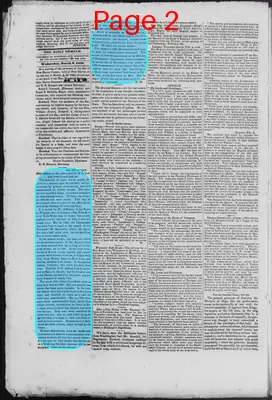
Domestic News
March 9, 1836
The Daily Herald
New Haven, New Haven County, Connecticut
What is this article about?
Observations comparing the severity of winters in 1740-41, 1779-80, and 1835-36, deeming 1779-80 the most rigorous based on ice thickness, snow depth, and weather patterns in regions like Virginia, Chesapeake, New York, and Connecticut.
Clipping
OCR Quality
95%
Excellent
Full Text
FOR THE HERALD.
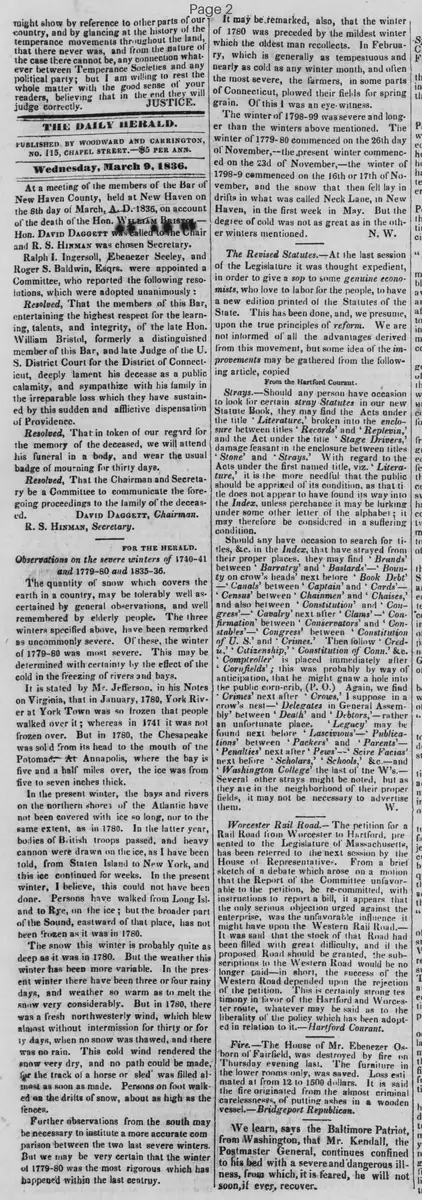
Observations on the severe winters of 1740-41, in 1779-80 and 1835-36.
The quantity of snow which covers the earth in a country, may be tolerably well ascertained by general observations, and well remembered by elderly people. The three winters specified above, have been remarked as uncommonly severe. Of these, the winter of 1779-80 was most severe. This may be determined with certainty by the effect of the cold in the freezing of rivers and bays.
It is stated by Mr. Jefferson, in his Notes on Virginia, that in January, 1780, York River at York Town was so frozen that people walked over it; whereas in 1741 it was not frozen over. But in 1780, the Chesapeake was solid from its head to the mouth of the Potomac. At Annapolis, where the bay is five and a half miles over, the ice was from five to seven inches thick.
In the present winter, the bays and rivers on the northern shores of the Atlantic have not been covered with ice so long, nor to the same extent, as in 1780. In the latter year, bodies of British troops passed, and heavy cannon were drawn on the ice, as I have been told, from Staten Island to New York, and this ice continued for weeks. In the present winter, I believe, this could not have been done. Persons have walked from Long Isl. and to Rye, on the ice; but the broader part of the Sound, eastward of that place, has not been frozen as it was in 1780.
The snow this winter is probably quite as deep as it was in 1780. But the weather this winter has been more variable. In the present winter there have been three or four rainy days, and weather so warm as to melt the snow very considerably. But in 1780, there was a fresh northwesterly wind, which blew almost without intermission for thirty or forty days, when no snow was thawed, and there was no rain. This cold wind rendered the snow very dry, and no path could be made, for the track of a horse or sled was filled almost as soon as made. Persons on foot walked on the drifts of snow, about as high as the fences.
Further observations from the south may be necessary to institute a more accurate comparison between the two last severe winters. But we may be very certain that the winter of 1779-80 was the most rigorous which has happened within the last century.
It may be remarked, also, that the winter of 1780 was preceded by the mildest winter which the oldest man recollects. In February, which is generally as tempestuous and nearly as cold as any winter month, and often the most severe, the farmers, in some parts of Connecticut, plowed their fields for spring grain. Of this I was an eye-witness.
The winter of 1798-99 was severe and longer than the winters above mentioned. The winter of 1779-80 commenced on the 26th day of November,—the present winter commenced on the 23d of November,—the winter of 1798-9 commenced on the 16th or 17th of November, and the snow that then fell lay in drifts in what was called Neck Lane, in New Haven, in the first week in May. But the degree of cold was not as great as in the other winters mentioned.
N. W.
Observations on the severe winters of 1740-41, in 1779-80 and 1835-36.
The quantity of snow which covers the earth in a country, may be tolerably well ascertained by general observations, and well remembered by elderly people. The three winters specified above, have been remarked as uncommonly severe. Of these, the winter of 1779-80 was most severe. This may be determined with certainty by the effect of the cold in the freezing of rivers and bays.
It is stated by Mr. Jefferson, in his Notes on Virginia, that in January, 1780, York River at York Town was so frozen that people walked over it; whereas in 1741 it was not frozen over. But in 1780, the Chesapeake was solid from its head to the mouth of the Potomac. At Annapolis, where the bay is five and a half miles over, the ice was from five to seven inches thick.
In the present winter, the bays and rivers on the northern shores of the Atlantic have not been covered with ice so long, nor to the same extent, as in 1780. In the latter year, bodies of British troops passed, and heavy cannon were drawn on the ice, as I have been told, from Staten Island to New York, and this ice continued for weeks. In the present winter, I believe, this could not have been done. Persons have walked from Long Isl. and to Rye, on the ice; but the broader part of the Sound, eastward of that place, has not been frozen as it was in 1780.
The snow this winter is probably quite as deep as it was in 1780. But the weather this winter has been more variable. In the present winter there have been three or four rainy days, and weather so warm as to melt the snow very considerably. But in 1780, there was a fresh northwesterly wind, which blew almost without intermission for thirty or forty days, when no snow was thawed, and there was no rain. This cold wind rendered the snow very dry, and no path could be made, for the track of a horse or sled was filled almost as soon as made. Persons on foot walked on the drifts of snow, about as high as the fences.
Further observations from the south may be necessary to institute a more accurate comparison between the two last severe winters. But we may be very certain that the winter of 1779-80 was the most rigorous which has happened within the last century.
It may be remarked, also, that the winter of 1780 was preceded by the mildest winter which the oldest man recollects. In February, which is generally as tempestuous and nearly as cold as any winter month, and often the most severe, the farmers, in some parts of Connecticut, plowed their fields for spring grain. Of this I was an eye-witness.
The winter of 1798-99 was severe and longer than the winters above mentioned. The winter of 1779-80 commenced on the 26th day of November,—the present winter commenced on the 23d of November,—the winter of 1798-9 commenced on the 16th or 17th of November, and the snow that then fell lay in drifts in what was called Neck Lane, in New Haven, in the first week in May. But the degree of cold was not as great as in the other winters mentioned.
N. W.
What sub-type of article is it?
Weather
What keywords are associated?
Severe Winters
Snow Depth
Freezing Rivers
Ice Thickness
Weather Comparison
What entities or persons were involved?
Mr. Jefferson
N. W.
Domestic News Details
Event Date
Winters Of 1740 41, 1779 80, 1835 36
Key Persons
Mr. Jefferson
N. W.
Event Details
Comparative observations on the severity of three winters, with 1779-80 noted as the most extreme due to prolonged freezing of rivers and bays, deep dry snow, and consistent cold winds; contrasts with the present winter and others like 1798-99.