Thank you for visiting SNEWPapers!
Sign up free
The Patowmac Guardian, And Berkeley Advertiser
Martinsburg, Shepherdstown, Berkeley County, Jefferson County, West Virginia
What is this article about?
In the U.S. House on March 12, T. R. Sedgwick proposes resolutions for 15 auxiliary regiments to bolster defense and enable retaliation against European powers, especially Britain, including troop enlistment, pay, arms, funding, and presidential embargo authority amid international tensions.
Clipping
OCR Quality
Full Text
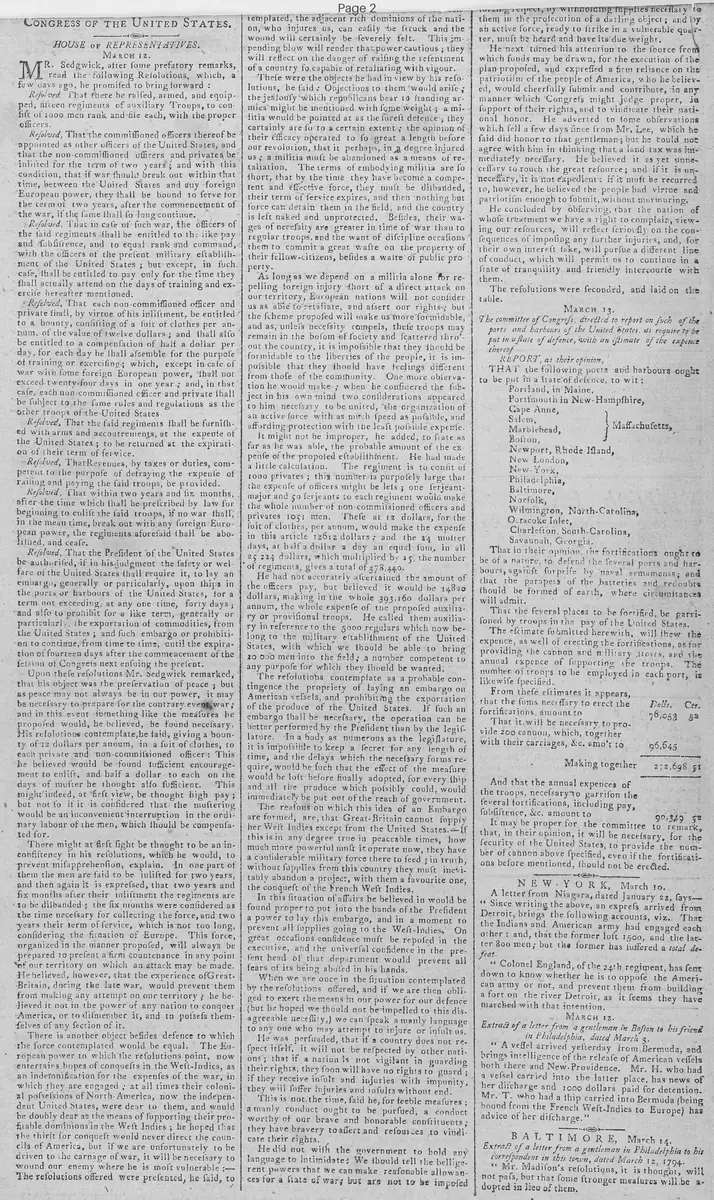
HOUSE OF REPRESENTATIVES
MARCH 12.
T. R. Sedgwick, after some prefatory remarks, read the following Resolutions, which, a few days ago, he promised to bring forward:
Resolved, that there be raised, armed, and equipped, fifteen regiments of auxiliary Troops, to consist of 1000 men rank and file each, with the proper officers.
Resolved, That the commissioned officers thereof be appointed as other officers of the United States, and that the non-commissioned officers and privates be enlisted for the term of two years: and with this condition, that if war should break out within that time, between the United States and any foreign European power, they shall be bound to serve for the term of two years, after the commencement of the war, if the same shall so long continue.
Resolved, That in case of such war, the officers of the said regiments shall be entitled to the like pay and Subsistence, and to equal rank and command, with the officers of the present military establishment of the United States: but except, in such case, shall be entitled to pay only for the time they shall actually attend on the days of training and exercise hereafter mentioned.
Resolved, That each non-commissioned officer and private shall, by virtue of his enlistment, be entitled to a bounty, consisting of a suit of clothes per annum, of the value of twelve dollars: and shall also be entitled to a compensation of half a dollar per day, for each day he shall assemble for the purpose of training or exercising: which, except in case of war with some foreign European power, shall not exceed twenty-four days in one year; and, in that case, each non-commissioned officer and private shall be subject to the same rules and regulations as the other troops of the United States.
Resolved, That the said regiments shall be furnished with arms and accoutrements, at the expense of the United States: to be returned at the expiration of their term of service.
Resolved, That Revenues, by taxes or duties, competent to the purpose of defraying the expense of raising and paying the said troops, be provided.
Resolved, That within two years and six months, after the time which shall be prescribed by law for beginning to enlist the said troops, if no war shall, in the mean time, break out with any foreign European power, the regiments aforesaid shall be abolished, and cease.
Resolved, That the President of the United States be authorized, if in his judgment the safety or welfare of the United States shall require it, to lay an embargo, generally or particularly, upon ships in the ports or harbours of the United States, for a term not exceeding, at any one time, forty days; and also to prohibit for a like term, generally or particularly, the exportation of commodities, from the United States; and such embargo or prohibition to continue, from time to time, until the expiration of fourteen days after the commencement of the session of Congress next ensuing the present.
Upon these resolutions Mr. Sedgwick remarked, that his object was the preservation of peace; but as peace may not always be in our power, it may be necessary to prepare for the contrary event, war; and in this event something like the measures he proposed would, he believed, be found necessary.
His resolutions contemplate, he said, giving a bounty of 12 dollars per annum, in a suit of clothes, to each private and non-commissioned officer: This he believed would be found sufficient encouragement to enlist, and half a dollar to each on the days of muster he thought also sufficient. This might indeed, at first view, be thought high pay; but not so if it is considered that the mustering would be an inconvenient interruption in the ordinary labour of the men, which should be compensated for.
There might at first sight be thought to be an inconsistency in his resolutions, which he would, to prevent misapprehension, explain. In one part of them the men are said to be enlisted for two years, and then again it is expressed, that two years and six months after their enlistment the regiments are to be disbanded: the six months were considered as the time necessary for collecting the force, and two years their term of service, which is not too long, considering the Situation of Europe. This force, organized in the manner proposed, will always be prepared to present a firm countenance in any point of our territory on which an attack may be made.
He believed, however, that the experience of Great-Britain, during the late war, would prevent them from making any attempt on our territory; he believed it not in the power of any nation to conquer America, or to dismember it, and to possess themselves of any section of it.
There is another object besides defence to which the force contemplated would be equal. The European power to which the resolutions point, now entertains hopes of conquests in the West-Indies, as an indemnification for the expenses of the war, in which they are engaged; at all times their colonial possessions of North-America, now the independent United States, were dear to them, and would be doubly dear as the means of supporting their profitable dominions in the West Indies; he hoped that the thirst for conquest would never direct the councils of America, but if we are unfortunately to be driven to the carnage of war, it will be necessary to wound our enemy where he is most vulnerable:--
The resolutions offered were presented, he said, to contemplated, the adjacent rich dominions of the nation, who injures us, can easily be struck and the wound will certainly be Severely felt. This impending blow will render that power cautious; they will reflect on the danger of raising the resentment of a country so capable of retaliating with vigour.
These were the objects he had in view by his resolutions, he said: Objections to them would arise; the jealousy which republicans bear to standing armies might be mentioned with some weight; a militia would be pointed at as the surest defence; they certainly are so to a certain extent; the opinion of their efficacy operated to a great a length before our revolution, that it perhaps, in a degree injured us: a militia must be abandoned as a means of retaliation. The terms of embodying militia are so short, that by the time they have become a competent and effective force, they must be disbanded, their term of service expires, and then nothing but force can detain them in the field, and the country is left naked and unprotected. Besides, their wages of necessity are greater in time of war than to regular troops, and the want of discipline occasions them to commit a great waste on the property of their fellow-citizens, besides a waste of public property.
As long as we depend on a militia alone for repelling foreign injury short of a direct attack on our territory, European nations will not consider us as able to retaliate, and assert our rights: but the scheme proposed will make us more formidable, and as, unless necessity compels, these troops may remain in the bosom of society and scattered throughout the country, it is impossible that they should be formidable to the liberties of the people, it is impossible that they should have feelings different from those of the community. One more observation he would make: when he considered the subject in his own mind two considerations appeared to him necessary to be united, the organization of an active force with as much speed as possible, and affording protection with the least possible expense.
It might not be improper, he added, to state as far as he was able, the probable amount of the expense of the proposed establishment. He had made a little calculation. The regiment is to consist of 1000 privates; this number is purposely large that the expense of officers might be less; one sergeant-major and 50 sergeants to each regiment would make the whole number of non-commissioned officers and privates 1051 men. These at 12 dollars, for the suit of clothes, per annum, would make the expense in this article 12612 dollars; and the 24 muster days, at half a dollar a day an equal sum, in all 25224 dollars, which multiplied by 15, the number of regiments, gives a total of 378,360.
He had not accurately ascertained the amount of the officers pay, but believed it would be 14800 dollars, making in the whole 393,160 dollars per annum, the whole expense of the proposed auxiliary or provisional troops. He called them auxiliary in reference to the 2000 regulars which now belong to the military establishment of the United States, with which we should be able to bring 20,000 men into the field; a number competent to any purpose for which they should be wanted.
The resolutions contemplate as a probable contingency the propriety of laying an embargo on American vessels, and prohibiting the exportation of the produce of the United States. If such an embargo shall be necessary, the operation can be better performed by the President than by the legislature. In a body as numerous as the legislature, it is impossible to keep a secret for any length of time, and the delays which the necessary forms require, would be such that the effect of the measure would be lost before finally adopted, for every ship and all the produce which possibly could, would immediately be put out of the reach of government.
The reasons on which this idea of an Embargo are formed, are, that Great-Britain cannot supply her West Indies except from the United States. If this is in any degree true in peaceable times, how much more powerful must it operate now, they have a considerable military force there to feed; in truth, without supplies from this country they must inevitably abandon a project, with them a favourite one, the conquest of the French West-Indies.
In this situation of affairs he believed it would be found proper to put into the hands of the President a power to lay this embargo, and in a moment to prevent all supplies going to the West-Indies. On great occasions confidence must be reposed in the executive, and the universal confidence in the present head of that department would prevent all fears of its being abused in his hands.
When we are once in the situation contemplated by the resolutions offered, and if we are then obliged to exert the means in our power for our defence (but he hoped we should not be impelled to this disagreeable necessity,) we can speak a manly language to any one who may attempt to injure or insult us.
He was persuaded, that if a country does not respect itself, it will not be respected by other nations; that if a nation is not vigilant in guarding their rights, they soon will have no rights to guard; if they receive insult and injuries with impunity, they will suffer injuries and insults without end.
This is not the time, said he, for feeble measures: a manly conduct ought to be pursued, a conduct worthy of our brave and honorable constituents; they have bravery to assert and resources to vindicate their rights.
He did not wish the government to hold any language to intimidate: We should tell the belligerent powers that we can make reasonable allowances for a state of war but are not to be imposed upon with disrespect, by withholding supplies necessary to them in the prosecution of a darling object; and by an active force, ready to strike in a vulnerable quarter, must be heard and have its due weight.
He next turned his attention to the source from which funds may be drawn, for the execution of the plan proposed, and expressed a firm reliance on the patriotism of the people of America, who he believed, would cheerfully submit and contribute, in any manner which Congress might judge proper, to support of their rights, and to vindicate their national honor. He adverted to some observations which fell a few days since from Mr. Lee, which he said did honor to that gentleman: but he could not agree with him in thinking that a land tax was immediately necessary. He believed it as yet unnecessary to touch the great resource; and if it is necessary, it is not expedient: If it must be recurred to, however, he believed the people had virtue and patriotism enough to submit, without murmuring.
He concluded by observing, that the nation of whose treatment we have a right to complain, viewing our resources, will reflect seriously on the consequences of imposing any further injuries, and, for their own interest sake, will pursue a different line of conduct, which will permit us to continue in a state of tranquility and friendly intercourse with them.
The resolutions were seconded, and laid on the table.
What sub-type of article is it?
What themes does it cover?
What keywords are associated?
What entities or persons were involved?
Where did it happen?
Story Details
Key Persons
Location
House Of Representatives, United States
Event Date
March 12
Story Details
T. R. Sedgwick presents resolutions to raise 15 regiments of auxiliary troops for two years, with provisions for war extension, pay, and embargo powers to the President, aimed at national defense and retaliation against European powers like Britain to protect U.S. interests and deter aggression.