Thank you for visiting SNEWPapers!
Sign up free
Editorial
January 23, 1788
The Daily Advertiser
New York, New York County, New York
What is this article about?
Federalist No. 40 defends the U.S. Constitution's provisions limiting army funding to two years, necessity of naval power, militia regulation, and broad taxation authority. It refutes Anti-Federalist objections by contrasting with British practices and emphasizing safeguards against abuse.
Clipping
OCR Quality
95%
Excellent
Full Text
For the Daily Advertiser.
The FEDERALIST, No. XL.
(Concluded from yesterday's Paper.)
To the People of the State of New-York.
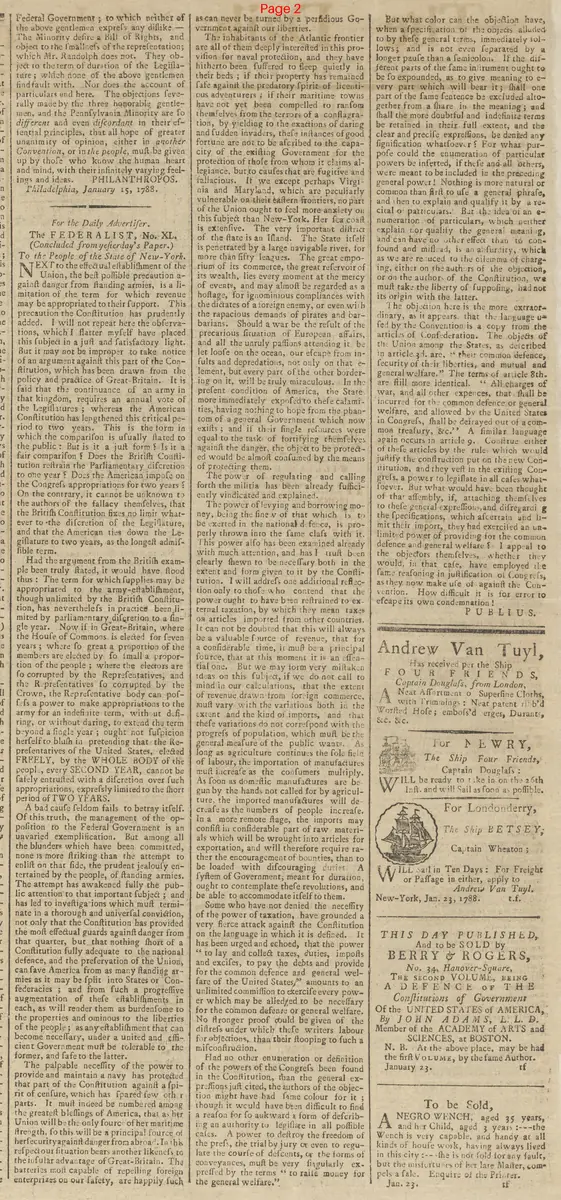
Next to the effectual establishment of the Union, the best possible precaution against danger from standing armies, is a limitation of the term for which revenue may be appropriated to their support. This precaution the Constitution has prudently added. I will not repeat here the observations, which I flatter myself have placed this subject in a just and satisfactory light. But it may not be improper to take notice of an argument against this part of the Constitution, which has been drawn from the policy and practice of Great-Britain. It is said that the continuance of an army in that kingdom, requires an annual vote of the Legislature; whereas the American Constitution has lengthened this critical period to two years. This is the form in which the comparison is usually stated to the public: But is it a just form? Is it a fair comparison? Does the British Constitution restrain the Parliamentary discretion to one year? Does the American impose on the Congress appropriations for two years? On the contrary, it cannot be unknown to the authors of the fallacy themselves, that the British Constitution fixes no limit whatever to the discretion of the Legislature, and that the American ties down the Legislature to two years, as the longest admissible term. Had the argument from the British example been truly stated, it would have stood thus: The term for which supplies may be appropriated to the army-establishment, though unlimited by the British Constitution, has nevertheless in practice been limited by parliamentary discretion to a single year. Now if in Great-Britain, where the House of Commons is elected for seven years; where so great a proportion of the members are elected by so small a proportion of the people; where the electors are so corrupted by the Representatives, and the Representatives so corrupted by the Crown, the Representative body can possess a power to make appropriations to the army for an indefinite term, without desiring, or without daring, to extend the term beyond a single year; ought not suspicion herself to blush in pretending that the Representatives of the United States, elected freely, by the WHOLE BODY of the people, every SECOND YEAR, cannot be safely entrusted with a discretion over such appropriations, expressly limited to the short period of TWO YEARS. A bad cause seldom fails to betray itself. Of this truth, the management of the opposition to the Federal Government is an unvaried exemplification. But among all the blunders which have been committed, none is more striking than the attempt to enlist on that side, the prudent jealousy entertained by the people, of standing armies. The attempt has awakened fully the public attention to that important subject; and has led to investigations which must terminate in a thorough and universal conviction, not only that the Constitution has provided the most effectual guards against danger from that quarter, but that nothing short of a Constitution fully adequate to the national defence, and the preservation of the Union, can save America from as many standing armies as it may be split into States or Confederacies; and from such a progressive augmentation of these establishments in each, as will render them as burdensome to the properties and ominous to the liberties of the people; as any establishment that can become necessary, under a united and efficient Government must be tolerable to the former, and safe to the latter. The palpable necessity of the power to provide and maintain a navy has protected that part of the Constitution against a spirit of censure, which has spared few other parts. It must indeed be numbered among the greatest blessings of America, that as her Union will be the only source of her maritime strength, so this will be a principal source of her security against danger from abroad. In this respect our situation bears another likeness to the insular advantage of Great-Britain. The batteries most capable of repelling foreign enterprises on our safety, are happily such as can never be turned by a perfidious Government against our liberties. The inhabitants of the Atlantic frontier are all of them deeply interested in this provision for naval protection, and they have hitherto been suffered to sleep quietly in their beds; if their property has remained safe against the predatory spirit of licentious adventurers; if their maritime towns have not yet been compelled to ransom themselves from the terrors of a conflagration, by yielding to the exactions of daring and sudden invaders, these instances of good fortune are not to be ascribed to the capacity of the existing Government for the protection of those from whom it claims allegiance, but to causes that are fugitive and fallacious. If we except perhaps Virginia and Maryland, which are peculiarly vulnerable on their eastern frontiers, no part of the Union ought to feel more anxiety on this subject than New-York. Her sea coast is extensive. The very important district of the state is an Island. The State itself is penetrated by a large navigable river, for more than fifty leagues. The great emporium of its commerce, the great reservoir of its wealth, lies every moment at the mercy of events, and may almost be regarded as a hostage, for ignominious compliances with the dictates of a foreign enemy, or even with the rapacious demands of pirates and barbarians. Should a war be the result of the precarious situation of European affairs, and all the unruly passions attending it be let loose on the ocean, our escape from insults and depredations, not only on that element, but every part of the other bordering on it, will be truly miraculous. In the present condition of America, the States more immediately exposed to these calamities, having nothing to hope from the phantom of a general Government which now exists; and if their single resources were equal to the task of fortifying themselves against the danger, the object to be protected would be almost consumed by the means of protecting them. The power of regulating and calling forth the militia has been already sufficiently vindicated and explained. The power of levying and borrowing money, being the sinew of that which is to be exerted in the national defence, is properly thrown into the same class with it. This power also has been examined already with much attention, and has I trust been clearly shewn to be necessary both in the extent and form given to it by the Constitution. I will address one additional reflection only to those who contend that the power ought to have been restrained to external taxation, by which they mean taxes on articles imported from other countries. It cannot be doubted that this will always be a valuable source of revenue, that for a considerable time, it must be a principal source, that at this moment it is an essential one. But we may form very mistaken ideas on this subject, if we do not call to mind in our calculations, that the extent of revenue drawn from foreign commerce, must vary with the variations both in the extent and the kind of imports, and that these variations do not correspond with the progress of population, which must be the general measure of the public wants. As long as agriculture continues the sole field of labour, the importation of manufactures must increase as the consumers multiply. As soon as domestic manufactures are begun by the hands not called for by agriculture, the imported manufactures will decrease as the numbers of people increase. In a more remote stage, the imports may consist in considerable part of raw materials which will be wrought into articles for exportation, and will therefore require rather the encouragement of bounties, than to be loaded with discouraging duties. A system of Government, meant for duration, ought to contemplate these revolutions, and be able to accommodate itself to them. Some who have not denied the necessity of the power of taxation, have grounded a very fierce attack against the Constitution, on the language in which it is defined. It has been urged and echoed, that the power "to lay and collect taxes, duties, imposts and excises, to pay the debts and provide for the common defence and general welfare of the United States" amounts to an unlimited commission to exercise every power which may be alleged to be necessary for the common defence or general welfare. No stronger proof could be given of the distresses under which these writers labour for objections, than their stooping to such a misconstruction. Had no other enumeration or definition of the powers of the Congress been found in the Constitution, than the general expressions just cited, the authors of the objection might have had some colour for it; though it would have been difficult to find a reason for so awkward a form of describing an authority to legislate in all possible cases. A power to destroy the freedom of the press, the trial by jury or even to regulate the course of descents, or the forms of conveyances, must be very singularly expressed by the terms "to raise money for the general welfare." But what color can the objection have, when a specification of the objects alluded to by these general terms, immediately follows, and is not even separated by a longer pause than a semicolon. If the different parts of the same instrument ought to be so expounded, as to give meaning to every part which will bear it; shall one part of the same sentence be excluded altogether from a share in the meaning; and shall the more doubtful and indefinite terms be retained in their full extent, and the clear and precise expressions, be denied any signification whatsoever? For what purpose could the enumeration of particular powers be inserted, if these and all others, were meant to be included in the preceding general power! Nothing is more natural or common than first to use a general phrase, and then to explain and qualify it by a recital of particulars. But the idea of an enumeration of particulars, which neither explain nor qualify the general meaning, and can have no other effect than to confound and mislead, is an absurdity, which as we are reduced to the dilemma of charging, either on the authors of the objection, or on the authors of the Constitution, we must take the liberty of supposing, had not its origin with the latter. The objection here is the more extraordinary, as it appears, that the language used by the Convention is a copy from the articles of Confederation. The objects of the Union among the States, as described in article 3d. are, "their common defence, security of their liberties, and mutual and general welfare." The terms of article 8th. are still more identical. "All charges of war, and all other expences, that shall be incurred for the common defence or general welfare, and allowed by the United States in Congress, shall be defrayed out of a common treasury, &c." A similar language again occurs in article 9. Construing either of these articles by the rule which would justify the construction put on the new Constitution, and they vest in the existing Congress, a power to legislate in all cases whatsoever. But what would have been thought of that assembly, if, attaching themselves to these general expressions, and disregarding the specifications, which ascertain and limit their import, they had exercised an unlimited power of providing for the common defence and general welfare? I appeal to the objectors themselves, whether they would, in that case, have employed the same reasoning in justification of Congress; as they now make use of against the Convention. How difficult it is for error to escape its own condemnation!
PUBLIUS.
The FEDERALIST, No. XL.
(Concluded from yesterday's Paper.)
To the People of the State of New-York.
Next to the effectual establishment of the Union, the best possible precaution against danger from standing armies, is a limitation of the term for which revenue may be appropriated to their support. This precaution the Constitution has prudently added. I will not repeat here the observations, which I flatter myself have placed this subject in a just and satisfactory light. But it may not be improper to take notice of an argument against this part of the Constitution, which has been drawn from the policy and practice of Great-Britain. It is said that the continuance of an army in that kingdom, requires an annual vote of the Legislature; whereas the American Constitution has lengthened this critical period to two years. This is the form in which the comparison is usually stated to the public: But is it a just form? Is it a fair comparison? Does the British Constitution restrain the Parliamentary discretion to one year? Does the American impose on the Congress appropriations for two years? On the contrary, it cannot be unknown to the authors of the fallacy themselves, that the British Constitution fixes no limit whatever to the discretion of the Legislature, and that the American ties down the Legislature to two years, as the longest admissible term. Had the argument from the British example been truly stated, it would have stood thus: The term for which supplies may be appropriated to the army-establishment, though unlimited by the British Constitution, has nevertheless in practice been limited by parliamentary discretion to a single year. Now if in Great-Britain, where the House of Commons is elected for seven years; where so great a proportion of the members are elected by so small a proportion of the people; where the electors are so corrupted by the Representatives, and the Representatives so corrupted by the Crown, the Representative body can possess a power to make appropriations to the army for an indefinite term, without desiring, or without daring, to extend the term beyond a single year; ought not suspicion herself to blush in pretending that the Representatives of the United States, elected freely, by the WHOLE BODY of the people, every SECOND YEAR, cannot be safely entrusted with a discretion over such appropriations, expressly limited to the short period of TWO YEARS. A bad cause seldom fails to betray itself. Of this truth, the management of the opposition to the Federal Government is an unvaried exemplification. But among all the blunders which have been committed, none is more striking than the attempt to enlist on that side, the prudent jealousy entertained by the people, of standing armies. The attempt has awakened fully the public attention to that important subject; and has led to investigations which must terminate in a thorough and universal conviction, not only that the Constitution has provided the most effectual guards against danger from that quarter, but that nothing short of a Constitution fully adequate to the national defence, and the preservation of the Union, can save America from as many standing armies as it may be split into States or Confederacies; and from such a progressive augmentation of these establishments in each, as will render them as burdensome to the properties and ominous to the liberties of the people; as any establishment that can become necessary, under a united and efficient Government must be tolerable to the former, and safe to the latter. The palpable necessity of the power to provide and maintain a navy has protected that part of the Constitution against a spirit of censure, which has spared few other parts. It must indeed be numbered among the greatest blessings of America, that as her Union will be the only source of her maritime strength, so this will be a principal source of her security against danger from abroad. In this respect our situation bears another likeness to the insular advantage of Great-Britain. The batteries most capable of repelling foreign enterprises on our safety, are happily such as can never be turned by a perfidious Government against our liberties. The inhabitants of the Atlantic frontier are all of them deeply interested in this provision for naval protection, and they have hitherto been suffered to sleep quietly in their beds; if their property has remained safe against the predatory spirit of licentious adventurers; if their maritime towns have not yet been compelled to ransom themselves from the terrors of a conflagration, by yielding to the exactions of daring and sudden invaders, these instances of good fortune are not to be ascribed to the capacity of the existing Government for the protection of those from whom it claims allegiance, but to causes that are fugitive and fallacious. If we except perhaps Virginia and Maryland, which are peculiarly vulnerable on their eastern frontiers, no part of the Union ought to feel more anxiety on this subject than New-York. Her sea coast is extensive. The very important district of the state is an Island. The State itself is penetrated by a large navigable river, for more than fifty leagues. The great emporium of its commerce, the great reservoir of its wealth, lies every moment at the mercy of events, and may almost be regarded as a hostage, for ignominious compliances with the dictates of a foreign enemy, or even with the rapacious demands of pirates and barbarians. Should a war be the result of the precarious situation of European affairs, and all the unruly passions attending it be let loose on the ocean, our escape from insults and depredations, not only on that element, but every part of the other bordering on it, will be truly miraculous. In the present condition of America, the States more immediately exposed to these calamities, having nothing to hope from the phantom of a general Government which now exists; and if their single resources were equal to the task of fortifying themselves against the danger, the object to be protected would be almost consumed by the means of protecting them. The power of regulating and calling forth the militia has been already sufficiently vindicated and explained. The power of levying and borrowing money, being the sinew of that which is to be exerted in the national defence, is properly thrown into the same class with it. This power also has been examined already with much attention, and has I trust been clearly shewn to be necessary both in the extent and form given to it by the Constitution. I will address one additional reflection only to those who contend that the power ought to have been restrained to external taxation, by which they mean taxes on articles imported from other countries. It cannot be doubted that this will always be a valuable source of revenue, that for a considerable time, it must be a principal source, that at this moment it is an essential one. But we may form very mistaken ideas on this subject, if we do not call to mind in our calculations, that the extent of revenue drawn from foreign commerce, must vary with the variations both in the extent and the kind of imports, and that these variations do not correspond with the progress of population, which must be the general measure of the public wants. As long as agriculture continues the sole field of labour, the importation of manufactures must increase as the consumers multiply. As soon as domestic manufactures are begun by the hands not called for by agriculture, the imported manufactures will decrease as the numbers of people increase. In a more remote stage, the imports may consist in considerable part of raw materials which will be wrought into articles for exportation, and will therefore require rather the encouragement of bounties, than to be loaded with discouraging duties. A system of Government, meant for duration, ought to contemplate these revolutions, and be able to accommodate itself to them. Some who have not denied the necessity of the power of taxation, have grounded a very fierce attack against the Constitution, on the language in which it is defined. It has been urged and echoed, that the power "to lay and collect taxes, duties, imposts and excises, to pay the debts and provide for the common defence and general welfare of the United States" amounts to an unlimited commission to exercise every power which may be alleged to be necessary for the common defence or general welfare. No stronger proof could be given of the distresses under which these writers labour for objections, than their stooping to such a misconstruction. Had no other enumeration or definition of the powers of the Congress been found in the Constitution, than the general expressions just cited, the authors of the objection might have had some colour for it; though it would have been difficult to find a reason for so awkward a form of describing an authority to legislate in all possible cases. A power to destroy the freedom of the press, the trial by jury or even to regulate the course of descents, or the forms of conveyances, must be very singularly expressed by the terms "to raise money for the general welfare." But what color can the objection have, when a specification of the objects alluded to by these general terms, immediately follows, and is not even separated by a longer pause than a semicolon. If the different parts of the same instrument ought to be so expounded, as to give meaning to every part which will bear it; shall one part of the same sentence be excluded altogether from a share in the meaning; and shall the more doubtful and indefinite terms be retained in their full extent, and the clear and precise expressions, be denied any signification whatsoever? For what purpose could the enumeration of particular powers be inserted, if these and all others, were meant to be included in the preceding general power! Nothing is more natural or common than first to use a general phrase, and then to explain and qualify it by a recital of particulars. But the idea of an enumeration of particulars, which neither explain nor qualify the general meaning, and can have no other effect than to confound and mislead, is an absurdity, which as we are reduced to the dilemma of charging, either on the authors of the objection, or on the authors of the Constitution, we must take the liberty of supposing, had not its origin with the latter. The objection here is the more extraordinary, as it appears, that the language used by the Convention is a copy from the articles of Confederation. The objects of the Union among the States, as described in article 3d. are, "their common defence, security of their liberties, and mutual and general welfare." The terms of article 8th. are still more identical. "All charges of war, and all other expences, that shall be incurred for the common defence or general welfare, and allowed by the United States in Congress, shall be defrayed out of a common treasury, &c." A similar language again occurs in article 9. Construing either of these articles by the rule which would justify the construction put on the new Constitution, and they vest in the existing Congress, a power to legislate in all cases whatsoever. But what would have been thought of that assembly, if, attaching themselves to these general expressions, and disregarding the specifications, which ascertain and limit their import, they had exercised an unlimited power of providing for the common defence and general welfare? I appeal to the objectors themselves, whether they would, in that case, have employed the same reasoning in justification of Congress; as they now make use of against the Convention. How difficult it is for error to escape its own condemnation!
PUBLIUS.
What sub-type of article is it?
Constitutional
Military Affairs
Economic Policy
What keywords are associated?
Federalist Papers
Standing Armies
Naval Power
Taxation Authority
Constitutional Safeguards
National Defense
British Comparison
What entities or persons were involved?
Publius
British Constitution
House Of Commons
Congress
Articles Of Confederation
Editorial Details
Primary Topic
Defense Of Constitutional Provisions On Armies, Navy, Militia, And Taxation Against Anti Federalist Objections
Stance / Tone
Strongly Pro Constitution, Refuting Opposition Arguments
Key Figures
Publius
British Constitution
House Of Commons
Congress
Articles Of Confederation
Key Arguments
Constitution Limits Army Funding To Two Years, Safer Than Unlimited British Practice Given Freer U.S. Elections.
Opposition Misuses Fears Of Standing Armies; Constitution Provides Best Guards Against Them.
Naval Power Essential For Maritime Security, Especially For States Like New York.
Broad Taxation Power Necessary As Import Duties Vary And Cannot Always Meet Needs.
General Welfare Clause Does Not Grant Unlimited Power; It Is Limited By Enumerated Powers, Mirroring Articles Of Confederation.