Thank you for visiting SNEWPapers!
Sign up free
The Augusta Courier
Augusta, Richmond County, Georgia
What is this article about?
In a March 19, 1957, speech, Congressman Jim Davis of Georgia criticizes the U.S. Supreme Court for destroying public confidence in courts by overreaching into state jurisdictions. He highlights rebukes from supreme courts in Georgia, Florida, and Virginia in cases involving a murder conviction, interracial marriage annulment, and Negro admission to law school, arguing the Court imposes its social philosophy unlawfully.
Merged-components note: Merged story starting on page 4 continuing to page 2 based on explicit 'Continued from Page 4' and 'Continued on Page 2' indicators. UUIDs ordered by logical reading flow: page 4 start first, then page 2 continuation. Note: page 4 component includes additional text from editorial continuation due to initial parsing of multiple columns into one component.
Clippings
1 of 2
OCR Quality
Full Text
Congressman Davis Reviews Resentment Shown By Judges In 3 Southern States
Congressman Jim Davis, of Georgia, says that the Supreme Court of the United States is surely destroying the confidence of the people in the courts.
Not only is the Court destroying the confidence of the people in general, but also of the Members of Congress and the judges of other courts.
He made this statement in a speech delivered on the floor of the House of Representatives in Washington on March 19, 1957.
Court Been Rebuked
He called the Congress' attention to the fact that the Supreme Courts of Georgia, Florida and Virginia had recently rebuked the Supreme Court of the United States and that District Judges of the Supreme Court have done likewise.
In this connection, Davis said:
The decisions of our present Supreme Court are slowly but surely destroying this confidence of the people and their elected representatives as well as the subordinate judicial bodies of this country.
Evidence is daily accumulating that serious, patriotic Americans are finding it impossible to accept the efforts of the Court to usurp the power of the other constitutional bodies of our Government.
More and more we find the challenge to the Supreme Court's invasion of reserved powers and its bare grab for power being shouldered by those instruments of Government closest to the people.
Not only is the Court's unwarranted attempt to impose its social philosophy upon the people by its decisions and orders being resisted by individuals and groups, but also by legislative bodies and our State courts.
State Court Decision
I was impressed by the latest State court decision which found it necessary to deny the Supreme Court the authority to invade its jurisdiction. I refer to the decision of the State Supreme Court of Florida announced March 8, 1957.
This is the third State supreme court in the recent past that has found it necessary to reject an opinion of the United States Supreme Court, which had, by a most unique and possibly illegal means, tried to usurp the power of a jurisdiction reserved to another branch of our Government, that of the right of a State court to control its own discretionary process.
The first case in which a State court found it necessary to deliver a stinging, but merited, rebuke to the Supreme Court for unauthorized meddling in the affairs of the State was in the Supreme Court of the State of Georgia. In this case, Williams against State of Georgia, the Supreme Court attempted to invade the jurisdiction of the State courts in a matter strictly reserved for State determination.
Convicted of Murder
The case involved a Negro who had been convicted of murder by a jury and sentenced to death by the trial court. After sentence was imposed the defendant filed a formal motion for a new trial, which was later amended, and then overruled. Exceptions were filed; the Supreme Court of Georgia affirmed the conviction, and the defendant was again sentenced to death. At this stage in the proceedings the defendant filed an extraordinary motion for a new trial, claiming for the first time that his conviction was invalid because of a defect in selecting the jury panel from which the jury was drawn that convicted him. Georgia law provides that the jury panel must be challenged before the panel is put upon the defendant. If the panel is not thus challenged, the issue cannot later be raised and is considered waived once and for all. Therefore, after due consideration, the trial court dismissed the motion. This dismissal also was appealed to the supreme court of the State, where it was affirmed, the court holding that the challenge to the panel was made too late, and that the grounds for the motion were insufficient.
Certiorari to the Supreme Court of the United States was granted and after a hearing the Court remanded the case to the Supreme Court of Georgia for reconsideration.
Federal Court
The Federal court after acknowledging that a State procedural rule such as that applicable in Georgia was recognized as valid exercise of State power concluded that the trial court and the Supreme Court of Georgia though possessed of power to do so under State law had declined to grant the motion and that in view of the extraordinary facts of the case procedure required that the case be remanded to the State Supreme Court for reconsideration. The court did not reverse: it did not affirm: it did not find error: it found that the Georgia law vested in the trial court discretion in ruling upon an extraordinary motion for a new trial and apparently concluded therefrom that the Supreme Court of Georgia should reverse the trial court because the discretion was not exercised as the Supreme Court of the United States would have exercised it.
Headnotes 2 and 3 to the Court's decision (349 U. S. 375) are as follows:
2. A review of the Georgia decisions leads to the conclusion that the trial court and the State's Supreme Court in this case declined to grant petitioner's motion though possessed of the power to do so under State law.
3. In view of the extraordinary facts of this case, orderly procedure requires a remand to the State Supreme Court for reconsideration, and it is so remanded.
Blatant Attempt
This was a blatant attempt, in the absence of any legal ground for interfering with the Georgia court's decision, to impose, by a circuitous use of language the will of the Federal Supreme Court on the Georgia court. It was an outright attempt because of the prestige of the Supreme Court to frighten a State court into a position of servitude.
I am glad to say that the Georgia court recognized this attempt for what it was and refused to be intimidated. I might say that it hastened to reply to the Supreme Court not only by adhering to its decision but stating as follows:
The powers not delegated to the United States by the Constitution, nor prohibited by it to the States, are reserved to the States, or to the people * * * (Constitution of the United States, 10th amendment). Even though executives and legislators, not being constitutional lawyers, might often overstep the foregoing unambiguous constitutional prohibition of Federal invasion of State jurisdiction, there can never be an acceptable excuse for judicial failure to strictly observe it. This court bows to the Supreme Court on all Federal questions of law but we will not supinely surrender sovereign powers of this State.
Rules of Law
In this case the opinion of the majority of that Court recognizes that this court decided the case according to established rules of law and that no Federal jurisdiction existed which would authorize that Court to render a judgement either affirming or reversing the judgment of this court, which are the only judgments by that Court that this court can constitutionally recognize.
The Supreme Court (349 U. S. 375, 75 S. Ct. 814) undertakes to remand the case for further consideration, and in their opinion has pointed to Georgia law vesting in trial judge discretion in ruling upon an extraordinary motion for new trial and apparently concluded therefrom that this court should reverse the trial court because that discretion was not exercised in the way that the Supreme Court would have exercised it. We know and respect the universally recognized rule that the exercise of discretion never authorizes a violation or defiance of law. In this case, as pointed out by us, that law is that the question sought to be raised must be raised before trial and not otherwise.
Not in recognition of any jurisdiction of the Supreme Court to influence or in any manner to interfere with the functioning of this court on strictly State questions, but solely for the purpose of completing the record in this court in a case that was first decided by us in 1953, and to avoid further delay, we state that our opinion in Williams v. State (210 Ga. 665, 82 S. E. 2d. 217) is supported by sound and unchallenged law, conforms with the State and Federal Constitutions, and stands as the judgment of all seven of the justices of this court.
Court of Appeals
This commendable stand for independence was soon followed by the Virginia Supreme Court of Appeals in a case involving the application of a Virginia State statute. In this case the Supreme Court attempted, by remanding the case to the Virginia court for further action, to require that court to conform its views to that of the Federal Supreme Court even though it could find no legitimate grounds for reversal.
The case of Naim against Naim was a suit originally brought in the circuit court of Portsmouth, Va., to annul a marriage between a white person and a Chinese. A valid Virginia statute prohibited all such marriages and declared same void. The facts were not in dispute. The circuit court granted the petition for annulment and on appeal the Virginia Supreme Court of Appeals affirmed, holding that the State acting through its court properly exercised its power respecting marriage.
Per Curiam Decision
On appeal to the United States Supreme Court, that Court in a per curiam decision stated:
The inadequacy of the record as to the relationship of the parties to the Commonwealth of Virginia at the time of the marriage in North Carolina and upon their return to Virginia, and the failure of the parties to bring here all questions relevant to the disposition of the case, prevents the constitutional issue of the validity of the Virginia statute on miscegenation tendered here being considered in clean-cut concrete form, unclouded by such problems. (Rescue Army v. Municipal Court (331 U. S. 549, 584.) The judgment is vacated and the case remanded to the supreme court of appeals in order that the case may be returned to the circuit court of the city of Portsmouth for action not inconsistent with this opinion.
In reply, the Virginia Supreme Court of Appeals on January 18, 1956, notified the Federal Supreme Court that it refused to take further action, stating:
The record before the circuit court of the city of Portsmouth was adequate for a decision of the issues presented to it. The record before this court was adequate for deciding the issues on review. The decision of the circuit court adjudicated the issues presented to that court. The
(Continued on Page 2)
Therefore, the court followed "the unequivocal line of authority reaching over many years"
And then the court concluded by saying:
"We, therefore, conclude that the orderly way to eliminate error or discrimination, if any there be, is by legislation and not by court decision."
This last statement damns the court. This last statement damns the court for its decision in the segregation cases.
Here they said they couldn't afford to reverse the baseball case because a lot of money and effort had been put into organized baseball in the belief that the court would stick to its thirty-one year-old decision.
Now, the decision in the segregation cases was nearly twice as old as the baseball case.
The Supreme Court, for the first time, held that segregation was legal in 1896.
The Supreme Court followed the 1896 decision on numerous occasions.
It re-affirmed this position for more than sixty years.
Now, when it comes to baseball, they say that they shouldn't change their minds, that if there has been any discrimination that the Congress should make the change.
But they didn't take this position in the segregation cases.
Here we had a precedent for sixty years.
In the schools, millions of dollars had been spent in building separate schools for whites and Negroes. Many of them had been placed in sections where they could not be desegregated.
The school authorities, relying upon the Supreme Court decisions, and thinking that the Supreme Court would do the same thing for the schools that they did for baseball, would continue to hold segregation legal.
But in the segregation cases, the Supreme Court didn't think that they should wait on Congress.
Congress had had sixty years to change the decisions of the Supreme Court which held that segregation was legal. But Congress did not make the change.
Yet, now in the year 1957, the court concludes "that the orderly way to eliminate error or discrimination, if any there be, is by legislation and not by court decision."
If this statement in the football cases, which we quote from the court, is a true statement of the law, then the court automatically damns itself for its action in the segregation cases.
Yet, in the segregation cases, the court refused to follow the court's own decisions over a period of sixty years. The court elected to follow the writings of Gunnar Myrdal, a Swedish socialist, and to substitute his writings for the law of the land.
There is a famous quotation to the effect that: "If the law says that, the law is a ass".
Now the court has said both ways. The Supreme Court was "a ass" in either the segregation cases or in the football case.
We prefer to believe that the Court is in all cases "a ass".
What further and stronger evidence could anyone want to impeach the Supreme Court than its own decisions?
They have condemned themselves to be either fools or knaves.
If they have no more sense than to write decisions that sound like the aberrations of a mental patient, then they should be removed from office.
If they are scoundrels enough to ignore the law deliberately, they ought to be removed from office.
But either fools or knaves they are.
You can pay your money and take your choice.
But there will be no such thing as justice in this country until they are removed from office.
It is striking that the two new justices dissented from the decision.
Justice Harlan of New York and Justice Brennan of New Jersey couldn't go along.
Mr. Justice Harlan, in dissenting, said:
"Since I am unable to distinguish football from baseball under the rationale of Federal Base Ball and Toolson, and can find no basis for attributing to Congress a purpose to put baseball in a class by itself, I would adhere to the rule of stare decisis and affirm the judgment below."
Had the court adhered to the rule of stare decisis, segregation of the races in the public schools would now be legal.
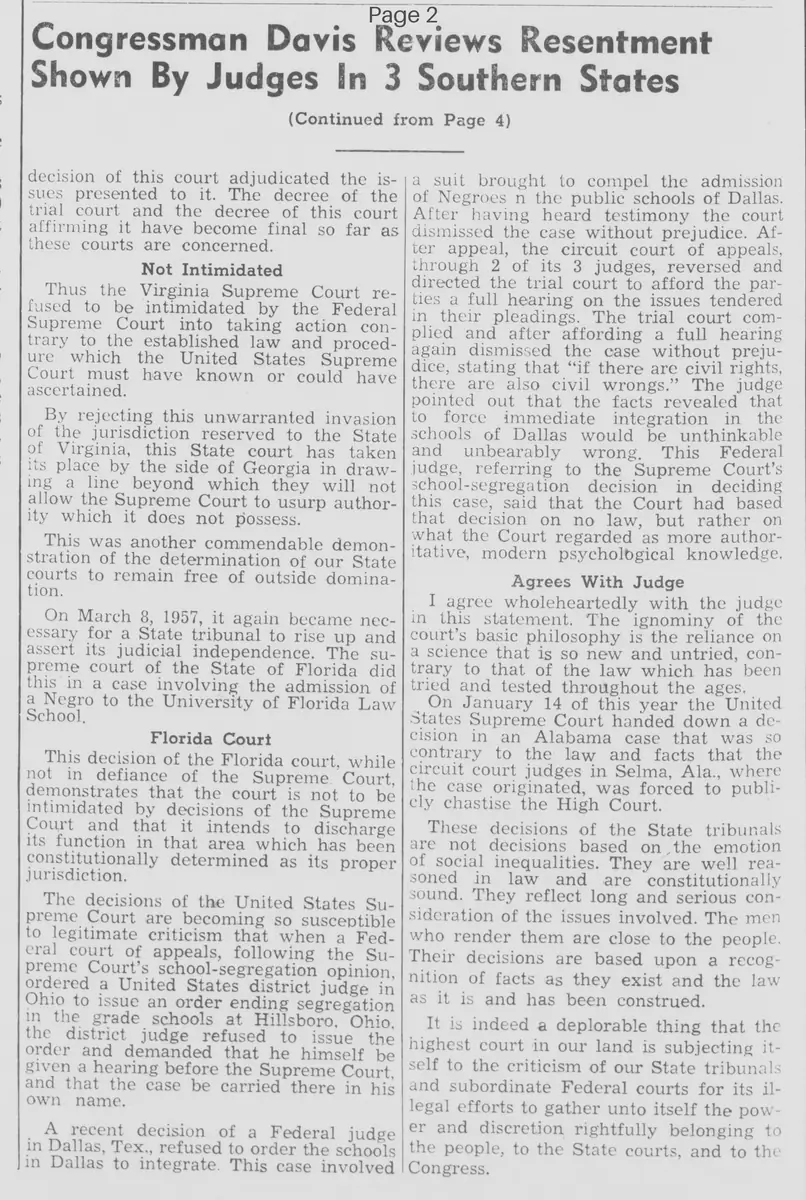
Congressman Davis Reviews Resentment Shown By Judges In Southern States
(Continued from Page 4)
decision of this court adjudicated the issues presented to it. The decree of the trial court and the decree of this court affirming it have become final so far as these courts are concerned.
Not Intimidated
Thus the Virginia Supreme Court refused to be intimidated by the Federal Supreme Court into taking action contrary to the established law and procedure which the United States Supreme Court must have known or could have ascertained.
By rejecting this unwarranted invasion of the jurisdiction reserved to the State of Virginia, this State court has taken its place by the side of Georgia in drawing a line beyond which they will not allow the Supreme Court to usurp authority which it does not possess.
This was another commendable demonstration of the determination of our State courts to remain free of outside domination.
On March 8, 1957, it again became necessary for a State tribunal to rise up and assert its judicial independence. The supreme court of the State of Florida did this in a case involving the admission of a Negro to the University of Florida Law School.
Florida Court
This decision of the Florida court. while not in defiance of the Supreme Court, demonstrates that the court is not to be intimidated by decisions of the Supreme Court and that it intends to discharge its function in that area which has been constitutionally determined as its proper jurisdiction.
The decisions of the United States Supreme Court are becoming so susceptible to legitimate criticism that when a Federal court of appeals, following the Supreme Court's school-segregation opinion, ordered a United States district judge in Ohio to issue an order ending segregation in the grade schools at Hillsboro, Ohio. the district judge refused to issue the order and demanded that he himself be given a hearing before the Supreme Court, and that the case be carried there in his own name.
A recent decision of a Federal judge in Dallas, Tex.. refused to order the schools in Dallas to integrate. This case involved a suit brought to compel the admission of Negroes in the public schools of Dallas.
After having heard testimony the court dismissed the case without prejudice. After appeal, the circuit court of appeals, through 2 of its 3 judges. reversed and directed the trial court to afford the parties a full hearing on the issues tendered in their pleadings. The trial court complied and after affording a full hearing again dismissed the case without prejudice, stating that if there are civil rights, there are also civil wrongs." The judge pointed out that the facts revealed that to force immediate integration in the schools of Dallas would be unthinkable and unbearably wrong.
This Federal judge, referring to the Supreme Court's school-segregation decision in deciding this case, said that the Court had based that decision on no law, but rather on what the Court regarded as more authoritative, modern psychological knowledge.
Agrees With Judge
I agree wholeheartedly with the judge in this statement. The ignominy of the court's basic philosophy is the reliance on a science that is so new and untried, contrary to that of the law which has been tried and tested throughout the ages.
On January 14 of this year the United States Supreme Court handed down a decision in an Alabama case that was so contrary to the law and facts that the circuit court judges in Selma, Ala., where the case originated, was forced to publicly chastise the High Court.
These decisions of the State tribunals are not decisions based on the emotion of social inequalities. They are well reasoned in law and are constitutionally sound. They reflect long and serious consideration of the issues involved. The men who render them are close to the people.
Their decisions are based upon a recognition of facts as they exist and the law as it is and has been construed.
It is indeed a deplorable thing that the highest court in our land is subjecting itself to the criticism of our State tribunals and subordinate Federal courts for its illegal efforts to gather unto itself the power and discretion rightfully belonging to the people, to the State courts, and to the Congress.
What sub-type of article is it?
What themes does it cover?
What keywords are associated?
What entities or persons were involved?
Where did it happen?
Story Details
Key Persons
Location
Washington, Georgia, Florida, Virginia
Event Date
1957 03 19
Story Details
Congressman Jim Davis delivers a speech criticizing the U.S. Supreme Court for usurping state powers and destroying confidence in courts, citing rebukes from Georgia, Florida, and Virginia supreme courts in cases like Williams v. State (murder conviction), Naim v. Naim (interracial marriage annulment), and a Florida law school admission case, linking to broader issues like segregation rulings.