Thank you for visiting SNEWPapers!
Sign up free
Story
April 16, 1886
Weekly Commercial Herald
Vicksburg, Warren County, Mississippi
What is this article about?
Article on spring beekeeping practices: Overhaul hives early, reduce brood chamber frames to concentrate queen's laying, store excess frames with honey for later use, ensuring strong colonies for harvest and winter stores. From Indiana Farmer.
Clipping
OCR Quality
98%
Excellent
Full Text
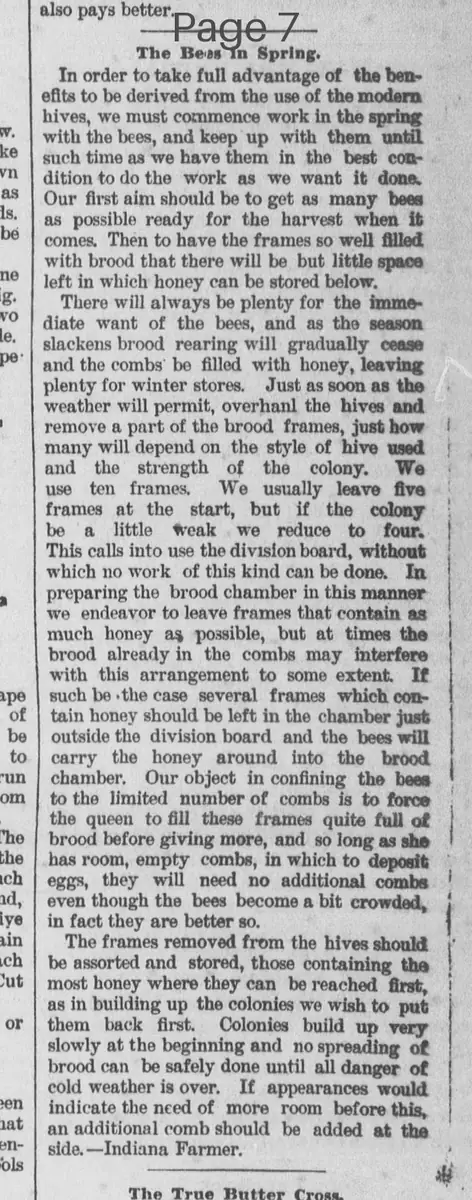
The Bees in Spring.
In order to take full advantage of the benefits to be derived from the use of the modern hives, we must commence work in the spring with the bees, and keep up with them until such time as we have them in the best condition to do the work as we want it done.
Our first aim should be to get as many bees as possible ready for the harvest when it comes. Then to have the frames so well filled with brood that there will be but little space left in which honey can be stored below. There will always be plenty for the immediate want of the bees, and as the season slackens brood rearing will gradually cease and the combs be filled with honey, leaving plenty for winter stores. Just as soon as the weather will permit, overhaul the hives and remove a part of the brood frames, just how many will depend on the style of hive used and the strength of the colony. We use ten frames. We usually leave five frames at the start, but if the colony be a little weak we reduce to four. This calls into use the division board, without which no work of this kind can be done. In preparing the brood chamber in this manner we endeavor to leave frames that contain as much honey as possible, but at times the brood already in the combs may interfere with this arrangement to some extent. If such be the case several frames which contain honey should be left in the chamber just outside the division board and the bees will carry the honey around into the brood chamber. Our object in confining the bees to the limited number of combs is to force the queen to fill these frames quite full of brood before giving more, and so long as she has room, empty combs, in which to deposit eggs, they will need no additional combs even though the bees become a bit crowded. In fact they are better so.
The frames removed from the hives should be assorted and stored, those containing the most honey where they can be reached first, as in building up the colonies we wish to put them back first. Colonies build up very slowly at the beginning and no spreading of brood can be safely done until all danger of cold weather is over. If appearances would indicate the need of more room before this, an additional comb should be added at the side.-Indiana Farmer
In order to take full advantage of the benefits to be derived from the use of the modern hives, we must commence work in the spring with the bees, and keep up with them until such time as we have them in the best condition to do the work as we want it done.
Our first aim should be to get as many bees as possible ready for the harvest when it comes. Then to have the frames so well filled with brood that there will be but little space left in which honey can be stored below. There will always be plenty for the immediate want of the bees, and as the season slackens brood rearing will gradually cease and the combs be filled with honey, leaving plenty for winter stores. Just as soon as the weather will permit, overhaul the hives and remove a part of the brood frames, just how many will depend on the style of hive used and the strength of the colony. We use ten frames. We usually leave five frames at the start, but if the colony be a little weak we reduce to four. This calls into use the division board, without which no work of this kind can be done. In preparing the brood chamber in this manner we endeavor to leave frames that contain as much honey as possible, but at times the brood already in the combs may interfere with this arrangement to some extent. If such be the case several frames which contain honey should be left in the chamber just outside the division board and the bees will carry the honey around into the brood chamber. Our object in confining the bees to the limited number of combs is to force the queen to fill these frames quite full of brood before giving more, and so long as she has room, empty combs, in which to deposit eggs, they will need no additional combs even though the bees become a bit crowded. In fact they are better so.
The frames removed from the hives should be assorted and stored, those containing the most honey where they can be reached first, as in building up the colonies we wish to put them back first. Colonies build up very slowly at the beginning and no spreading of brood can be safely done until all danger of cold weather is over. If appearances would indicate the need of more room before this, an additional comb should be added at the side.-Indiana Farmer
What sub-type of article is it?
Beekeeping Guide
Agricultural Advice
What themes does it cover?
Nature
What keywords are associated?
Beekeeping
Spring Management
Hives
Brood Frames
Honey Storage
Story Details
Event Date
Spring
Story Details
Instructions for managing bee hives in spring to maximize brood and honey production by overhauling hives, reducing frames, using division boards, and strategically placing honey-filled combs.