Thank you for visiting SNEWPapers!
Sign up free
Literary
April 4, 1867
The Wyandot Pioneer
Upper Sandusky, Wyandot County, Ohio
What is this article about?
A man recounts his experience at Tremewen Grange in Cornwall, where he witnesses the apparition of a drowned sailor during a stormy night in a seaside hut, later confirmed by the discovery of the body near the cliffs.
Clipping
OCR Quality
95%
Excellent
Full Text
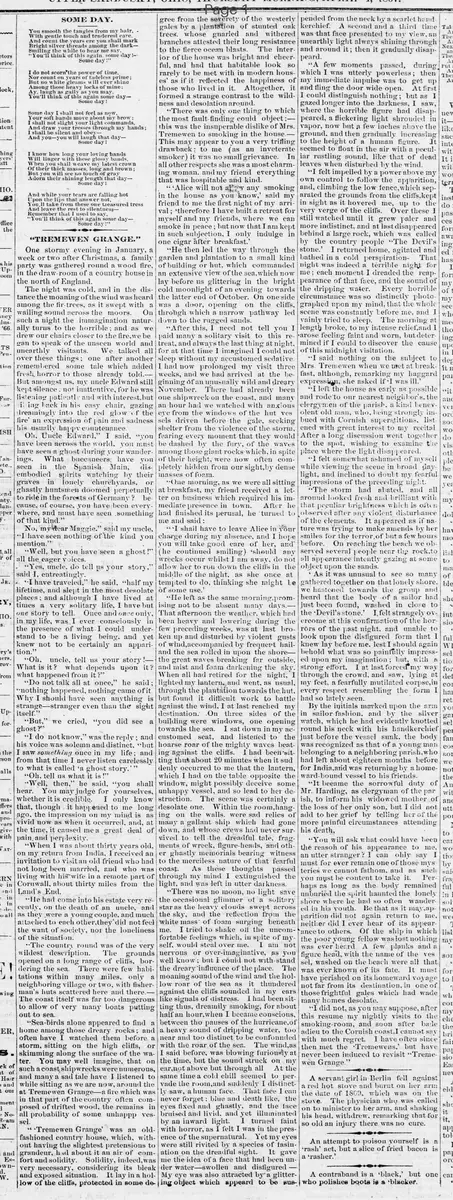
"TREMENWEN GRANGE."
One stormy evening in January, a week or two after Christmas, a family party was gathered round a wood fire, in the drawing-room of a country house in the north of England.
The night was cold, and in the distance the moaning of the wind was heard among the fir-trees, as it swept with a wailing sound across the moors. On such a night the imagination naturally turns to the horrible; and as we drew our chairs closer to the fire, we began to speak of the unseen world and unearthly visitants. We talked all over these things; one after another remembered some tale which added fresh horror to those already told.—
But amongst us, my uncle Edward still kept silence, not inattentive, for he was listening patiently and with interest, but sitting back in his easy chair, gazing dreamily into the red glow of the fire, an expression of pain and sadness his usually happy countenance
"Oh, Uncle Edward," I said, "you have been across the world, you must have seen a ghost during your wanderings. What buccaneers have you seen in the Spanish Main, disembodied spirits watching by their graves in lonely churchyards, or ghastly huntsmen doomed perpetually to ride in the forests of Germany? because, of course, you have been everywhere, and must have seen something of that kind."
"No, my dear Maggie," said my uncle, "I have seen nothing of the kind you mention."
"Well, but you have seen a ghost!" all the eager voices.
"Yes, uncle, do tell us your story," said I, entreatingly.
."I have traveled," he said, "half my lifetime, and slept in the most desolate places; and although I have lived at times a very solitary life, I have but one story to tell. Once and once only, in my life, was I ever consciously in the presence of what I could understand to be a living being, and yet knew not to be certainly an apparition."
"Oh, uncle, tell us your story!— What is it? what depends upon it? what happened from it?"
"Do not talk all at once," he said; "nothing happened, nothing came of it Why I should have seen anything is strange—stranger even than the sight itself."
"But," we cried, "you did see a ghost?"
"I do not know," was the reply; and his voice was solemn and distinct, "but I saw something once in my life; and from that time I never listen carelessly to what is called a ghost story.
"Oh. tell us what it is!"
"Well, then," he said, "you shall hear. You may judge for yourselves, whether it is credible. I only know that, though it happened to me long ago, the impression on my mind is as vivid now as when it occurred, and, at the time, it caused me a great deal of pain, and perplexity.
"When I was about thirty years old, on my return from India, I received an invitation to visit an old friend who had not long been married, and who was living with his wife in a remote part of Cornwall, about thirty miles from the Land's End.
He had come into his estate very recently, on the death of an uncle, and as they were a young couple, and much attached to each other, they did not feel the want of society, nor the loneliness of the situation.
"The country round was of the very wildest description. The grounds opened on a long range of cliffs, bordering the sea. There were few habitations within many miles, only a neighboring village or two, with fisherman's huts scattered here and there.— The coast itself was far too dangerous to allow of very many boats putting out to sea.
"Sea-birds alone appeared to find a home among those dreary rocks: and often have I watched them before a storm, sitting on the high cliffs, or skimming along the surface of the water. You may well imagine, that on such a coast shipwrecks were numerous, and many a sad tale have I listened to while sitting as we are now, around the fire at Tremewen Grange—a fire which was in that part of the country often composed of drifted wood, the remains in all probability of some unhappy vessel.
"Tremewen Grange' was an old-fashioned country house, which, without having the slightest pretensions to grandeur, had about it an air of comfort and solidity. Solidity, indeed, was very necessary, considering its bleak and exposed situation. It lay in a hollow of the cliffs, protected in some degree from the severity of the westerly gales by a plantation of stunted oak trees, whose gnarled and withered branches attested their long resistance to the fierce ocean blasts. The interior of the house was bright and cheerful, and had that habitable look so rarely to be met with in modern houses' as if it reflected the happiness of those who lived in it. Altogether, it formed a strange contrast to the wilderness and desolation around.
"There was only one thing to which the most fault-finding could object;— this was the insuperable dislike of Mrs. Tremewen to smoking in the house.— This may appear to you a very trifling drawback: to me (as an inveterate smoker) it was no small grievance. In all other respects she was a most charming woman. and my friend everything that was hospitable and kind.
"'Alice will not allow any smoking in the house as you know,' said my friend to me the first night of my arrival; 'therefore I have built a retreat for myself and my friends, where we can smoke in peace; but now that I am kept in such subjection, I only indulge in one cigar after breakfast."
He then led the way through the garden and plantation to a small kind of building or hut, which commanded an extensive view of the sea, which now lay before us glittering in the bright cold moonlight of an evening towards the latter end of October. On one side was a door, opening on the cliffs, through which a narrow pathway led down to the rugged sands.
"After this, I need not tell you I paid many a solitary visit to this retreat, and always the last thing at night. for at that time I imagined I could not sleep without my accustomed sedative.
I had now prolonged my visit three weeks, and we had arrived at the beginning of an unusually wild and dreary November. There had already been one shipwreck on the coast, and many an hour had we watched with anxious eye from the windows of the hut vessels driven before the gale, seeking shelter from the violence of the storm, fearing every moment that they would be dashed by the fury of the waves among those giant rocks which, in spite of their height, were now often completely hidden from our sight, by dense masses of foam.
"(One morning, as we were all sitting at breakfast, my friend received a letter on business which required his immediate presence in town. After he had finished its perusal, he turned to me and said :
"I shall have to leave Alice in your charge during my absence, and I hope you will take good care of her, and (he continued smiling) 'should any wrecks occur whilst I am away, do not allow her to run down the cliffs in the middle of the night, as she once attempted to do, thinking she might be of some use."
"He left the same morning, promising not to be absent many days.— That afternoon the weather, which had been heavy and lowering during the few preceding weeks, was at last broken up and disturbed by violent gusts of wind, accompanied by frequent hail— and the sea rolled in upon the shore— the great waves breaking far outside, and mist and foam darkening the sky.
When all had retired for the night, I lighted my lantern. and went, as usual, through the plantation towards the hut, but found it difficult work to battle against the wind, I at last reached my destination. On three sides of the building were windows, one opening towards the sea. I sat down in my accustomed seat, and listened to the hoarse roar of the mighty waves beating against the cliffs. I had been sitting thus about 20 minutes when it suddenly occurred to me that the lantern, which I had on the table opposite the window, might possibly deceive some unhappy vessel, and so lead to her destruction. The scene was certainly a desolate one. Within the room, hanging on the walls. were sad relics of many a gallant ship which had gone down, and whose crews had never survived to tell the dreadful tale, fragments of wreck, figure-heads, and other ghastly memorials bearing witness to the merciless nature of that fearful coast. As these thoughts passed through my mind I extinguished the light, and was left in utter darkness.
"There was no moon, no light save the occasional glimmer of a solitary star as the heavy clouds swept across the sky, and the reflection from the white mass' of foam surging beneath me. I tried to shake off the uncomfortable feelings which, in spite of myself, would steal over me. I am not nervous or over-imaginative, as you well know; but I could not withstand the dreary influence of the place. The moaning sound of the wind and the hollow roar of the sea as it thundered against the cliffs sounded in my ears like signals of distress. I had been sitting thus, dreamily smoking, for about half an hour, when I became conscious, between the pauses of the hurricane, of a heavy sound of dripping water, too near and too distinct to be confounded with the roar of the sea. The wind, as I said before, was blowing furiously at the time, but the sound struck on my ear, not above but through all At the same time a cold chill seemed to pervade the room, and suddenly I distinctly saw, a human face. That face I can never forget: blue and death like, the eyes fixed and ghastly, and the face bruised and livid, and yet illuminated by an inward light. I turned faint with horror, as I felt I was in the presence of the supernatural. Yet my eyes were still riveted by a species of fascination on the dreadful sight. It gave me the idea of a face that had been under water—swollen and disfigured— My eye was also attracted by a glitter pended from the neck by a scarlet handkerchief. A second and a third time was that face presented to my view, an unearthly light always shining through and around it; then it gradually disappeared.
"A few moments passed, during which I was utterly powerless; then my immediate impulse was to get up and fling the door wide open. At first I could distinguish nothing; but as I gazed longer into the darkness, I saw, where the horrible figure had disappeared, a flickering light shrouded in vapor, now but a few inches above the ground, and then gradually increasing to the height of a human figure.
It seemed to float in the air with a peculiar rustling sound. like that of dead leaves when disturbed by the wind.
"I felt impelled by a power above my own control to follow the apparition, and, climbing the low fence, which separated the grounds from the cliffs, kept in sight as it hovered over me, up to the very verge of the cliffs. Over these I still watched until it grew paler and more indistinct, and at last disappeared behind a large rock, which was called by the country people "The Devil's stone.' I returned home, agitated and bathed in a cold perspiration— That night was indeed a terrible night for me; each moment I dreaded the reappearance of that face, and the sound of the dripping water. Every horrible circumstance was so distinctly photographed upon my mind, that the whole scene was constantly before me. and I vainly tried to sleep. The morning at length broke, to my intense relief, and I arose feeling faint and worn, but determined if I could to discover the cause of this midnight visitation.
"I said nothing on the subject to Mrs. Tremewen when we met at breakfast, although, remarking my haggard expression, she asked if I was ill.'
"I left the house as early as possible and rode to our nearest neighbor's, the clergyman of the parish. a kind benevolent old man, who, being strongly imbued with Cornish superstitions, listened with great interest to my recital After a long discussion went together to the spot, wishing to examine the place where the light disappeared.
"I felt somewhat ashamed of myself while viewing the scene in broad daylight, and inclined to doubt my fearful impressions of the preceding night.
"The storm had abated, and all around looked fresh and brilliant with that peculiar brightness which is often observed after any violent disturbance of the elements. It appeared as if nature was trying to make amends by her smiles for the terror of but a few hours before. On reaching the beach we observed several people near the rock, to all appearance intently gazing at some object upon the sands.
'As it was unusual to see so many gathered together on that lonely shore. we hastened towards the group and heard that the body of a sailor had just been found, washed in close to the ·Devil's stone.' I felt strangely overcome at this confirmation of the horrors of the past night, and unable to look upon the disfigured form that I knew lay before me, lest I should again behold what was so painfully impressed upon my imagination; but, with a strong effort. I at last forced my way through the crowd, and saw, lying at my feet. a fearfully mutilated corpse, in every respect resembling the form I had so lately seen.
By the initials marked upon the arm in sailor-fashion, and by the silver watch, which he had evidently knotted round his neck with his handkerchief just before the vessel sunk, the body was recognized as that of a young man belonging to a neighboring parish, who had left about eighteen months before for India, and was returning by a homeward-bound vessel to his friends.
"It became the sorrowful duty of Mr. Harding, as clergyman of the parish. to inform his widowed mother of the loss of her only son, but I did not add to her grief by telling her of the more painful circumstances attending his death,
"You will ask what could have been the reason of his appearance to me, an utter stranger? I can only say I must for ever remain one of those mysteries we cannot fathom, and as such you must be content to take it. Perhaps as long as the body remained unburied the spirit haunted the lonely shore where he had so often wandered in his youth. Be that as it may, apparition did not again return to me, neither did I ever hear of its appearance to others. Of the ship in which the poor young fellow was lost nothing was ever heard A few planks and a figure head, with the name of the vessel, washed on the beach were all that was ever known of its fate. It must have perished on its homeward voyage not far from its destination. in one of those frightful gales which had made many homes desolate.
"I did not, as you may suppose, after this resume my nightly visits to the smoking-room, and soon after bade adieu to the Cornish coast, I cannot say with much regret. I have often since then met the -Tremewens.' but have never been induced to revisit "Tremewen Grange."
One stormy evening in January, a week or two after Christmas, a family party was gathered round a wood fire, in the drawing-room of a country house in the north of England.
The night was cold, and in the distance the moaning of the wind was heard among the fir-trees, as it swept with a wailing sound across the moors. On such a night the imagination naturally turns to the horrible; and as we drew our chairs closer to the fire, we began to speak of the unseen world and unearthly visitants. We talked all over these things; one after another remembered some tale which added fresh horror to those already told.—
But amongst us, my uncle Edward still kept silence, not inattentive, for he was listening patiently and with interest, but sitting back in his easy chair, gazing dreamily into the red glow of the fire, an expression of pain and sadness his usually happy countenance
"Oh, Uncle Edward," I said, "you have been across the world, you must have seen a ghost during your wanderings. What buccaneers have you seen in the Spanish Main, disembodied spirits watching by their graves in lonely churchyards, or ghastly huntsmen doomed perpetually to ride in the forests of Germany? because, of course, you have been everywhere, and must have seen something of that kind."
"No, my dear Maggie," said my uncle, "I have seen nothing of the kind you mention."
"Well, but you have seen a ghost!" all the eager voices.
"Yes, uncle, do tell us your story," said I, entreatingly.
."I have traveled," he said, "half my lifetime, and slept in the most desolate places; and although I have lived at times a very solitary life, I have but one story to tell. Once and once only, in my life, was I ever consciously in the presence of what I could understand to be a living being, and yet knew not to be certainly an apparition."
"Oh, uncle, tell us your story!— What is it? what depends upon it? what happened from it?"
"Do not talk all at once," he said; "nothing happened, nothing came of it Why I should have seen anything is strange—stranger even than the sight itself."
"But," we cried, "you did see a ghost?"
"I do not know," was the reply; and his voice was solemn and distinct, "but I saw something once in my life; and from that time I never listen carelessly to what is called a ghost story.
"Oh. tell us what it is!"
"Well, then," he said, "you shall hear. You may judge for yourselves, whether it is credible. I only know that, though it happened to me long ago, the impression on my mind is as vivid now as when it occurred, and, at the time, it caused me a great deal of pain, and perplexity.
"When I was about thirty years old, on my return from India, I received an invitation to visit an old friend who had not long been married, and who was living with his wife in a remote part of Cornwall, about thirty miles from the Land's End.
He had come into his estate very recently, on the death of an uncle, and as they were a young couple, and much attached to each other, they did not feel the want of society, nor the loneliness of the situation.
"The country round was of the very wildest description. The grounds opened on a long range of cliffs, bordering the sea. There were few habitations within many miles, only a neighboring village or two, with fisherman's huts scattered here and there.— The coast itself was far too dangerous to allow of very many boats putting out to sea.
"Sea-birds alone appeared to find a home among those dreary rocks: and often have I watched them before a storm, sitting on the high cliffs, or skimming along the surface of the water. You may well imagine, that on such a coast shipwrecks were numerous, and many a sad tale have I listened to while sitting as we are now, around the fire at Tremewen Grange—a fire which was in that part of the country often composed of drifted wood, the remains in all probability of some unhappy vessel.
"Tremewen Grange' was an old-fashioned country house, which, without having the slightest pretensions to grandeur, had about it an air of comfort and solidity. Solidity, indeed, was very necessary, considering its bleak and exposed situation. It lay in a hollow of the cliffs, protected in some degree from the severity of the westerly gales by a plantation of stunted oak trees, whose gnarled and withered branches attested their long resistance to the fierce ocean blasts. The interior of the house was bright and cheerful, and had that habitable look so rarely to be met with in modern houses' as if it reflected the happiness of those who lived in it. Altogether, it formed a strange contrast to the wilderness and desolation around.
"There was only one thing to which the most fault-finding could object;— this was the insuperable dislike of Mrs. Tremewen to smoking in the house.— This may appear to you a very trifling drawback: to me (as an inveterate smoker) it was no small grievance. In all other respects she was a most charming woman. and my friend everything that was hospitable and kind.
"'Alice will not allow any smoking in the house as you know,' said my friend to me the first night of my arrival; 'therefore I have built a retreat for myself and my friends, where we can smoke in peace; but now that I am kept in such subjection, I only indulge in one cigar after breakfast."
He then led the way through the garden and plantation to a small kind of building or hut, which commanded an extensive view of the sea, which now lay before us glittering in the bright cold moonlight of an evening towards the latter end of October. On one side was a door, opening on the cliffs, through which a narrow pathway led down to the rugged sands.
"After this, I need not tell you I paid many a solitary visit to this retreat, and always the last thing at night. for at that time I imagined I could not sleep without my accustomed sedative.
I had now prolonged my visit three weeks, and we had arrived at the beginning of an unusually wild and dreary November. There had already been one shipwreck on the coast, and many an hour had we watched with anxious eye from the windows of the hut vessels driven before the gale, seeking shelter from the violence of the storm, fearing every moment that they would be dashed by the fury of the waves among those giant rocks which, in spite of their height, were now often completely hidden from our sight, by dense masses of foam.
"(One morning, as we were all sitting at breakfast, my friend received a letter on business which required his immediate presence in town. After he had finished its perusal, he turned to me and said :
"I shall have to leave Alice in your charge during my absence, and I hope you will take good care of her, and (he continued smiling) 'should any wrecks occur whilst I am away, do not allow her to run down the cliffs in the middle of the night, as she once attempted to do, thinking she might be of some use."
"He left the same morning, promising not to be absent many days.— That afternoon the weather, which had been heavy and lowering during the few preceding weeks, was at last broken up and disturbed by violent gusts of wind, accompanied by frequent hail— and the sea rolled in upon the shore— the great waves breaking far outside, and mist and foam darkening the sky.
When all had retired for the night, I lighted my lantern. and went, as usual, through the plantation towards the hut, but found it difficult work to battle against the wind, I at last reached my destination. On three sides of the building were windows, one opening towards the sea. I sat down in my accustomed seat, and listened to the hoarse roar of the mighty waves beating against the cliffs. I had been sitting thus about 20 minutes when it suddenly occurred to me that the lantern, which I had on the table opposite the window, might possibly deceive some unhappy vessel, and so lead to her destruction. The scene was certainly a desolate one. Within the room, hanging on the walls. were sad relics of many a gallant ship which had gone down, and whose crews had never survived to tell the dreadful tale, fragments of wreck, figure-heads, and other ghastly memorials bearing witness to the merciless nature of that fearful coast. As these thoughts passed through my mind I extinguished the light, and was left in utter darkness.
"There was no moon, no light save the occasional glimmer of a solitary star as the heavy clouds swept across the sky, and the reflection from the white mass' of foam surging beneath me. I tried to shake off the uncomfortable feelings which, in spite of myself, would steal over me. I am not nervous or over-imaginative, as you well know; but I could not withstand the dreary influence of the place. The moaning sound of the wind and the hollow roar of the sea as it thundered against the cliffs sounded in my ears like signals of distress. I had been sitting thus, dreamily smoking, for about half an hour, when I became conscious, between the pauses of the hurricane, of a heavy sound of dripping water, too near and too distinct to be confounded with the roar of the sea. The wind, as I said before, was blowing furiously at the time, but the sound struck on my ear, not above but through all At the same time a cold chill seemed to pervade the room, and suddenly I distinctly saw, a human face. That face I can never forget: blue and death like, the eyes fixed and ghastly, and the face bruised and livid, and yet illuminated by an inward light. I turned faint with horror, as I felt I was in the presence of the supernatural. Yet my eyes were still riveted by a species of fascination on the dreadful sight. It gave me the idea of a face that had been under water—swollen and disfigured— My eye was also attracted by a glitter pended from the neck by a scarlet handkerchief. A second and a third time was that face presented to my view, an unearthly light always shining through and around it; then it gradually disappeared.
"A few moments passed, during which I was utterly powerless; then my immediate impulse was to get up and fling the door wide open. At first I could distinguish nothing; but as I gazed longer into the darkness, I saw, where the horrible figure had disappeared, a flickering light shrouded in vapor, now but a few inches above the ground, and then gradually increasing to the height of a human figure.
It seemed to float in the air with a peculiar rustling sound. like that of dead leaves when disturbed by the wind.
"I felt impelled by a power above my own control to follow the apparition, and, climbing the low fence, which separated the grounds from the cliffs, kept in sight as it hovered over me, up to the very verge of the cliffs. Over these I still watched until it grew paler and more indistinct, and at last disappeared behind a large rock, which was called by the country people "The Devil's stone.' I returned home, agitated and bathed in a cold perspiration— That night was indeed a terrible night for me; each moment I dreaded the reappearance of that face, and the sound of the dripping water. Every horrible circumstance was so distinctly photographed upon my mind, that the whole scene was constantly before me. and I vainly tried to sleep. The morning at length broke, to my intense relief, and I arose feeling faint and worn, but determined if I could to discover the cause of this midnight visitation.
"I said nothing on the subject to Mrs. Tremewen when we met at breakfast, although, remarking my haggard expression, she asked if I was ill.'
"I left the house as early as possible and rode to our nearest neighbor's, the clergyman of the parish. a kind benevolent old man, who, being strongly imbued with Cornish superstitions, listened with great interest to my recital After a long discussion went together to the spot, wishing to examine the place where the light disappeared.
"I felt somewhat ashamed of myself while viewing the scene in broad daylight, and inclined to doubt my fearful impressions of the preceding night.
"The storm had abated, and all around looked fresh and brilliant with that peculiar brightness which is often observed after any violent disturbance of the elements. It appeared as if nature was trying to make amends by her smiles for the terror of but a few hours before. On reaching the beach we observed several people near the rock, to all appearance intently gazing at some object upon the sands.
'As it was unusual to see so many gathered together on that lonely shore. we hastened towards the group and heard that the body of a sailor had just been found, washed in close to the ·Devil's stone.' I felt strangely overcome at this confirmation of the horrors of the past night, and unable to look upon the disfigured form that I knew lay before me, lest I should again behold what was so painfully impressed upon my imagination; but, with a strong effort. I at last forced my way through the crowd, and saw, lying at my feet. a fearfully mutilated corpse, in every respect resembling the form I had so lately seen.
By the initials marked upon the arm in sailor-fashion, and by the silver watch, which he had evidently knotted round his neck with his handkerchief just before the vessel sunk, the body was recognized as that of a young man belonging to a neighboring parish, who had left about eighteen months before for India, and was returning by a homeward-bound vessel to his friends.
"It became the sorrowful duty of Mr. Harding, as clergyman of the parish. to inform his widowed mother of the loss of her only son, but I did not add to her grief by telling her of the more painful circumstances attending his death,
"You will ask what could have been the reason of his appearance to me, an utter stranger? I can only say I must for ever remain one of those mysteries we cannot fathom, and as such you must be content to take it. Perhaps as long as the body remained unburied the spirit haunted the lonely shore where he had so often wandered in his youth. Be that as it may, apparition did not again return to me, neither did I ever hear of its appearance to others. Of the ship in which the poor young fellow was lost nothing was ever heard A few planks and a figure head, with the name of the vessel, washed on the beach were all that was ever known of its fate. It must have perished on its homeward voyage not far from its destination. in one of those frightful gales which had made many homes desolate.
"I did not, as you may suppose, after this resume my nightly visits to the smoking-room, and soon after bade adieu to the Cornish coast, I cannot say with much regret. I have often since then met the -Tremewens.' but have never been induced to revisit "Tremewen Grange."
What sub-type of article is it?
Prose Fiction
What themes does it cover?
Death Mortality
What keywords are associated?
Ghost Story
Shipwreck
Apparition
Drowned Sailor
Cornwall Cliffs
Tremewen Grange
Supernatural Sighting
Literary Details
Title
"Tremenwen Grange."
Subject
Ghost Story Of A Drowned Sailor
Key Lines
That Face I Can Never Forget: Blue And Death Like, The Eyes Fixed And Ghastly, And The Face Bruised And Livid, And Yet Illuminated By An Inward Light.
I Turned Faint With Horror, As I Felt I Was In The Presence Of The Supernatural.
It Gave Me The Idea Of A Face That Had Been Under Water—Swollen And Disfigured— My Eye Was Also Attracted By A Glitter Pended From The Neck By A Scarlet Handkerchief.
I Felt Strangely Overcome At This Confirmation Of The Horrors Of The Past Night, And Unable To Look Upon The Disfigured Form That I Knew Lay Before Me...
Perhaps As Long As The Body Remained Unburied The Spirit Haunted The Lonely Shore Where He Had So Often Wandered In His Youth.