Thank you for visiting SNEWPapers!
Sign up free
Story
November 4, 1861
The National Republican
Washington, District Of Columbia
What is this article about?
Historical account of charges against General Fremont's Civil War command in Missouri, citing administrative abuses, incompetence, and military failures like the loss at Lexington, countered by defense of his effective European arms procurement.
Clipping
OCR Quality
95%
Excellent
Full Text
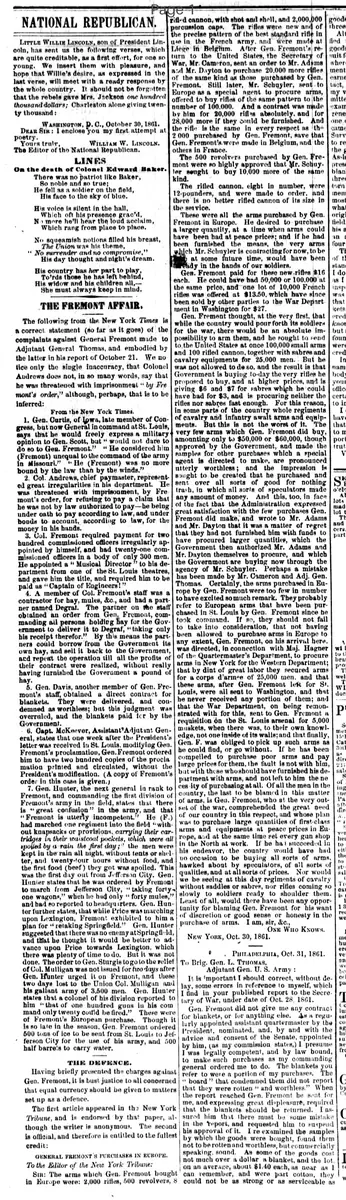
THE FREMONT AFFAIR.
The following from the New York Times is a correct statement (so far as it goes) of the complaints against General Fremont made to Adjutant General Thomas, and embodied by the latter in his report of October 21. We notice only the single inaccuracy, that Colonel Andrews does not, in so many words, say that he was threatened with imprisonment "by Fremont's order," although, perhaps, that is to be inferred:
From the New York Times.
1. Gen. Curtis, of Iowa, late member of Congress, but now General in command at St. Louis, says that he would freely express a military opinion to Gen. Scott, but "would not dare to do so to Gen. Fremont." "He considered him (Fremont) unequal to the command of the army in Missouri." "He (Fremont) was no more bound by the law than by the winds."
2. Col. Andrews, chief paymaster, represented great irregularities in his department. He was threatened with imprisonment, by Fremont's order, for refusing to pay a claim that he was not by law authorized to pay—he being under oath to pay according to law, and under bonds to account, according to law, for the money in his hands.
3. Col. Fremont required payment for two hundred commissioned officers irregularly appointed by himself, and had twenty-one commissioned officers in a body of only 300 men. He appointed a "Musical Director" to his department from one of the St. Louis theatres, and gave him the title, and required him to be paid as "Captain of Engineers!"
4. A member of Col. Fremont's staff was a contractor for hay, mules, &c., and had a partner named Degral. The partner on the staff obtained an order from Gen. Fremont, commanding all persons holding hay for the Government to deliver it to Degral, "taking only his receipt therefor." By this means the partners could borrow from the Government its own hay, and sell it back to the Government, and repeat the operation till all the profits of their contract were realized, without really having furnished the Government a pound of hay.
5. Gen. Davis, another member of Gen. Fremont's staff, obtained a direct contract for blankets. They were delivered, and condemned as worthless; but this judgment was overruled, and the blankets paid for by the Government.
6. Capt. McKeever, Assistant Adjutant General, states that one week after the President's letter was received in St. Louis, modifying Gen. Fremont's proclamation, Gen. Fremont ordered him to have two hundred copies of the proclamation printed and circulated, without the President's modification. (A copy of Fremont's order in this case is given.)
7. Gen. Hunter, the next general in rank to Fremont, and commanding the first division of Fremont's army in the field, states that there is "great confusion" in the army, and that "Fremont is utterly incompetent." He (F.) had marched one regiment into the field "without knapsacks or provisions, carrying their cartridges in their waistcoat pockets, which were all spoiled by a rain the first day;" the men were kept in the rain all night, without tents or shelter, and twenty-four hours without food, and the first food (beef) they got was spoiled. This was the first day out from Jefferson City. Gen. Hunter states that he was ordered by Fremont to march from Jefferson City, "taking forty-one wagons," when he had only "forty mules," and had to report to headquarters. Gen. Hunter further states, that while Price was marching upon Lexington, Fremont exhibited to him a plan for "retaking Springfield." Gen. Hunter suggested that there was no enemy at Springfield, and that he thought it would be better to advance upon Price towards Lexington, which there was plenty of time to do. But it was not done. The order to Gen. Sturgis to go to the relief of Col. Mulligan was not issued for two days after Gen. Hunter urged it on Fremont, and these two days lost to the Union Col. Mulligan and his gallant army of 3,500 men. Gen. Hunter states that a colonel of his division reported to him "that of one hundred guns in his command only twenty could be fired." There were of Fremont's European purchase. Though it is so late in the season, Gen. Fremont ordered 500 tons of ice to be sent from St. Louis to Jefferson City for the use of his army, and 500 half barrels to carry water.
THE DEFENCE.
Having briefly presented the charges against Gen. Fremont, it is but justice to all concerned that equal currency should be given to matters set up as a defence.
The first article appeared in the New York Tribune, and is endorsed by that paper, although the writer is anonymous. The second is official, and therefore is entitled to the fullest credit:
GENERAL FREMONT'S PURCHASES IN EUROPE.
To the Editor of the New York Tribune:
SIR: The arms which Gen. Fremont bought in Europe were: 2,000 rifles, 500 revolvers, 8 rifled cannon, with shot and shell, and 2,000,000 percussion caps. The rifles were new and of the precise pattern of the best standard rifle in use in the French army, and were made at Liege in Belgium. After Gen. Fremont's return to the United States, the Secretary of War, Mr. Cameron, sent an order to Mr. Adams and Mr. Dayton to purchase 20,000 more rifles of the same kind as those purchased by Gen. Fremont. Still later, Mr. Schuyler, sent to Europe as a special agent to procure arms, offered to buy rifles of the same pattern to the number of 100,000. And a contract was made by him for 20,000 rifles absolutely, and for 80,000 more if they could be furnished. And the rifle is the same in every respect as that 2,000 purchased by Gen. Fremont, save that Gen. Fremont's were made in Belgium, and the others in France.
The 500 revolvers purchased by Gen. Fremont were so highly approved that Mr. Schuyler sought to buy 10,000 more of the same kind.
The rifled cannon, eight in number, were 12-pounders, and were made to order, and there is no better rifled cannon of its size in the service.
These were all the arms purchased by Gen. Fremont in Europe. He desired to purchase a larger quantity, at a time when arms could have been had at peace prices; and if he had been furnished the means, the very arms which Mr. Schuyler is contracting for now, to be at some future time, would have been already in the hands of our soldiers.
Gen. Fremont paid for these new rifles $16 each. He could have had 50,000 or 100,000 at the same price, and one lot of 10,000 French rifles was offered at $13.50, which have since been sold by other parties to the War Department in Washington for $27.
Gen. Fremont thought, at the very first, that while the country would pour forth its soldiers for the war, there would be an absolute impossibility to arm them, and he fought to send to the United States at once 100,000 small arms and 100 rifled cannon, together with sabres and cavalry equipments for 25,000 men. But he was not allowed to do so, and the result is that Government is buying to-day the very rifles he proposed to buy, and at higher prices, and is giving $6 and $7 for sabres which he could have had for $3, and is procuring neither the rifles nor sabres fast enough. For this reason, in some parts of the country whole regiments of cavalry and infantry await arms and equipments. But this is not the worst of it. The very few arms which Gen. Fremont did buy, amounting only to $50,000 or $60,000, though approved by the Government, and made the samples for other purchases which a special agent is directed to make, are pronounced utterly worthless; and the impression is sought to be created that he purchased and sent over all sorts of good for nothing trash, in which all sorts of speculators made any amount of money. And this, too, in face of the fact that the Administration expressed great satisfaction with the few purchases Gen. Fremont did make, and wrote to Mr. Adams and Mr. Dayton that it was a matter of regret that they had not furnished him with funds to have procured larger quantities, which the Government then authorized Mr. Adams and Mr. Dayton themselves to procure, and which the Government are buying now through the agency of Mr. Schuyler. Perhaps a mistake has been made by Mr. Cameron and Adj. Gen. Thomas. Certainly, the arms purchased in Europe by Gen. Fremont were too few in number to have excited so much remark. They probably refer to European arms that have been purchased in St. Louis by Gen. Fremont since he took command. If so, they should not fail to take into consideration, that not having been allowed to purchase arms in Europe to any extent, Gen. Fremont, on his arrival here, was directed, in connection with Maj. Hagner of the Quartermaster's Department, to procure arms in New York for the Western Department; that by dint of great labor they secured arms for a corps d'armee of 25,000 men, and that these arms, after Gen. Fremont left for St. Louis, were all sent to Washington, and that he never received any portion of them; and that the War Department, on being remonstrated with for this, sent to Gen. Fremont a requisition on the St. Louis arsenal for 5,000 muskets, when there was, to their own knowledge, not one inside of its walls; and that finally, Gen. F. was obliged to pick up such arms as he could find, or go without. If he has been compelled to purchase poor arms and pay large prices for them, the fault is not with him, but with those who should have furnished his department with arms, and not left to him the necessity of purchasing at all. Of all the men in the country, the last to be blamed in this matter of arms, is Gen. Fremont, who at the very outset of the war, comprehended the great need of our country in this respect, and whose plan was to purchase large quantities of first-class arms and equipments at peace prices in Europe, and at the same time set every gun shop in the North at work. If he had succeeded in his endeavor, the country would have had no occasion to be buying all sorts of arms, hawked about by speculators, of all sorts of qualities, and at all sorts of prices. Nor would we be seeing at this day regiments of cavalry without saddles or sabres, nor rifles coming so slowly to soldiers ready to shoulder them. Least of all, would there have been any opportunity for blaming Gen. Fremont for his want of discretion or good sense or honesty in the purchase of arms. I am, sir, &c.,
The following from the New York Times is a correct statement (so far as it goes) of the complaints against General Fremont made to Adjutant General Thomas, and embodied by the latter in his report of October 21. We notice only the single inaccuracy, that Colonel Andrews does not, in so many words, say that he was threatened with imprisonment "by Fremont's order," although, perhaps, that is to be inferred:
From the New York Times.
1. Gen. Curtis, of Iowa, late member of Congress, but now General in command at St. Louis, says that he would freely express a military opinion to Gen. Scott, but "would not dare to do so to Gen. Fremont." "He considered him (Fremont) unequal to the command of the army in Missouri." "He (Fremont) was no more bound by the law than by the winds."
2. Col. Andrews, chief paymaster, represented great irregularities in his department. He was threatened with imprisonment, by Fremont's order, for refusing to pay a claim that he was not by law authorized to pay—he being under oath to pay according to law, and under bonds to account, according to law, for the money in his hands.
3. Col. Fremont required payment for two hundred commissioned officers irregularly appointed by himself, and had twenty-one commissioned officers in a body of only 300 men. He appointed a "Musical Director" to his department from one of the St. Louis theatres, and gave him the title, and required him to be paid as "Captain of Engineers!"
4. A member of Col. Fremont's staff was a contractor for hay, mules, &c., and had a partner named Degral. The partner on the staff obtained an order from Gen. Fremont, commanding all persons holding hay for the Government to deliver it to Degral, "taking only his receipt therefor." By this means the partners could borrow from the Government its own hay, and sell it back to the Government, and repeat the operation till all the profits of their contract were realized, without really having furnished the Government a pound of hay.
5. Gen. Davis, another member of Gen. Fremont's staff, obtained a direct contract for blankets. They were delivered, and condemned as worthless; but this judgment was overruled, and the blankets paid for by the Government.
6. Capt. McKeever, Assistant Adjutant General, states that one week after the President's letter was received in St. Louis, modifying Gen. Fremont's proclamation, Gen. Fremont ordered him to have two hundred copies of the proclamation printed and circulated, without the President's modification. (A copy of Fremont's order in this case is given.)
7. Gen. Hunter, the next general in rank to Fremont, and commanding the first division of Fremont's army in the field, states that there is "great confusion" in the army, and that "Fremont is utterly incompetent." He (F.) had marched one regiment into the field "without knapsacks or provisions, carrying their cartridges in their waistcoat pockets, which were all spoiled by a rain the first day;" the men were kept in the rain all night, without tents or shelter, and twenty-four hours without food, and the first food (beef) they got was spoiled. This was the first day out from Jefferson City. Gen. Hunter states that he was ordered by Fremont to march from Jefferson City, "taking forty-one wagons," when he had only "forty mules," and had to report to headquarters. Gen. Hunter further states, that while Price was marching upon Lexington, Fremont exhibited to him a plan for "retaking Springfield." Gen. Hunter suggested that there was no enemy at Springfield, and that he thought it would be better to advance upon Price towards Lexington, which there was plenty of time to do. But it was not done. The order to Gen. Sturgis to go to the relief of Col. Mulligan was not issued for two days after Gen. Hunter urged it on Fremont, and these two days lost to the Union Col. Mulligan and his gallant army of 3,500 men. Gen. Hunter states that a colonel of his division reported to him "that of one hundred guns in his command only twenty could be fired." There were of Fremont's European purchase. Though it is so late in the season, Gen. Fremont ordered 500 tons of ice to be sent from St. Louis to Jefferson City for the use of his army, and 500 half barrels to carry water.
THE DEFENCE.
Having briefly presented the charges against Gen. Fremont, it is but justice to all concerned that equal currency should be given to matters set up as a defence.
The first article appeared in the New York Tribune, and is endorsed by that paper, although the writer is anonymous. The second is official, and therefore is entitled to the fullest credit:
GENERAL FREMONT'S PURCHASES IN EUROPE.
To the Editor of the New York Tribune:
SIR: The arms which Gen. Fremont bought in Europe were: 2,000 rifles, 500 revolvers, 8 rifled cannon, with shot and shell, and 2,000,000 percussion caps. The rifles were new and of the precise pattern of the best standard rifle in use in the French army, and were made at Liege in Belgium. After Gen. Fremont's return to the United States, the Secretary of War, Mr. Cameron, sent an order to Mr. Adams and Mr. Dayton to purchase 20,000 more rifles of the same kind as those purchased by Gen. Fremont. Still later, Mr. Schuyler, sent to Europe as a special agent to procure arms, offered to buy rifles of the same pattern to the number of 100,000. And a contract was made by him for 20,000 rifles absolutely, and for 80,000 more if they could be furnished. And the rifle is the same in every respect as that 2,000 purchased by Gen. Fremont, save that Gen. Fremont's were made in Belgium, and the others in France.
The 500 revolvers purchased by Gen. Fremont were so highly approved that Mr. Schuyler sought to buy 10,000 more of the same kind.
The rifled cannon, eight in number, were 12-pounders, and were made to order, and there is no better rifled cannon of its size in the service.
These were all the arms purchased by Gen. Fremont in Europe. He desired to purchase a larger quantity, at a time when arms could have been had at peace prices; and if he had been furnished the means, the very arms which Mr. Schuyler is contracting for now, to be at some future time, would have been already in the hands of our soldiers.
Gen. Fremont paid for these new rifles $16 each. He could have had 50,000 or 100,000 at the same price, and one lot of 10,000 French rifles was offered at $13.50, which have since been sold by other parties to the War Department in Washington for $27.
Gen. Fremont thought, at the very first, that while the country would pour forth its soldiers for the war, there would be an absolute impossibility to arm them, and he fought to send to the United States at once 100,000 small arms and 100 rifled cannon, together with sabres and cavalry equipments for 25,000 men. But he was not allowed to do so, and the result is that Government is buying to-day the very rifles he proposed to buy, and at higher prices, and is giving $6 and $7 for sabres which he could have had for $3, and is procuring neither the rifles nor sabres fast enough. For this reason, in some parts of the country whole regiments of cavalry and infantry await arms and equipments. But this is not the worst of it. The very few arms which Gen. Fremont did buy, amounting only to $50,000 or $60,000, though approved by the Government, and made the samples for other purchases which a special agent is directed to make, are pronounced utterly worthless; and the impression is sought to be created that he purchased and sent over all sorts of good for nothing trash, in which all sorts of speculators made any amount of money. And this, too, in face of the fact that the Administration expressed great satisfaction with the few purchases Gen. Fremont did make, and wrote to Mr. Adams and Mr. Dayton that it was a matter of regret that they had not furnished him with funds to have procured larger quantities, which the Government then authorized Mr. Adams and Mr. Dayton themselves to procure, and which the Government are buying now through the agency of Mr. Schuyler. Perhaps a mistake has been made by Mr. Cameron and Adj. Gen. Thomas. Certainly, the arms purchased in Europe by Gen. Fremont were too few in number to have excited so much remark. They probably refer to European arms that have been purchased in St. Louis by Gen. Fremont since he took command. If so, they should not fail to take into consideration, that not having been allowed to purchase arms in Europe to any extent, Gen. Fremont, on his arrival here, was directed, in connection with Maj. Hagner of the Quartermaster's Department, to procure arms in New York for the Western Department; that by dint of great labor they secured arms for a corps d'armee of 25,000 men, and that these arms, after Gen. Fremont left for St. Louis, were all sent to Washington, and that he never received any portion of them; and that the War Department, on being remonstrated with for this, sent to Gen. Fremont a requisition on the St. Louis arsenal for 5,000 muskets, when there was, to their own knowledge, not one inside of its walls; and that finally, Gen. F. was obliged to pick up such arms as he could find, or go without. If he has been compelled to purchase poor arms and pay large prices for them, the fault is not with him, but with those who should have furnished his department with arms, and not left to him the necessity of purchasing at all. Of all the men in the country, the last to be blamed in this matter of arms, is Gen. Fremont, who at the very outset of the war, comprehended the great need of our country in this respect, and whose plan was to purchase large quantities of first-class arms and equipments at peace prices in Europe, and at the same time set every gun shop in the North at work. If he had succeeded in his endeavor, the country would have had no occasion to be buying all sorts of arms, hawked about by speculators, of all sorts of qualities, and at all sorts of prices. Nor would we be seeing at this day regiments of cavalry without saddles or sabres, nor rifles coming so slowly to soldiers ready to shoulder them. Least of all, would there have been any opportunity for blaming Gen. Fremont for his want of discretion or good sense or honesty in the purchase of arms. I am, sir, &c.,
What sub-type of article is it?
Historical Event
Biography
Military Action
What themes does it cover?
Justice
Crime Punishment
Misfortune
What keywords are associated?
Fremont Affair
Military Complaints
Arms Purchases
Civil War
St. Louis
Jefferson City
Lexington Surrender
What entities or persons were involved?
Gen. Fremont
Gen. Curtis
Col. Andrews
Gen. Hunter
Gen. Scott
Col. Mulligan
Gen. Price
Where did it happen?
Missouri, St. Louis, Jefferson City
Story Details
Key Persons
Gen. Fremont
Gen. Curtis
Col. Andrews
Gen. Hunter
Gen. Scott
Col. Mulligan
Gen. Price
Location
Missouri, St. Louis, Jefferson City
Event Date
October 21
Story Details
Complaints against General Fremont include military incompetence, payment irregularities, irregular appointments, fraudulent contracts, and poor decisions leading to loss at Lexington; defended by detailing quality European arms purchases approved and later emulated by the government.