Thank you for visiting SNEWPapers!
Sign up free
Editorial
April 22, 1828
The New Hampshire Gazette
Portsmouth, Rockingham County, New Hampshire
What is this article about?
Criticism of New Hampshire Senator Samuel Bell for spreading false claims that James Madison and James Monroe agreed to serve as electors for John Quincy Adams in Virginia, despite knowing they had declined, to influence an election. The piece condemns this as fraud and highlights the desperation of the political coalition.
Clipping
OCR Quality
95%
Excellent
Full Text
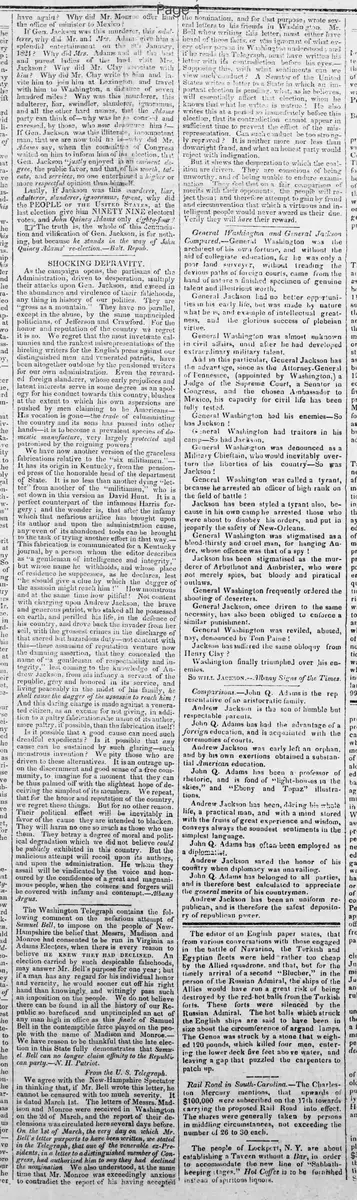
The Washington Telegraph contains the following comment on the nefarious attempt of Samuel Bell, to impose on the people of New-Hampshire the belief that Messrs. Madison and Monroe had consented to be run in Virginia as Adams Electors, when there is every reason to believe HE KNEW THEY HAD DECLINED. An election carried by such despicable falsehoods, may answer Mr. Bell's purpose for one year; but if a man has any regard for his individual honor and veracity, he would sooner cut off his right hand than knowingly and wittingly pass such an imposition on the people. We do not believe there can be found in all the history of our Republic so barefaced and unprincipled an act of any man high in office as this finale of Samuel Bell in the contemptible farce played on the people with the name of Madison and Monroe.—
We have reason to be thankful that the late election in this State fully demonstrates that Samuel Bell can no longer claim affinity to the Republican party.—N. H. Patriot.
From the U. S. Telegraph.
We agree with the New-Hampshire Spectator in thinking that, if Mr. Bell wrote this letter, he cannot be censured with too much severity. It is dated March 1st. The letters of Messrs. Madison and Monroe were received in Washington on the 2d of March, and the report of their declensions was circulated here several days before. On the 1st of March, the very day on which Mr. Bell's letter purports to have been written, we stated in the Telegraph, that one of the venerable ex-Presidents, in a letter to a distinguished member of Congress, had authorized him to say they had declined the nomination We also understood, at the same time that Mr. Monroe was exceedingly anxious to contradict the report of his having accepted the nomination, and for that purpose, wrote several letters to his friends in Washington. Mr. Bell when writing this letter, must either have heard of these facts, or was ignorant of what every other person in Washington understood: and if he reads the Telegraph, must have written his letter with its contradiction before his eyes.—
Supposing this, with what sentiments can we view such conduct? A Senator of the United States writes a letter to a State in which an important election is pending, what, as he believes, will essentially affect that election, when he knows that what he writes is untrue! He also writes this at a period so immediately before this election, that its contradiction cannot appear in sufficient time to prevent the effect of the misrepresentation. Can such conduct be too strongly reproved? It is neither more nor less than downright fraud, and what an honest party would reject with indignation.
But it shews the desperation to which the coalition are driven. They are conscious of being unworthy, and of being unable to endure examination They feel that on a fair comparison of merits with their opponents, the people will reject them; and therefore attempt to gain by fraud and circumvention that which a virtuous and intelligent people would never award as their due.
Verily they will have their reward.
We have reason to be thankful that the late election in this State fully demonstrates that Samuel Bell can no longer claim affinity to the Republican party.—N. H. Patriot.
From the U. S. Telegraph.
We agree with the New-Hampshire Spectator in thinking that, if Mr. Bell wrote this letter, he cannot be censured with too much severity. It is dated March 1st. The letters of Messrs. Madison and Monroe were received in Washington on the 2d of March, and the report of their declensions was circulated here several days before. On the 1st of March, the very day on which Mr. Bell's letter purports to have been written, we stated in the Telegraph, that one of the venerable ex-Presidents, in a letter to a distinguished member of Congress, had authorized him to say they had declined the nomination We also understood, at the same time that Mr. Monroe was exceedingly anxious to contradict the report of his having accepted the nomination, and for that purpose, wrote several letters to his friends in Washington. Mr. Bell when writing this letter, must either have heard of these facts, or was ignorant of what every other person in Washington understood: and if he reads the Telegraph, must have written his letter with its contradiction before his eyes.—
Supposing this, with what sentiments can we view such conduct? A Senator of the United States writes a letter to a State in which an important election is pending, what, as he believes, will essentially affect that election, when he knows that what he writes is untrue! He also writes this at a period so immediately before this election, that its contradiction cannot appear in sufficient time to prevent the effect of the misrepresentation. Can such conduct be too strongly reproved? It is neither more nor less than downright fraud, and what an honest party would reject with indignation.
But it shews the desperation to which the coalition are driven. They are conscious of being unworthy, and of being unable to endure examination They feel that on a fair comparison of merits with their opponents, the people will reject them; and therefore attempt to gain by fraud and circumvention that which a virtuous and intelligent people would never award as their due.
Verily they will have their reward.
What sub-type of article is it?
Partisan Politics
What keywords are associated?
Samuel Bell
Madison Monroe
Election Fraud
Partisan Deception
Adams Electors
New Hampshire Election
Political Coalition
What entities or persons were involved?
Samuel Bell
James Madison
James Monroe
John Quincy Adams
Republican Party
Coalition
Editorial Details
Primary Topic
Samuel Bell's Election Misinformation About Madison And Monroe
Stance / Tone
Strongly Critical Of Fraud And Political Deception
Key Figures
Samuel Bell
James Madison
James Monroe
John Quincy Adams
Republican Party
Coalition
Key Arguments
Bell Knowingly Spread Falsehood That Madison And Monroe Consented To Be Adams Electors
Their Declinations Were Public Knowledge By March 2, 1820s
Bell's Letter Dated March 1 Contradicted Reports In Washington Telegraph
Such Misrepresentation Is Downright Fraud To Influence Election
Conduct Shows Desperation Of Unworthy Coalition Unable To Win Fairly
Bell No Longer Affiliated With Republican Party After Election Loss