Thank you for visiting SNEWPapers!
Sign up free
Story
April 8, 1833
Lynchburg Virginian
Lynchburg, Virginia
What is this article about?
Daniel Webster's speech in the Senate replying to John C. Calhoun, defending the U.S. Constitution as a permanent union against nullification and secession doctrines in the context of the Revenue Collection Bill during the Nullification Crisis.
Clipping
OCR Quality
95%
Excellent
Full Text
POLITICAL.
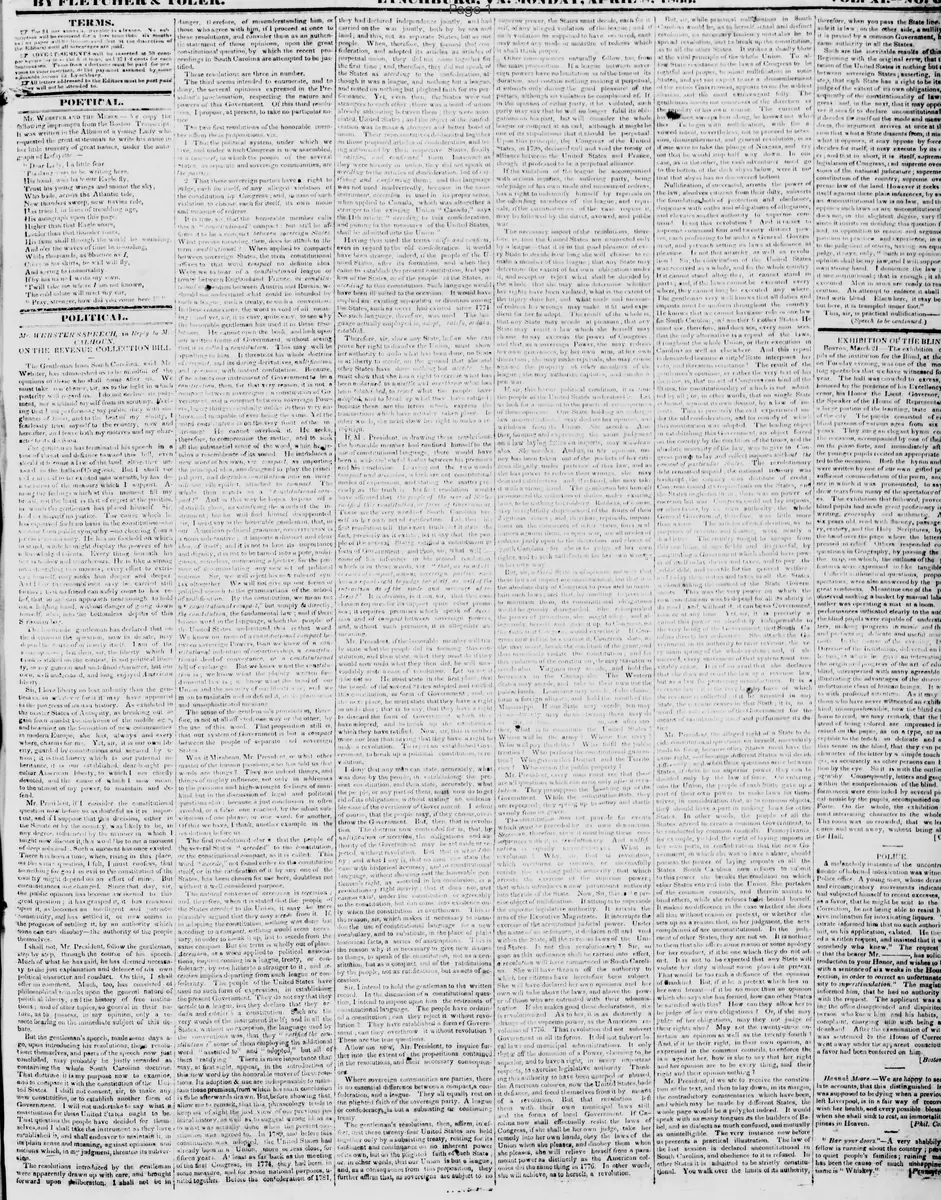
Mr. Webster's Speech, in Reply to Mr. Calhoun, on the Revenue Collection Bill.
The gentleman from South Carolina, said Mr. Webster, has admonished us to be mindful of the opinions of those who shall come after us. We must take our chance, sir, as to the light in which posterity will regard us. I do not decline its judgment, nor withhold myself from its scrutiny. Feeling that I am performing my public duty with singleness of heart, and to the best of my ability, I fearlessly trust myself to the country, now and hereafter, and leave both my motives and my character to its decision.
The gentleman has terminated his speech in a tone of threat and defiance toward this bill, even should it become a law of the land — altogether unusual in the halls of Congress. But I shall vote for it, sir, most sincerely hoping that its passage may not be excited into warmth, by his denunciation of the measure which I support. Among the feelings which at this moment fill my breast, not the least is that of regret at the position in which the gentleman has placed himself. Sir, I do myself no justice. The cause which he espouses, finds no basis in the constitution — loses the entire support of public sympathy — has no cheering form from a majority. He has no foothold on which to stand, while he might display the powers of his acknowledged eloquence. Everything beneath his feet is hollow and treacherous. He is like a strong man struggling in a morass; every effort to extricate himself only sinks him deeper and deeper. And if this resemblance may be carried still further, trust no friend can safely come to his relief, that no one can approach near enough to hold out a helping hand, without danger of going down himself into the bottomless depths of this Serbonian bog.
The honorable gentleman has declared that on the decision of the question now in debate, my personal fate depends on the use of liberty itself. I am of the same opinion, but then, sir, the liberty which I think is at stake in the contest, is not political liberty, in any general and undefined character, but our own, well understood, and long enjoyed American liberty.
Sir, I love liberty no less ardently than the gentleman. Whatever it may have appeared in the progress of human history. As exhibited in the master States of Antiquity, as breaking out again from amidst the darkness of the middle ages, and beaming on the formation of new communities in modern Europe, she has, always and everywhere, charms for me. Yet, sir, it is our own liberty, guarded by constitutions and secured by union; it is that liberty which is our paternal inheritance, it is our established, dear-bought peculiar American liberty, to which I am chiefly devoted, and the cause of which I now mean to the utmost of my power, to maintain and defend.
Mr. President, if I consider the constitutional question now before us as doubtful as it is important, and if I suppose that this decision, either in the Senate or by the country, was likely to be, in any degree, influenced by the manner in which I might now discuss it, this would be to me a moment of deep solicitude. Such a moment has once existed. There has been a time, when, rising in this place, on the same question, I felt, I must confess, that something for good or evil to the constitution of the country might depend on an effort of mine. But circumstances are changed. Since that day, sir, the public opinion has become awakened to this great question; it has grasped it, it has reasoned upon it, as becomes an intelligent and patriotic community, and has settled it, or now seems in the progress of settling it, by an authority which none can disobey — the authority of the people themselves.
I shall not, Mr. President, follow the gentleman step by step, through the course of his speech. Much of what he has said, he has deemed necessary to the just explanation and defence of his own political character and conduct. On this, I shall offer no comment. Much, too, has consisted of philosophical remarks upon the general nature of political liberty, and the history of free institutions; and of other topics, so general in their nature, as to possess, in my opinion, only a remote bearing on the immediate subject of this debate.
But the gentleman's speech, made some days ago, upon introducing his resolutions, those resolutions themselves, and parts of the speech now just concluded, may probably be justly regarded as containing the whole South Carolina doctrine. That doctrine it is my purpose now to examine, and to compare it with the constitution of the United States. I shall not consent, sir, to make any new constitution, or to establish another form of Government. I will not undertake to say what a constitution for these United States ought to be. That question the people have decided for themselves, and I shall take the instrument as they have established it, and shall endeavor to maintain it, in its plain sense and meaning, against opinions and notions which, in my judgment, threaten its subversion.
The resolutions introduced by the gentleman were apparently drawn up with care, and brought forward upon deliberation. I shall not be in danger, therefore, of misunderstanding him, or those who agree with him, if I proceed at once to these resolutions, and consider them as an authentic statement of those opinions, upon the great constitutional question, by which the recent proceedings in South Carolina are attempted to be justified.
These resolutions are three in number. The third seems intended to enumerate, and to deny, the several opinions expressed in the President's proclamation, respecting the nature and powers of this Government. Of this third resolution, I propose, at present, to take no particular notice.
The two first resolutions of the honorable member affirm these propositions, viz:
1. That the political system, under which we live, and under which Congress is now assembled, is a compact, to which the people of the several States, as separate and sovereign communities, are the parties.
2. That these sovereign parties have right to judge, each for itself, of any alleged violation of the constitution by Congress, and, in case of such violation, to choose, each for itself, its own mode and measure of redress.
It is true, sir, that the honorable member calls this a "constitutional compact:" but still he affirms it to be a compact between sovereign States. What precise meaning, then, does he attach to the term constitutional? When applied to compacts between sovereign States, the term constitutional annexes to that word compact no definite idea. Were we to hear of a constitutional league or treaty between England and France, or constitutional convention between Austria and Russia, we should not understand what could be intended by such a league, such a treaty, or such a convention. In these connexions, the word is void of all meaning: should yet, sir, it is easy, quite easy, to see why the honorable gentleman has used it in these resolutions. He cannot open the book, and look upon our written frame of Government, without seeing that it is a constitution. This may well be appalling to him. It threatens his whole doctrine of expunging, and its daring derivatives, nullification and secession, with instant confutation. Because, if he admits our instrument of Government to be a constitution, then, for that very reason, it is not a compact between sovereigns. A constitution of Government, and a compact between sovereign Powers, being things essentially unlike in theory and nature, and incapable of ever being the same. Yet the word constitution is on the very front of the instrument. He cannot overlook it. He seeks, therefore, to compromise the matter, and to sink all the substantial sense of the word, while he retains a resemblance of its sound. He introduces a new word of his own, the compound word, as importing the principal idea, and designed to play the principal part, and degrades constitution into an insignificant epithet, attached to compact. The whole then stands as a "constitutional compact!" And in this way he hopes to pass off his plausible gloss, as satisfying the words of the instrument, but he will find himself disappointed.
Sir, I must say to the honorable gentleman, that, in our American political grammar, constitution is a noun substantive; it imports a distinct and definite idea; of itself; and it is not to lose its importance and dignity, it is not to be turned into a poor, ambiguous, senseless, unmeaning adjective, for the purpose of levelling any new sort of political notions. Sir, we will reject his new rules of syntax altogether. We will not give up our forms of political speech to the grammarians of the school of nullification. By the constitution, we mean not a "constitutional compact," but simply and directly, the constitution, the fundamental law; and if there be one word in the language, which the people of the United States understand, this is that word. We know no more of a constitutional compact between sovereign Powers, than we know of a constitutional indenture of copartnership, a constitutional deed of conveyance, or a constitutional bill of exchange. But we know what the constitution is: we know what the plainly written fundamental law is: we know what the bond of our Union and the security of our liberties is, and we mean to maintain and to defend it, in its plain and unsophisticated meaning.
The sense of the gentleman's proposition, therefore, is not at all affected, one way or the other, by the use of this word. That proposition still is, that our system of Government is but a compact between the people of separate and sovereign States.
Was it Mirabeau, Mr. President, or what other master of the human passions, who has told us that words are things? They are indeed things, and things of mighty influence, not only in addresses to the passions and high-wrought feelings of mankind, but in the discussion of legal and political questions also: because a just conclusion is often avoided, or a false one reached, by the adroit substitution of one phrase, or one word, for another. Of this we have, I think, another example in the resolutions before us.
The first resolution declares that the people of the several States "acceded" to the constitution, or the constitutional compact, as it is called. This word "accede," not found either in the constitution itself, or in the ratification of it by any one of the States, has been chosen for use here, doubtless not without a well considered purpose. The natural converse of accession is secession; and therefore, when it is stated that the people of the States acceded to the Union, it may be more plausibly argued that they may secede from it. If, in adopting the constitution, nothing was done but acceding to a compact, nothing would seem necessary, in order to break it up, but to secede from the same compact. But the term is wholly out of place. Accession, as a word applied to political associations, implies coming into a league, treaty, or confederacy, by one hitherto a stranger to it; and secession implies departing from such league or confederacy. The people of the United States have used no such form of expression, in establishing the present Government. They do not say that they accede to a league, but they declare that they ordain and establish a constitution. Such are the very words of the instrument itself; and in all the States, without an exception, the language used by the conventions was, that they "ratified the constitution;" some of them employing the additional words "assented to" and "adopted," but all of them "ratifying." There is more importance than may, at first sight, appear, in the introduction of this new word by the honorable mover of these resolutions. Its adoption and use are indispensable to maintain those premises, from which his main conclusion is to be afterwards drawn. But, before showing that, allow me to remark, that this phraseology tends to keep out of sight the just view of our previous political history, as well as to suggest wrong ideas as to what was actually done when the present constitution was agreed to. In 1789, and before this constitution was adopted, the United States had already been in a Union, more or less close, for fifteen years. At least as far back as the meeting of the first Congress, in 1774, they had been, in some measure, and for some national purposes, united together. Before the confederation of 1781, they had declared independence jointly, and had carried on the war jointly, both by sea and land; and this, not as separate States, but as one people. When, therefore, they formed that confederation, and adopted its articles as articles of perpetual union, they did not come together for the first time, and, therefore, they did not speak of the States as acceding to the confederation, although it was a league, and nothing but a league, and rested on nothing but plighted faith for its performance. Yet, even then, the States were not strangers to each other: there was a bond of union already subsisting between them, they were associated, United States; and the object of the confederation was to make a stronger and better bond of union. Their representatives deliberated together on those proposed articles of confederation, and by them authorized by their respective States, finally ratified and confirmed them. Inasmuch as they were already in union, they did not speak of acceding to the articles of confederation, but of ratifying and confirming them, and this language was not used inadvertently, because in the same instrument, accession is used in its proper sense, when applied to Canada, which was altogether a stranger to the existing Union. "Canada," says the 11th article, "acceding to this confederation, and joining in the measures of the United States, shall be admitted into the Union."
Having thus used the terms ratify and confirm, even in regard to the old confederation, it would have been strange, indeed, if the people of the United States, after its formation, and when they came to establish the present constitution, had spoken of the States, or of the people of the States, as acceding to this constitution. Such language would have been ill suited to the occasion. It would have implied an existing separation or disunion among the States, such as never had existed since 1776. No such language, therefore, was used. The language actually employed is, adopt, ratify, ordain, establish.
Therefore, sir, since any State, before she can prove her right to dissolve the Union, must show her authority to do what has been done, no State is at liberty to secede, on the ground that she and other States have done nothing but accede. She must show that she has a right to reverse what has been done, to unsettle and overturn what has been established, to repeal what the people have adopted, and to break up what they have ratified, because these are the terms which express the transactions which have actually taken place. In other words, she must show her right to make a revolution.
If, Mr. President, in drawing these resolutions, the honorable member had confined himself to the use of constitutional language, there would have been twice as wide a chasm between his premises and his conclusion. Leaving out the two words compact and accession, which are not constitutional modes of expression, and stating the matter as the truth is, his first resolution would have affirmed that the people of the several States ratified this constitution, or form of Government. These are the very words of South Carolina herself in her own act of ratification. Let this first resolution tell the exact truth, if it state the fact precisely as it exists, if it say that the people of the several States ratified a constitution or form of Government, and then, sir, what will come of his inference in his second resolution, which is in these words, viz: "that, as in other cases of compact among sovereign parties, each has an equal right to judge for itself, as well of the infraction as of the mode and measure of redress?" It is obvious, is it not, sir, that this conclusion requires for its support quite other premises; it requires premises which speak of secession and of compact between sovereign powers, and, without such premises, it is altogether unmeaning.
Mr. President, if the honorable member will try to state what the people did in forming this constitution, and then state what they must do if they would now undo what they then did, he will unavoidably state a case of revolution. Let us see if it be not so. He must state, in the first place, that the people of the several States adopted and ratified this constitution, or form of Government, and, in the next place, he must state that they have a right to undo this, that is to say, that they have a right to discard the form of Government which they have adopted, and to break up the constitution which they have ratified. Now, sir, this is neither more nor less than saying that they have a right to make a revolution. To erect an established Government, to break up a political constitution, is revolution. I deny that any man can state, accurately, what was done by the people, in establishing the present constitution, and then state, accurately, what the people, or any part of them, must now do to get rid of its obligations, without stating an undeniable case of the overthrow of Government. I admit, of course, that the people may, if they choose, overthrow the Government. But, then, that is revolution. The doctrine now contended for is, that, by nullification or secession, the obligations and authority of the Government may be set aside or rejected without revolution. But that is wholly idle; and what I say is, that no man can state the case with historical accuracy, and in constitutional language, without showing that the honorable gentleman's right, as asserted in his conclusion, is a revolutionary right merely, that it does not, and cannot exist, under the constitution or agreeably to the constitution, but can come into existence only when the constitution is overthrown. This is the reason, sir, which makes it necessary to abandon the use of constitutional language for a new vocabulary, and to substitute, in the place of plain historical facts, a series of assumptions. This is the reason why it is necessary to give new names to things, to speak of the constitution, not as a constitution, but as a compact, and of the ratifications by the people, not as ratifications, but as acts of accession. Sir, I intend to hold the gentleman to the written record. In the discussion of a constitutional question, I intend to impose upon him the restraints of constitutional language. The people have ordained a constitution; can they reject it without revolution? They have established a form of Government; can they overthrow it without revolution? These are the true questions.
Allow me now, Mr. President, to inquire further into the extent of the propositions contained in the resolutions, and their necessary consequences.
Where sovereign communities are parties, there is no essential difference between a compact, a confederation, and a league. They all equally rest on the plighted faith of the sovereign party. A league or confederacy is but a subsisting or continuing treaty. The gentleman's resolutions, then, affirm, in effect, that these twenty-four United States are held together only by a subsisting treaty, resting for its fulfilment and continuance on no inherent power of its own, but on the plighted faith of each State. Or, in other words, that our Union is but a league, and, as a consequence from this proposition, they further affirm that, as sovereigns are subject to no superior power, the States must decide, each for itself, of any alleged violation of the league; and if such violation be supposed to have occurred, each may adopt any mode or measure of redress which it shall think proper.
Other consequences naturally follow, too, from the main proposition. If a league between sovereign powers have no limitation as to the time of its duration, and contain nothing making it perpetual, it subsists only during the good pleasure of the parties, although no violation be complained of. If, in the opinion of either party, it be violated, such party may say that he will no longer fulfil its obligations on his part, but will consider the whole league or compact at an end, although it might be one of its stipulations that it should be perpetual. Upon this principle, the Congress of the United States, in 1798, declared null and void the treaty of alliance between the United States and France, though it professed to be a perpetual alliance.
If the violation of the league be accompanied with serious injuries, the suffering party, being sole judge of his own mode and measure of redress, has a right to indemnify himself by reprisals on the offending members of the league, and reprisals, if the circumstances of the case require it, may be followed by the direct, avowed, and public war.
The necessary import of the resolutions, therefore, is, that the United States are connected only by a league, that it is in the good pleasure of every State to decide how long she will choose to remain a member of this league, that any State may determine the extent of her own obligations under it, and accept or reject what shall be decided by the whole; that she may also determine whether her rights have been violated, what is the extent of the injury done her, and what mode and measure of redress her wrongs may make it fit and expedient for her to adopt. The result of the whole is, that any State may secede at pleasure, that any State may resist a law which she herself may choose to say exceeds the power of Congress, and that, as a sovereign Power, she may redress her own grievances, by her own arm, at her own discretion, she may make reprisals, she may cruise against the property of other members of the league, she may authorize captures, and make open war.
I, sir, thus view our political condition. Is it what the people of the United States understood? Let us look for a moment to the practical consequences of these opinions. One State holds a law unconstitutional; she declares her opinion, and withdraws from the Union. She secedes. Another, forming and expressing the same judgment on a law laying duties on imports, may withdraw also. She secedes. And as, in her own opinion, money has been taken out of the pockets of her citizens illegally, under pretence of this law, and as she has power to redress their wrongs, she may demand satisfaction, and if refused, she may take it with a strong hand. The gentleman has himself pronounced the collection of duties and existing laws to be nothing but robbery. Of course, the robbers may be rightfully despoiled of the fruits of their dubious gains, and, therefore, reprisals, impositions on the commerce of other States, force against them or open war, are all modes of redress justly open to the discretion and choice of South Carolina; for she is to judge of her own rights, and to seek satisfaction for her own wrongs.
But, sir, a far State so deems these laws of Congress unconstitutional, but that it is the absolute duty of Congress to pass, and to maintain such laws, and that, by omitting to pass, and to maintain them, its constitutional obligations would be grossly disregarded. She relinquishes the power of protection, she might nullify and annul a law truly her own, and give up to nothingness one of the objects for which the constitution was ordained. Congress refuses now to exercise it. Congress does, as she may wait, break the condition of the grant, and thus most seriously violate the constitution, and in violation of the constitution, she may threaten to secede also. Virginia may secede, and hold the fortresses in the Chesapeake. The Western States may secede, and take to their own use the public lands. Louisiana may secede, if she choose, form a foreign alliance, and hold the mouth of the Mississippi. If one State may secede, ten may; twenty-three may; sir, what is to constitute the United States? Whose will be the army? Whose the navy? Who will pay the debt? Who fulfil the public treaties? Who perform the constitutional guarantees? Who govern the District and the Territories? Who retain the public property? Mr. President, every man must see that these are all questions which can arise only after a revolution. While the constitution lasts, they are repressed, they spring up only from its grave.
The constitution does not provide for conventions which must be preceded by its own destruction. Secession, therefore, since it must bring these consequences with it, is revolution. And nullification is equally revolutionary. What is revolution? Why, sir, that is revolution, which overturns, or controls, or successfully resists, the existing public authority; that which arrests the exercise of the supreme power, that which introduces a new paramount authority into the rule of the State. Now, sir, this is the precise object of nullification. It attempts to supersede the supreme legislative authority. It arrests the arm of the Executive Magistrate. It interrupts the exercise of the accustomed judicial power. Under the name of ordinance, it declares null and void, within the State, all the revenue laws of the United States. Is not this revolutionary? Sir, so soon as this ordinance shall be carried into effect, a revolution will have commenced in South Carolina. She will have thrown off the authority to which her citizens have heretofore been subject. She will have declared her own opinions and her own will to be above the laws, and above the power of those who are entrusted with their administration. If she makes good these declarations, she is revolutionized. As to her, it is as distinctly a change of the supreme power, as the American revolution of 1776. That revolution did not subvert Government in all its forms. It did not subvert local laws and municipal administrations. It only threw off the dominion of a Power, claiming to be superior, and to have a right, in many important respects, to exercise legislative authority. Thinking this authority to have been usurped or abused, the American colonies, now the United States, bade it defiance, and freed themselves from it by means of a revolution. But that revolution left them with their own municipal laws still, and the forms of local Government. If Carolina now shall effectually resist the laws of Congress, if she shall be her own judge, take her remedy into her own hands, obey the laws of the Union when she pleases, and disobey them when she pleases, she will relieve herself from a paramount power as distinctly as the American colonies did the same thing in 1776. In other words, she will achieve, as to herself, a revolution.
But, sir, while practical nullification in South Carolina would be, as to herself, actual and distinct revolution, it necessarily leads to spreading revolution, and to break up the constitution, as to all the other States. It strikes a deadly blow at the vital principle of the whole Union. To allow State resistance to the laws of Congress to be rightful and proper, to admit nullification in some States, and yet not expect to see a dismemberment of the entire Government, appears to me the wildest delusion and the most extravagant folly. The gentleman seems not considering of the direction or the rapidity of his own course. The current of his opinion sweeps him along, he knows not whither. To logick with nullification, with the avowed intent, nevertheless, to proceed to secession, dismemberment, and general revolution, is as if one were to take the plunge of Niagara, and cry out that he would stop half way down. In one case, as in the other, the rash adventurer must go to the bottom of the dark abyss below, were it not that that abyss has no discovered bottom.
Nullification, if successful, arrests the power of the law, absolves citizens from their duty, subverts the foundation, both of protection and obedience. Dispenses with oaths and obligations of allegiance, and elevates another authority to supreme command. Is not this revolution? And it raises to supreme command four and twenty distinct powers, each professing to be under a General Government, and yet each setting its laws at defiance at pleasure. Is not this anarchy, as well as revolution? Sir, the constitution of the United States was received as a whole, and for the whole country. If it cannot stand altogether, it cannot stand in parts, and, if the laws cannot be executed everywhere, they cannot long be executed anywhere. The gentleman very well knows that all duties and imposts must be uniform throughout the country. He knows that we cannot have one rule or one law for South Carolina, and another for other States. He must see, therefore, and does see, every man sees, that the only alternative is a repeal of the laws, throughout the whole Union, or their execution in Carolina as well as elsewhere. And this repeal is demanded because a single State interposes her veto, and threatens resistance. The result of the gentleman's opinions, or rather the very text of his logic is, that three-fourths of Congress cannot bind all the States, the constitutionality of which is not admitted by all; or, in other words, that no single State is bound, against its own dissent, by a law of imposts. This is precisely the evil experienced under the old confederation, and for remedy of which this constitution was adopted. The leading object in establishing this Government, an object forced on the country by the condition of the times, and the absolute necessity of the case, was to give to Congress power to lay and collect imposts without the consent of individual States. The revolutionary debt remained unpaid, the national treasury was bankrupt, the country was destitute of credit, Congress issued its requisitions on the States, and the States neglected them, there was no power of coercion but war. Congress could not lay imposts, or other taxes, by any authority, the whole Government was, therefore, little more than the shadow of a Federal Government, the articles of confederation, as to purposes of revenue and taxes, were nearly a nullity. The country sought to escape from this helpless and disgraceful condition, by instituting a Government which should have power to lay taxes and assessments, and to pay the public debt and provide for the general welfare. To lay these taxes and assessments on all the States without asking the consent of the State Governments. This was the very power on which the new constitution was to depend for all its ability to do good; and without it, it can be no Government, now or at any time. Yet, sir, it is precisely against this power, so absolutely indispensable to the very being of the Government, that South Carolina directs her ordinance. She attacks the Government in its authority to raise revenue, the very main spring of the whole system, and, if she succeed, every movement of that system must inevitably cease. It is of no avail that she declares that she does not resist the law as a revenue law, but as a law for protecting manufactures. It is a revenue law; it is the very law by force of which the revenue is collected. If it be arrested in any State, the revenue ceases in that State; it is, in a word, the main sinew of the Government for the means of maintaining itself and performing its duties.
Mr. President, the alleged right of a State to decide constitutional questions for herself, necessarily leads to force, because other States must have the difficulty met when these questions arise between them. Having the same right, and because different States will decide differently, and without any superior power, they can be decided only by the law of force. On entering into the Union, the people of each State gave up a part of their own power to make laws for themselves, in consideration that, as to common objects, they should have a part in making laws for other States. In other words, the people of all the States agreed to create a common Government, to be conducted by common councils. Pennsylvania, for example, yielded the right of laying imposts in her own ports, in consideration that the new Government, in which she was to have a share, should possess the power of laying imposts in all the States. South Carolina now refuses to submit to this power; she breaks the condition on which other States entered into the Union. She partakes in the common councils, and therein assists to bind others, while she refuses to be bound herself. It makes no difference in the case whether she does all this without reason or pretext, or whether she sets up as a reason that, in her judgment, the acts complained of are unconstitutional. In the judgment of other States, they are not so. It is nothing to them that she offers some reason or some apology for her conduct, if it be one which they do not admit. It is not to be expected that any State will violate her duty without some plausible pretext. That would be too rash a defiance of the opinion of mankind. But, if it be a pretext which lies in her own breast — if it be no more than an opinion which she says she has formed, how can other States be satisfied with this? How can they allow her to be judge of her own obligations? Or, if she may judge of her obligations, may they not judge of their rights also? May not the twenty-three entertain an opinion as well as the twenty-fourth? And, if it be their right, in their own opinion, as expressed in the common councils, to enforce the law against her, how is she to say that her right and her opinion are to be everything, and their right and their opinion nothing?
Mr. President, if we are to receive the constitution as the text, and then to lay down, in its margin, the contradictory commentaries which have been, and which may be made by different States, the whole page would be a polyglot indeed. It would speak with as many tongues as the builders of Babel, and in dialects as much confused, and mutually as unintelligible. The very instance now before us presents a practical illustration. The law of the last session is declared unconstitutional in South Carolina, and obedience to it is refused. In other States it is admitted to be strictly constitutional. You walk over the limits of its authority, therefore, when you pass the State line. On one side it is law; on the other side, a nullity; and yet it is passed by a common Government, having the same authority in all the States.
Such are the inevitable results of this doctrine. Beginning with the original error, that the constitution of the United States is nothing but a compact between sovereign States; asserting, in the next step, that each State has a right to be its own sole judge of the extent of its own obligations, and consequently of the constitutionality of laws of Congress; and, in the next, that it may oppose whatever it sees fit to declare unconstitutional, and that it decides for itself on the mode and measure of redress; the argument arrives at once at the conclusion that what a State dissents from, it may nullify; what it opposes, it may oppose by force; what it decides for itself, it may execute by its own power, and that in short, it is itself, supreme over the legislation of Congress, and supreme over the decisions of the national judicature; supreme over the constitution of the country, supreme over the supreme law of the land. However it seeks to protect itself against these plain inferences, by saying that an unconstitutional law is no law, and that it only opposes such laws as are unconstitutional, yet this does not, in the slightest degree, vary the result, since it insists on deciding this question for itself; and, in opposition to reason and argument, in opposition to practice and experience, in opposition to the judgment of others, having an equal right to judge, it says, only, "such is my opinion, and my opinion shall be my law, and I will support it by my own strong hand. I denounce the law; I declare it unconstitutional; that is enough; it shall not be executed. Men in arms are ready to resist its execution. An attempt to enforce it shall cover the land with blood. Elsewhere, it may be binding, but here, it is trampled under foot."
Thus, sir, is practical nullification —
(Speech to be continued.)
Mr. Webster's Speech, in Reply to Mr. Calhoun, on the Revenue Collection Bill.
The gentleman from South Carolina, said Mr. Webster, has admonished us to be mindful of the opinions of those who shall come after us. We must take our chance, sir, as to the light in which posterity will regard us. I do not decline its judgment, nor withhold myself from its scrutiny. Feeling that I am performing my public duty with singleness of heart, and to the best of my ability, I fearlessly trust myself to the country, now and hereafter, and leave both my motives and my character to its decision.
The gentleman has terminated his speech in a tone of threat and defiance toward this bill, even should it become a law of the land — altogether unusual in the halls of Congress. But I shall vote for it, sir, most sincerely hoping that its passage may not be excited into warmth, by his denunciation of the measure which I support. Among the feelings which at this moment fill my breast, not the least is that of regret at the position in which the gentleman has placed himself. Sir, I do myself no justice. The cause which he espouses, finds no basis in the constitution — loses the entire support of public sympathy — has no cheering form from a majority. He has no foothold on which to stand, while he might display the powers of his acknowledged eloquence. Everything beneath his feet is hollow and treacherous. He is like a strong man struggling in a morass; every effort to extricate himself only sinks him deeper and deeper. And if this resemblance may be carried still further, trust no friend can safely come to his relief, that no one can approach near enough to hold out a helping hand, without danger of going down himself into the bottomless depths of this Serbonian bog.
The honorable gentleman has declared that on the decision of the question now in debate, my personal fate depends on the use of liberty itself. I am of the same opinion, but then, sir, the liberty which I think is at stake in the contest, is not political liberty, in any general and undefined character, but our own, well understood, and long enjoyed American liberty.
Sir, I love liberty no less ardently than the gentleman. Whatever it may have appeared in the progress of human history. As exhibited in the master States of Antiquity, as breaking out again from amidst the darkness of the middle ages, and beaming on the formation of new communities in modern Europe, she has, always and everywhere, charms for me. Yet, sir, it is our own liberty, guarded by constitutions and secured by union; it is that liberty which is our paternal inheritance, it is our established, dear-bought peculiar American liberty, to which I am chiefly devoted, and the cause of which I now mean to the utmost of my power, to maintain and defend.
Mr. President, if I consider the constitutional question now before us as doubtful as it is important, and if I suppose that this decision, either in the Senate or by the country, was likely to be, in any degree, influenced by the manner in which I might now discuss it, this would be to me a moment of deep solicitude. Such a moment has once existed. There has been a time, when, rising in this place, on the same question, I felt, I must confess, that something for good or evil to the constitution of the country might depend on an effort of mine. But circumstances are changed. Since that day, sir, the public opinion has become awakened to this great question; it has grasped it, it has reasoned upon it, as becomes an intelligent and patriotic community, and has settled it, or now seems in the progress of settling it, by an authority which none can disobey — the authority of the people themselves.
I shall not, Mr. President, follow the gentleman step by step, through the course of his speech. Much of what he has said, he has deemed necessary to the just explanation and defence of his own political character and conduct. On this, I shall offer no comment. Much, too, has consisted of philosophical remarks upon the general nature of political liberty, and the history of free institutions; and of other topics, so general in their nature, as to possess, in my opinion, only a remote bearing on the immediate subject of this debate.
But the gentleman's speech, made some days ago, upon introducing his resolutions, those resolutions themselves, and parts of the speech now just concluded, may probably be justly regarded as containing the whole South Carolina doctrine. That doctrine it is my purpose now to examine, and to compare it with the constitution of the United States. I shall not consent, sir, to make any new constitution, or to establish another form of Government. I will not undertake to say what a constitution for these United States ought to be. That question the people have decided for themselves, and I shall take the instrument as they have established it, and shall endeavor to maintain it, in its plain sense and meaning, against opinions and notions which, in my judgment, threaten its subversion.
The resolutions introduced by the gentleman were apparently drawn up with care, and brought forward upon deliberation. I shall not be in danger, therefore, of misunderstanding him, or those who agree with him, if I proceed at once to these resolutions, and consider them as an authentic statement of those opinions, upon the great constitutional question, by which the recent proceedings in South Carolina are attempted to be justified.
These resolutions are three in number. The third seems intended to enumerate, and to deny, the several opinions expressed in the President's proclamation, respecting the nature and powers of this Government. Of this third resolution, I propose, at present, to take no particular notice.
The two first resolutions of the honorable member affirm these propositions, viz:
1. That the political system, under which we live, and under which Congress is now assembled, is a compact, to which the people of the several States, as separate and sovereign communities, are the parties.
2. That these sovereign parties have right to judge, each for itself, of any alleged violation of the constitution by Congress, and, in case of such violation, to choose, each for itself, its own mode and measure of redress.
It is true, sir, that the honorable member calls this a "constitutional compact:" but still he affirms it to be a compact between sovereign States. What precise meaning, then, does he attach to the term constitutional? When applied to compacts between sovereign States, the term constitutional annexes to that word compact no definite idea. Were we to hear of a constitutional league or treaty between England and France, or constitutional convention between Austria and Russia, we should not understand what could be intended by such a league, such a treaty, or such a convention. In these connexions, the word is void of all meaning: should yet, sir, it is easy, quite easy, to see why the honorable gentleman has used it in these resolutions. He cannot open the book, and look upon our written frame of Government, without seeing that it is a constitution. This may well be appalling to him. It threatens his whole doctrine of expunging, and its daring derivatives, nullification and secession, with instant confutation. Because, if he admits our instrument of Government to be a constitution, then, for that very reason, it is not a compact between sovereigns. A constitution of Government, and a compact between sovereign Powers, being things essentially unlike in theory and nature, and incapable of ever being the same. Yet the word constitution is on the very front of the instrument. He cannot overlook it. He seeks, therefore, to compromise the matter, and to sink all the substantial sense of the word, while he retains a resemblance of its sound. He introduces a new word of his own, the compound word, as importing the principal idea, and designed to play the principal part, and degrades constitution into an insignificant epithet, attached to compact. The whole then stands as a "constitutional compact!" And in this way he hopes to pass off his plausible gloss, as satisfying the words of the instrument, but he will find himself disappointed.
Sir, I must say to the honorable gentleman, that, in our American political grammar, constitution is a noun substantive; it imports a distinct and definite idea; of itself; and it is not to lose its importance and dignity, it is not to be turned into a poor, ambiguous, senseless, unmeaning adjective, for the purpose of levelling any new sort of political notions. Sir, we will reject his new rules of syntax altogether. We will not give up our forms of political speech to the grammarians of the school of nullification. By the constitution, we mean not a "constitutional compact," but simply and directly, the constitution, the fundamental law; and if there be one word in the language, which the people of the United States understand, this is that word. We know no more of a constitutional compact between sovereign Powers, than we know of a constitutional indenture of copartnership, a constitutional deed of conveyance, or a constitutional bill of exchange. But we know what the constitution is: we know what the plainly written fundamental law is: we know what the bond of our Union and the security of our liberties is, and we mean to maintain and to defend it, in its plain and unsophisticated meaning.
The sense of the gentleman's proposition, therefore, is not at all affected, one way or the other, by the use of this word. That proposition still is, that our system of Government is but a compact between the people of separate and sovereign States.
Was it Mirabeau, Mr. President, or what other master of the human passions, who has told us that words are things? They are indeed things, and things of mighty influence, not only in addresses to the passions and high-wrought feelings of mankind, but in the discussion of legal and political questions also: because a just conclusion is often avoided, or a false one reached, by the adroit substitution of one phrase, or one word, for another. Of this we have, I think, another example in the resolutions before us.
The first resolution declares that the people of the several States "acceded" to the constitution, or the constitutional compact, as it is called. This word "accede," not found either in the constitution itself, or in the ratification of it by any one of the States, has been chosen for use here, doubtless not without a well considered purpose. The natural converse of accession is secession; and therefore, when it is stated that the people of the States acceded to the Union, it may be more plausibly argued that they may secede from it. If, in adopting the constitution, nothing was done but acceding to a compact, nothing would seem necessary, in order to break it up, but to secede from the same compact. But the term is wholly out of place. Accession, as a word applied to political associations, implies coming into a league, treaty, or confederacy, by one hitherto a stranger to it; and secession implies departing from such league or confederacy. The people of the United States have used no such form of expression, in establishing the present Government. They do not say that they accede to a league, but they declare that they ordain and establish a constitution. Such are the very words of the instrument itself; and in all the States, without an exception, the language used by the conventions was, that they "ratified the constitution;" some of them employing the additional words "assented to" and "adopted," but all of them "ratifying." There is more importance than may, at first sight, appear, in the introduction of this new word by the honorable mover of these resolutions. Its adoption and use are indispensable to maintain those premises, from which his main conclusion is to be afterwards drawn. But, before showing that, allow me to remark, that this phraseology tends to keep out of sight the just view of our previous political history, as well as to suggest wrong ideas as to what was actually done when the present constitution was agreed to. In 1789, and before this constitution was adopted, the United States had already been in a Union, more or less close, for fifteen years. At least as far back as the meeting of the first Congress, in 1774, they had been, in some measure, and for some national purposes, united together. Before the confederation of 1781, they had declared independence jointly, and had carried on the war jointly, both by sea and land; and this, not as separate States, but as one people. When, therefore, they formed that confederation, and adopted its articles as articles of perpetual union, they did not come together for the first time, and, therefore, they did not speak of the States as acceding to the confederation, although it was a league, and nothing but a league, and rested on nothing but plighted faith for its performance. Yet, even then, the States were not strangers to each other: there was a bond of union already subsisting between them, they were associated, United States; and the object of the confederation was to make a stronger and better bond of union. Their representatives deliberated together on those proposed articles of confederation, and by them authorized by their respective States, finally ratified and confirmed them. Inasmuch as they were already in union, they did not speak of acceding to the articles of confederation, but of ratifying and confirming them, and this language was not used inadvertently, because in the same instrument, accession is used in its proper sense, when applied to Canada, which was altogether a stranger to the existing Union. "Canada," says the 11th article, "acceding to this confederation, and joining in the measures of the United States, shall be admitted into the Union."
Having thus used the terms ratify and confirm, even in regard to the old confederation, it would have been strange, indeed, if the people of the United States, after its formation, and when they came to establish the present constitution, had spoken of the States, or of the people of the States, as acceding to this constitution. Such language would have been ill suited to the occasion. It would have implied an existing separation or disunion among the States, such as never had existed since 1776. No such language, therefore, was used. The language actually employed is, adopt, ratify, ordain, establish.
Therefore, sir, since any State, before she can prove her right to dissolve the Union, must show her authority to do what has been done, no State is at liberty to secede, on the ground that she and other States have done nothing but accede. She must show that she has a right to reverse what has been done, to unsettle and overturn what has been established, to repeal what the people have adopted, and to break up what they have ratified, because these are the terms which express the transactions which have actually taken place. In other words, she must show her right to make a revolution.
If, Mr. President, in drawing these resolutions, the honorable member had confined himself to the use of constitutional language, there would have been twice as wide a chasm between his premises and his conclusion. Leaving out the two words compact and accession, which are not constitutional modes of expression, and stating the matter as the truth is, his first resolution would have affirmed that the people of the several States ratified this constitution, or form of Government. These are the very words of South Carolina herself in her own act of ratification. Let this first resolution tell the exact truth, if it state the fact precisely as it exists, if it say that the people of the several States ratified a constitution or form of Government, and then, sir, what will come of his inference in his second resolution, which is in these words, viz: "that, as in other cases of compact among sovereign parties, each has an equal right to judge for itself, as well of the infraction as of the mode and measure of redress?" It is obvious, is it not, sir, that this conclusion requires for its support quite other premises; it requires premises which speak of secession and of compact between sovereign powers, and, without such premises, it is altogether unmeaning.
Mr. President, if the honorable member will try to state what the people did in forming this constitution, and then state what they must do if they would now undo what they then did, he will unavoidably state a case of revolution. Let us see if it be not so. He must state, in the first place, that the people of the several States adopted and ratified this constitution, or form of Government, and, in the next place, he must state that they have a right to undo this, that is to say, that they have a right to discard the form of Government which they have adopted, and to break up the constitution which they have ratified. Now, sir, this is neither more nor less than saying that they have a right to make a revolution. To erect an established Government, to break up a political constitution, is revolution. I deny that any man can state, accurately, what was done by the people, in establishing the present constitution, and then state, accurately, what the people, or any part of them, must now do to get rid of its obligations, without stating an undeniable case of the overthrow of Government. I admit, of course, that the people may, if they choose, overthrow the Government. But, then, that is revolution. The doctrine now contended for is, that, by nullification or secession, the obligations and authority of the Government may be set aside or rejected without revolution. But that is wholly idle; and what I say is, that no man can state the case with historical accuracy, and in constitutional language, without showing that the honorable gentleman's right, as asserted in his conclusion, is a revolutionary right merely, that it does not, and cannot exist, under the constitution or agreeably to the constitution, but can come into existence only when the constitution is overthrown. This is the reason, sir, which makes it necessary to abandon the use of constitutional language for a new vocabulary, and to substitute, in the place of plain historical facts, a series of assumptions. This is the reason why it is necessary to give new names to things, to speak of the constitution, not as a constitution, but as a compact, and of the ratifications by the people, not as ratifications, but as acts of accession. Sir, I intend to hold the gentleman to the written record. In the discussion of a constitutional question, I intend to impose upon him the restraints of constitutional language. The people have ordained a constitution; can they reject it without revolution? They have established a form of Government; can they overthrow it without revolution? These are the true questions.
Allow me now, Mr. President, to inquire further into the extent of the propositions contained in the resolutions, and their necessary consequences.
Where sovereign communities are parties, there is no essential difference between a compact, a confederation, and a league. They all equally rest on the plighted faith of the sovereign party. A league or confederacy is but a subsisting or continuing treaty. The gentleman's resolutions, then, affirm, in effect, that these twenty-four United States are held together only by a subsisting treaty, resting for its fulfilment and continuance on no inherent power of its own, but on the plighted faith of each State. Or, in other words, that our Union is but a league, and, as a consequence from this proposition, they further affirm that, as sovereigns are subject to no superior power, the States must decide, each for itself, of any alleged violation of the league; and if such violation be supposed to have occurred, each may adopt any mode or measure of redress which it shall think proper.
Other consequences naturally follow, too, from the main proposition. If a league between sovereign powers have no limitation as to the time of its duration, and contain nothing making it perpetual, it subsists only during the good pleasure of the parties, although no violation be complained of. If, in the opinion of either party, it be violated, such party may say that he will no longer fulfil its obligations on his part, but will consider the whole league or compact at an end, although it might be one of its stipulations that it should be perpetual. Upon this principle, the Congress of the United States, in 1798, declared null and void the treaty of alliance between the United States and France, though it professed to be a perpetual alliance.
If the violation of the league be accompanied with serious injuries, the suffering party, being sole judge of his own mode and measure of redress, has a right to indemnify himself by reprisals on the offending members of the league, and reprisals, if the circumstances of the case require it, may be followed by the direct, avowed, and public war.
The necessary import of the resolutions, therefore, is, that the United States are connected only by a league, that it is in the good pleasure of every State to decide how long she will choose to remain a member of this league, that any State may determine the extent of her own obligations under it, and accept or reject what shall be decided by the whole; that she may also determine whether her rights have been violated, what is the extent of the injury done her, and what mode and measure of redress her wrongs may make it fit and expedient for her to adopt. The result of the whole is, that any State may secede at pleasure, that any State may resist a law which she herself may choose to say exceeds the power of Congress, and that, as a sovereign Power, she may redress her own grievances, by her own arm, at her own discretion, she may make reprisals, she may cruise against the property of other members of the league, she may authorize captures, and make open war.
I, sir, thus view our political condition. Is it what the people of the United States understood? Let us look for a moment to the practical consequences of these opinions. One State holds a law unconstitutional; she declares her opinion, and withdraws from the Union. She secedes. Another, forming and expressing the same judgment on a law laying duties on imports, may withdraw also. She secedes. And as, in her own opinion, money has been taken out of the pockets of her citizens illegally, under pretence of this law, and as she has power to redress their wrongs, she may demand satisfaction, and if refused, she may take it with a strong hand. The gentleman has himself pronounced the collection of duties and existing laws to be nothing but robbery. Of course, the robbers may be rightfully despoiled of the fruits of their dubious gains, and, therefore, reprisals, impositions on the commerce of other States, force against them or open war, are all modes of redress justly open to the discretion and choice of South Carolina; for she is to judge of her own rights, and to seek satisfaction for her own wrongs.
But, sir, a far State so deems these laws of Congress unconstitutional, but that it is the absolute duty of Congress to pass, and to maintain such laws, and that, by omitting to pass, and to maintain them, its constitutional obligations would be grossly disregarded. She relinquishes the power of protection, she might nullify and annul a law truly her own, and give up to nothingness one of the objects for which the constitution was ordained. Congress refuses now to exercise it. Congress does, as she may wait, break the condition of the grant, and thus most seriously violate the constitution, and in violation of the constitution, she may threaten to secede also. Virginia may secede, and hold the fortresses in the Chesapeake. The Western States may secede, and take to their own use the public lands. Louisiana may secede, if she choose, form a foreign alliance, and hold the mouth of the Mississippi. If one State may secede, ten may; twenty-three may; sir, what is to constitute the United States? Whose will be the army? Whose the navy? Who will pay the debt? Who fulfil the public treaties? Who perform the constitutional guarantees? Who govern the District and the Territories? Who retain the public property? Mr. President, every man must see that these are all questions which can arise only after a revolution. While the constitution lasts, they are repressed, they spring up only from its grave.
The constitution does not provide for conventions which must be preceded by its own destruction. Secession, therefore, since it must bring these consequences with it, is revolution. And nullification is equally revolutionary. What is revolution? Why, sir, that is revolution, which overturns, or controls, or successfully resists, the existing public authority; that which arrests the exercise of the supreme power, that which introduces a new paramount authority into the rule of the State. Now, sir, this is the precise object of nullification. It attempts to supersede the supreme legislative authority. It arrests the arm of the Executive Magistrate. It interrupts the exercise of the accustomed judicial power. Under the name of ordinance, it declares null and void, within the State, all the revenue laws of the United States. Is not this revolutionary? Sir, so soon as this ordinance shall be carried into effect, a revolution will have commenced in South Carolina. She will have thrown off the authority to which her citizens have heretofore been subject. She will have declared her own opinions and her own will to be above the laws, and above the power of those who are entrusted with their administration. If she makes good these declarations, she is revolutionized. As to her, it is as distinctly a change of the supreme power, as the American revolution of 1776. That revolution did not subvert Government in all its forms. It did not subvert local laws and municipal administrations. It only threw off the dominion of a Power, claiming to be superior, and to have a right, in many important respects, to exercise legislative authority. Thinking this authority to have been usurped or abused, the American colonies, now the United States, bade it defiance, and freed themselves from it by means of a revolution. But that revolution left them with their own municipal laws still, and the forms of local Government. If Carolina now shall effectually resist the laws of Congress, if she shall be her own judge, take her remedy into her own hands, obey the laws of the Union when she pleases, and disobey them when she pleases, she will relieve herself from a paramount power as distinctly as the American colonies did the same thing in 1776. In other words, she will achieve, as to herself, a revolution.
But, sir, while practical nullification in South Carolina would be, as to herself, actual and distinct revolution, it necessarily leads to spreading revolution, and to break up the constitution, as to all the other States. It strikes a deadly blow at the vital principle of the whole Union. To allow State resistance to the laws of Congress to be rightful and proper, to admit nullification in some States, and yet not expect to see a dismemberment of the entire Government, appears to me the wildest delusion and the most extravagant folly. The gentleman seems not considering of the direction or the rapidity of his own course. The current of his opinion sweeps him along, he knows not whither. To logick with nullification, with the avowed intent, nevertheless, to proceed to secession, dismemberment, and general revolution, is as if one were to take the plunge of Niagara, and cry out that he would stop half way down. In one case, as in the other, the rash adventurer must go to the bottom of the dark abyss below, were it not that that abyss has no discovered bottom.
Nullification, if successful, arrests the power of the law, absolves citizens from their duty, subverts the foundation, both of protection and obedience. Dispenses with oaths and obligations of allegiance, and elevates another authority to supreme command. Is not this revolution? And it raises to supreme command four and twenty distinct powers, each professing to be under a General Government, and yet each setting its laws at defiance at pleasure. Is not this anarchy, as well as revolution? Sir, the constitution of the United States was received as a whole, and for the whole country. If it cannot stand altogether, it cannot stand in parts, and, if the laws cannot be executed everywhere, they cannot long be executed anywhere. The gentleman very well knows that all duties and imposts must be uniform throughout the country. He knows that we cannot have one rule or one law for South Carolina, and another for other States. He must see, therefore, and does see, every man sees, that the only alternative is a repeal of the laws, throughout the whole Union, or their execution in Carolina as well as elsewhere. And this repeal is demanded because a single State interposes her veto, and threatens resistance. The result of the gentleman's opinions, or rather the very text of his logic is, that three-fourths of Congress cannot bind all the States, the constitutionality of which is not admitted by all; or, in other words, that no single State is bound, against its own dissent, by a law of imposts. This is precisely the evil experienced under the old confederation, and for remedy of which this constitution was adopted. The leading object in establishing this Government, an object forced on the country by the condition of the times, and the absolute necessity of the case, was to give to Congress power to lay and collect imposts without the consent of individual States. The revolutionary debt remained unpaid, the national treasury was bankrupt, the country was destitute of credit, Congress issued its requisitions on the States, and the States neglected them, there was no power of coercion but war. Congress could not lay imposts, or other taxes, by any authority, the whole Government was, therefore, little more than the shadow of a Federal Government, the articles of confederation, as to purposes of revenue and taxes, were nearly a nullity. The country sought to escape from this helpless and disgraceful condition, by instituting a Government which should have power to lay taxes and assessments, and to pay the public debt and provide for the general welfare. To lay these taxes and assessments on all the States without asking the consent of the State Governments. This was the very power on which the new constitution was to depend for all its ability to do good; and without it, it can be no Government, now or at any time. Yet, sir, it is precisely against this power, so absolutely indispensable to the very being of the Government, that South Carolina directs her ordinance. She attacks the Government in its authority to raise revenue, the very main spring of the whole system, and, if she succeed, every movement of that system must inevitably cease. It is of no avail that she declares that she does not resist the law as a revenue law, but as a law for protecting manufactures. It is a revenue law; it is the very law by force of which the revenue is collected. If it be arrested in any State, the revenue ceases in that State; it is, in a word, the main sinew of the Government for the means of maintaining itself and performing its duties.
Mr. President, the alleged right of a State to decide constitutional questions for herself, necessarily leads to force, because other States must have the difficulty met when these questions arise between them. Having the same right, and because different States will decide differently, and without any superior power, they can be decided only by the law of force. On entering into the Union, the people of each State gave up a part of their own power to make laws for themselves, in consideration that, as to common objects, they should have a part in making laws for other States. In other words, the people of all the States agreed to create a common Government, to be conducted by common councils. Pennsylvania, for example, yielded the right of laying imposts in her own ports, in consideration that the new Government, in which she was to have a share, should possess the power of laying imposts in all the States. South Carolina now refuses to submit to this power; she breaks the condition on which other States entered into the Union. She partakes in the common councils, and therein assists to bind others, while she refuses to be bound herself. It makes no difference in the case whether she does all this without reason or pretext, or whether she sets up as a reason that, in her judgment, the acts complained of are unconstitutional. In the judgment of other States, they are not so. It is nothing to them that she offers some reason or some apology for her conduct, if it be one which they do not admit. It is not to be expected that any State will violate her duty without some plausible pretext. That would be too rash a defiance of the opinion of mankind. But, if it be a pretext which lies in her own breast — if it be no more than an opinion which she says she has formed, how can other States be satisfied with this? How can they allow her to be judge of her own obligations? Or, if she may judge of her obligations, may they not judge of their rights also? May not the twenty-three entertain an opinion as well as the twenty-fourth? And, if it be their right, in their own opinion, as expressed in the common councils, to enforce the law against her, how is she to say that her right and her opinion are to be everything, and their right and their opinion nothing?
Mr. President, if we are to receive the constitution as the text, and then to lay down, in its margin, the contradictory commentaries which have been, and which may be made by different States, the whole page would be a polyglot indeed. It would speak with as many tongues as the builders of Babel, and in dialects as much confused, and mutually as unintelligible. The very instance now before us presents a practical illustration. The law of the last session is declared unconstitutional in South Carolina, and obedience to it is refused. In other States it is admitted to be strictly constitutional. You walk over the limits of its authority, therefore, when you pass the State line. On one side it is law; on the other side, a nullity; and yet it is passed by a common Government, having the same authority in all the States.
Such are the inevitable results of this doctrine. Beginning with the original error, that the constitution of the United States is nothing but a compact between sovereign States; asserting, in the next step, that each State has a right to be its own sole judge of the extent of its own obligations, and consequently of the constitutionality of laws of Congress; and, in the next, that it may oppose whatever it sees fit to declare unconstitutional, and that it decides for itself on the mode and measure of redress; the argument arrives at once at the conclusion that what a State dissents from, it may nullify; what it opposes, it may oppose by force; what it decides for itself, it may execute by its own power, and that in short, it is itself, supreme over the legislation of Congress, and supreme over the decisions of the national judicature; supreme over the constitution of the country, supreme over the supreme law of the land. However it seeks to protect itself against these plain inferences, by saying that an unconstitutional law is no law, and that it only opposes such laws as are unconstitutional, yet this does not, in the slightest degree, vary the result, since it insists on deciding this question for itself; and, in opposition to reason and argument, in opposition to practice and experience, in opposition to the judgment of others, having an equal right to judge, it says, only, "such is my opinion, and my opinion shall be my law, and I will support it by my own strong hand. I denounce the law; I declare it unconstitutional; that is enough; it shall not be executed. Men in arms are ready to resist its execution. An attempt to enforce it shall cover the land with blood. Elsewhere, it may be binding, but here, it is trampled under foot."
Thus, sir, is practical nullification —
(Speech to be continued.)
What sub-type of article is it?
Historical Event
What themes does it cover?
Justice
Moral Virtue
What keywords are associated?
Webster Speech
Calhoun Reply
Nullification Crisis
Constitution Union
Revenue Collection Bill
South Carolina Doctrine
Secession
What entities or persons were involved?
Mr. Webster
Mr. Calhoun
Where did it happen?
Halls Of Congress
Story Details
Key Persons
Mr. Webster
Mr. Calhoun
Location
Halls Of Congress
Story Details
Mr. Webster defends the Revenue Collection Bill and the U.S. Constitution against Mr. Calhoun's doctrine of nullification and secession, arguing that the Constitution is a permanent union ordained by the people, not a compact between sovereign states allowing individual state veto or withdrawal without revolution.