Thank you for visiting SNEWPapers!
Sign up free
The Enquirer
Richmond, Henrico County, Virginia
What is this article about?
Pope Pius VII's allocution details his 1804-1805 journey from Rome to France to crown Napoleon as Emperor, highlighting warm receptions, religious restorations under the Concordat, discussions on church affairs, and return trip, emphasizing benefits to Catholicism in France.
Clipping
OCR Quality
Full Text
From a French Paper.
PARIS, JULY 8.
The Official Journal has this day published in Latin the Allocution of His Holiness the Pope, of which the following is a faithful translation:--
ALLOCUTION, OF OUR HOLY FATHER PIUS VII. By DIVINE PROVIDENCE POPE, DELIVERED IN THE SECRET CONSISTORY, HELD THE 26TH OF JUNE, 1805.
REVEREND BRETHREN,
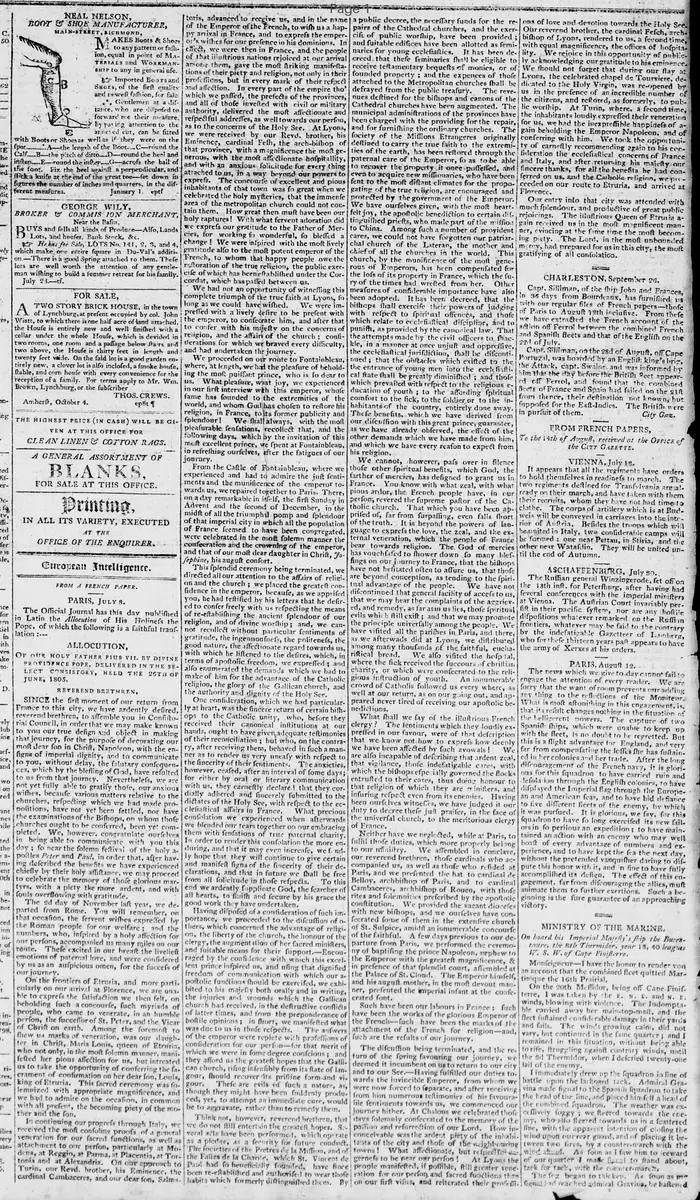
SINCE the first moment of our return from France to this city, we have ardently desired, reverend brethren, to assemble you in Consistorial Council, in order that we may make known to you our true design and object in making that journey, for the purpose of decorating our most dear son in Christ, Napoleon, with the ensigns of imperial dignity, and to communicate to you, without delay, the salutary consequences, which by the blessing of God, have resulted to us from that journey. Nevertheless, we are not yet fully able to gratify those, our anxious wishes, because various matters relative to the churches, respecting which we had made propositions, have not yet been settled, nor have the examinations of the Bishops, on whom those churches ought to be conferred, been yet completed. We, however, congratulate ourselves in being able to communicate with you this day; so near the solemn festival of the holy apostles Peter and Paul, in order that, after having described the benefits we have experienced chiefly by their holy assistance, we may proceed to celebrate the memory of those glorious martyrs, with a piety the more ardent, and with souls overflowing with gratitude.
The 2d day of November last year, we departed from Rome. You will remember, on that occasion, the fervent wishes expressed by the Roman people for our welfare; and the numbers, who, inspired by a holy affection for our persons, accompanied us many miles on our route. These excited in our breast the liveliest emotions of paternal love, and were considered by us as an auspicious omen, for the success of our journey.
On the frontiers of Etruria, and more particularly on our arrival at Florence, we are unable to express the satisfaction we then felt, on beholding such a concourse, such myriads of people, who came to venerate, in an humble person, the successor of St. Peter, and the Vicar of Christ on earth. Among the foremost to shew us marks of veneration, was our daughter in Christ, Maria Louisa, queen of Etruria, who not only, in the most solemn manner, manifested her pious affection for us, but intreated us to take the opportunity of conferring the sacrament of confirmation on her dear son, Louis, king of Etruria. This sacred ceremony was solemnized with appropriate magnificence, and we had to admire on the occasion, in common with all present, the becoming piety of the mother and the son.
In continuing our progress through Italy, we received the most consoling proofs of a general veneration for our sacred functions, as well as attachment to our person, particularly at Modena, at Reggio, at Parma, at Placentia, at Tortonia and at Alexandria. On our approach to Turin, our Revd. brother, his Eminence, the cardinal Cambaceres, and our dear son, Salmatoris, advanced to receive us, and in the name of the Emperor of the French, to wish us a happy arrival in France, and to express the emperor's wishes for our presence in his dominions. In effect, we were then in France, and the people of that illustrious nation rejoiced at our arrival amongst them, gave the most striking manifestations of their piety and religion, not only in their professions, but in every mark of their respect and affection. In every part of the empire through which we passed, the prefects of the provinces, and all of those invested with civil or military authority, delivered the most affectionate and respectful addresses, as well towards our person, as to the concerns of the Holy See. At Lyons, we were received by our Revd. brother, his Eminence, cardinal Fesch, the arch-bishop of that province, with a magnificence the most generous, with the most affectionate hospitality, and with an anxious solicitude for every thing attached to us, in a way beyond our powers to express. The concourse of excellent and pious inhabitants of that town was so great when we celebrated the holy mysteries, that the immense area of the metropolitan church could not contain them. How great then must have been our holy raptures! With what fervent adoration did we express our gratitude to the Father of Mercies, for working so wonderful, so blessed a change! We were inspired with the most lively gratitude also to the most potent emperor of the French, to whom that happy people owe the restoration of the true religion, the public exercise of which has been established under the Concordat, which has passed between us.
We had not an opportunity of witnessing this complete triumph of the true faith at Lyons, so long as we could have wished. We were impressed with a lively desire to be present with the emperor, to consecrate him, and after that to confer with his majesty on the concerns of religion, and the affairs of the church; considerations for which we braved every difficulty, and had undertaken the journey.
We proceeded on our route to Fontainbleau, where, at length, we had the pleasure of beholding the most puissant prince, who is so dear to us. What pleasure, what joy, we experienced in our first interview with this emperor, whose fame has resounded to the extremities of the world, and whom God has chosen to restore his religion, in France, to its former publicity and splendour! We shall always, with the most pleasurable sensations, recollect that, and the following days, which by the invitation of this most excellent prince, we spent at Fontainbleau, in refreshing ourselves, after the fatigues of our journey.
From the Castle of Fontainbleau, where we experienced and had to admire the just sentiments and the munificence of the emperor towards us, we repaired together to Paris. There, on a day remarkable in itself, the first Sunday in Advent and the second of December, in the midst of all the triumphant pomp and splendour of that imperial city in which all the population of France seemed to have been congregated, were celebrated in the most solemn manner the consecration and the crowning of the emperor, and that of our most dear daughter in Christ, Josephine, his august consort.
This splendid ceremony being terminated, we directed all our attention to the affairs of religion and the church; we placed the greatest confidence in the emperor, because, as we apprised you, he had testified by his letters that he desired to confer freely with us respecting the means of re-establishing the ancient splendour of our religion, and of divine worship; and, we cannot recollect without particular sentiments of gratitude, the ingenuousness, the politeness, the good nature, the affectionate regard towards us, with which he listened to the desires, which, in terms of apostolic freedom, we expressed; and also enumerated the demands which we had to make of him for the advantage of the Catholic religion, the glory of the Gallican church, and the authority and dignity of the Holy See.
One consideration, which we had particularly at heart, was the sincere return of certain bishops to the Catholic unity, who, before they received their canonical institutions at our hands, ought to have given adequate testimonies of their reconciliation: but who, on the contrary, after receiving them, behaved in such a manner as to render us very uneasy with respect to the sincerity of their sentiments. The anxieties, however, ceased, after an interval of some days; for either by oral or literary communication with us, they earnestly declared that they cordially adhered and sincerely submitted to the dictates of the Holy See, with respect to the ecclesiastical affairs in France. What precious consolation we experienced when afterwards we blended our tears together on our embracing them with sensations of true paternal charity.
In order to render this consolation the more enduring, and that it may even increase, we fondly hope that they will continue to give certain and manifest signs of the sincerity of their declarations, and that in future we shall be free from all solicitude in those respects. To this end we ardently supplicate God, the searcher of all hearts, to finish and secure by his grace the good work they have undertaken.
Having disposed of a consideration of such importance, we proceeded to the discussion of others, which concerned the advantage of religion, the liberty of the church, the honour of the clergy, the augmentation of her sacred ministers, and suitable means for their support.--Encouraged by the confidence with which this excellent prince inspired us, and using that dignified freedom of communication with which our apostolic functions should be exercised, we exhibited to his majesty both orally and in writing, the injuries and wounds which the Gallican church had received, in the destructive conflicts of latter times, and from the preponderance of hostile opinions; in short, we manifested what was due to us in those respects. The answers of the emperor were replete with professions of consideration for our person--for that merit of which we were in some degree conscious: and they afford us the greatest hopes that the Gallican church, rising insensibly from its state of languor, should recover its pristine form--and vigour. These are evils of such a nature, as, though they might have been suddenly produced, yet, to attempt an immediate cure, would be to aggravate, rather than to remedy them.
Think not, however, reverend brethren, that we do not still entertain the greatest hopes. Several acts have been performed, which operate as a pledge, as a security for future conduct. The societies of the Pretres de la Mission, and of the Filles de la Charite, which St. Vincent de Paul had so beneficially founded, have since been re-established and authorised to wear those habits which formerly distinguished them. By a public decree, the necessary funds for the repairs of the Cathedral churches, and the exercise of public worship, have been provided; and suitable edifices have been allotted as seminaries for young ecclesiastics. It has been decreed, that these seminaries shall be eligible to receive testamentary bequests of monies, or of founded property; and the expenses of those attached to the Metropolitan churches shall be defrayed from the public treasury. The revenues destined for the bishops and canons of the Cathedral churches have been augmented. The municipal administrations of the provinces have been charged with the providing for the repair, and for furnishing the ordinary churches. The society of the Missions Etrangeres originally destined to carry the true faith to the extremities of the earth, has been restored through the paternal care of the Emperor, so as to be able to recover the property it once possessed, and even to acquire new missionaries, who have been sent to the most distant climates for the propagating of the true religion, are encouraged and protected by the government of the Emperor.
We have ourselves given, with the most heartfelt joy, the apostolic benediction to certain distinguished priests, who made part of the mission to China. Among such a number of provident cares, we could not have forgotten our patriarchal church of the Lateran, the mother and chief of all the churches in the world. This church, by the munificence of the most generous of Emperors, has been compensated for the loss of its property in France, which the fury of the times had wrested from her. Other measures of considerable importance have also been adopted. It has been decreed, that the bishops shall exercise their powers of judging with respect to spiritual offences, and those which relate to ecclesiastical discipline, and to punish, as provided by the canonical law. That the attempts made by the civil officers to shackle, in a manner at once unjust and oppressive, the ecclesiastical jurisdiction, shall be discontinued; that the obstacles which existed to the entrance of young men into the ecclesiastical state shall be greatly diminished; and those which prevailed with respect to the religious education of youth; to the affording spiritual comfort to the sick, to the soldier or to the inhabitants of the country, entirely done away.
These benefits, which we have derived from our discussion with this great prince, guarantee, as we have already observed, the effect of the other demands which we have made from him, and which we have every reason to expect from his religion.
We cannot, however, pass over in silence those other spiritual benefits, which God, the father of mercies, has deigned to grant us in France. You know with what zeal, with what pious ardor, the French people have, in our person; revered the supreme pastor of the Catholic church. That which you have been apprised of, far from surpassing, even falls short of the truth. It is beyond the powers of language to express the love, the zeal, and the external veneration, which the people of France bear towards religion. The God of mercies has vouchsafed to shower down so many blessings on our journey to France, that the bishops have not hesitated often to assure us, that those are beyond conception, as tending to the spiritual advantage of the people. We have not discontinued that general facility of access to us, that we may hear the complaints of the aggrieved, and remedy, as far as in us lies, those spiritual evils which still exist; and that we may promote the principle universally among the people. We have visited all the parishes in Paris, and there, as we afterwards did at Lyons, we distributed among many thousands of the faithful, eucharistical bread. We also visited the hospital, where the sick received the succours of christian charity, or which were consecrated to the religious instruction of youth. An innumerable crowd of Catholics followed us every where, as well at our return, as on our going out, and appeared never tired of receiving our apostolic benedictions.
What shall we say of the illustrious French clergy? The sentiments which they loudly expressed in our favour, were of that description that we know not how to express how deeply we have been affected by such avowals! We are also incapable of describing that ardent zeal, that vigilance, those indefatigable cares, with which the bishops especially governed the flocks entrusted to their cares, thus doing honour to that religion of which they are ministers, and insuring respect even from its enemies. Having been ourselves witnesses, we have judged it our duty to decree these just praises, in the face of the universal church, to the meritorious clergy of France.
Neither have we neglected, while at Paris, to fulfil those duties, which more properly belong to our ministry. We assembled in conclave, our reverend brethren, those cardinals who accompanied us, as well as those who resided at Paris, and we presented the hat to cardinal de Belloy, archbishop of Paris, and to cardinal Cambaceres, archbishop of Rouen, with those rites and solemnities prescribed by the apostolic constitution. We provided the vacant dioceses with new bishops, and we ourselves have consecrated some of them in the extensive church of St. Sulpice, amidst an innumerable concourse of the faithful. A few days previous to our departure from Paris, we performed the ceremony of baptising the prince Napoleon, nephew to the Emperor with the greatest magnificence, & in presence of that splendid court, assembled at the Palace of St. Cloud. The Emperor himself, and his august mother, in the most devout manner, presented the imperial infant at the consecrated font.
Such have been our labours in France: such have been the works of the glorious Emperor of the French--such have been the marks of the attachment of the French for religion--and, such are the results of our journey.
The discussion being terminated, and the return of the spring favouring our journey, we deemed it incumbent on us to return to our city and to our See.--Having fulfilled our duties towards the invincible Emperor, from whom we were now forced to separate, and after receiving from him numerous testimonies of his favourable sentiments towards us, we commenced our journey hither. At Chalons we celebrated those days solemnly consecrated to the memory of the passion and resurrection of our Lord. How inconceivable was the ardent piety of the inhabitants of the city and those of the neighbouring towns! What affectionate, but respectful eagerness to be near our person! At Lyons the people manifested, if possible, still greater veneration for our person and sacred functions than on our first visit, and reiterated their professions of love and devotion towards the Holy See. Our reverend brother, the cardinal Fesch, archbishop of Lyons, rendered to us, a second time with equal magnificence, the offices of hospitality. We rejoice in this opportunity of publicly acknowledging our gratitude to his eminence. We should not forget that during our stay at Lyons, the celebrated chapel de Tourviere, dedicated to the Holy Virgin, was re-opened by us in the presence of an incredible number of the citizens, and restored, as formerly, to public worship. At Turin, where, a second time, the inhabitants loudly expressed their veneration for us, we had the inexpressible happiness of again beholding the Emperor Napoleon, and of conferring with him. We took the opportunity of earnestly recommending again to his consideration the ecclesiastical concerns of France and Italy, and after returning his majesty our sincere thanks, for all the benefits he had conferred on us, and the Catholic religion, we proceeded on our route to Etruria, and arrived at Florence.
Our entry into that city was attended with much splendour, and productive of great public rejoicings. The illustrious Queen of Etruria again received us in the most magnificent manner, evincing at the same time the most becoming piety. The Lord, in the most unbounded mercy, had prepared for us in this city, the most gratifying of all consolation.
What sub-type of article is it?
What keywords are associated?
What entities or persons were involved?
Where did it happen?
Foreign News Details
Primary Location
France
Event Date
26th Of June, 1805
Key Persons
Outcome
pope crowned napoleon and josephine on december 2, 1804; discussions led to re-establishment of religious societies, funding for church repairs and seminaries, augmentation of clerical revenues, restoration of ecclesiastical jurisdiction, and missions abroad; bishops reconciled to holy see.
Event Details
Pope Pius VII recounts his journey from Rome starting November 2, 1804, through Italy to France, receiving veneration en route; crowned Napoleon emperor and Josephine in Paris on December 2, 1804; held discussions with Napoleon on church restoration, resulting in decrees supporting Catholic institutions, seminaries, and missions; reconciled bishops; performed sacraments and visited parishes; returned to Rome in spring 1805, with further receptions.