Thank you for visiting SNEWPapers!
Sign up free
Story
June 30, 1899
The Scranton Tribune
Scranton, Lackawanna County, Pennsylvania
What is this article about?
In Michigan, a state legislator sued the Good Government league for libel over campaign literature calling his liquor-on-holidays bill 'immoral.' The court ruled for defendants, deeming the criticism privileged opinion on public acts, defining limits of justifiable political critique.
Clipping
OCR Quality
98%
Excellent
Full Text
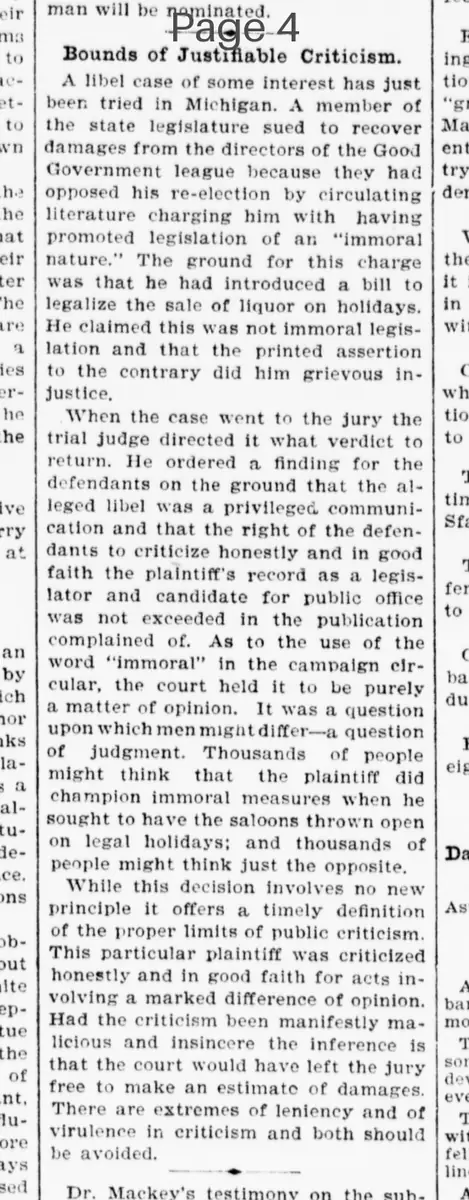
Bounds of Justifiable Criticism.
A libel case of some interest has just been tried in Michigan. A member of the state legislature sued to recover damages from the directors of the Good Government league because they had opposed his re-election by circulating literature charging him with having promoted legislation of an "immoral nature." The ground for this charge was that he had introduced a bill to legalize the sale of liquor on holidays. He claimed this was not immoral legislation and that the printed assertion to the contrary did him grievous injustice.
When the case went to the jury the trial judge directed it what verdict to return. He ordered a finding for the defendants on the ground that the alleged libel was a privileged communication and that the right of the defendants to criticize honestly and in good faith the plaintiff's record as a legislator and candidate for public office was not exceeded in the publication complained of. As to the use of the word "immoral" in the campaign circular, the court held it to be purely a matter of opinion. It was a question upon which men might differ--a question of judgment. Thousands of people might think that the plaintiff did champion immoral measures when he sought to have the saloons thrown open on legal holidays; and thousands of people might think just the opposite.
While this decision involves no new principle it offers a timely definition of the proper limits of public criticism. This particular plaintiff was criticized honestly and in good faith for acts involving a marked difference of opinion. Had the criticism been manifestly malicious and insincere the inference is that the court would have left the jury free to make an estimate of damages. There are extremes of leniency and of virulence in criticism and both should be avoided.
A libel case of some interest has just been tried in Michigan. A member of the state legislature sued to recover damages from the directors of the Good Government league because they had opposed his re-election by circulating literature charging him with having promoted legislation of an "immoral nature." The ground for this charge was that he had introduced a bill to legalize the sale of liquor on holidays. He claimed this was not immoral legislation and that the printed assertion to the contrary did him grievous injustice.
When the case went to the jury the trial judge directed it what verdict to return. He ordered a finding for the defendants on the ground that the alleged libel was a privileged communication and that the right of the defendants to criticize honestly and in good faith the plaintiff's record as a legislator and candidate for public office was not exceeded in the publication complained of. As to the use of the word "immoral" in the campaign circular, the court held it to be purely a matter of opinion. It was a question upon which men might differ--a question of judgment. Thousands of people might think that the plaintiff did champion immoral measures when he sought to have the saloons thrown open on legal holidays; and thousands of people might think just the opposite.
While this decision involves no new principle it offers a timely definition of the proper limits of public criticism. This particular plaintiff was criticized honestly and in good faith for acts involving a marked difference of opinion. Had the criticism been manifestly malicious and insincere the inference is that the court would have left the jury free to make an estimate of damages. There are extremes of leniency and of virulence in criticism and both should be avoided.
What sub-type of article is it?
Crime Story
Historical Event
What themes does it cover?
Justice
Moral Virtue
What keywords are associated?
Libel Case
Michigan Legislature
Liquor Bill
Justifiable Criticism
Privileged Communication
Political Opinion
What entities or persons were involved?
Member Of The State Legislature
Directors Of The Good Government League
Where did it happen?
Michigan
Story Details
Key Persons
Member Of The State Legislature
Directors Of The Good Government League
Location
Michigan
Story Details
A Michigan legislator sued the Good Government league for libel after they criticized his bill to legalize liquor sales on holidays as 'immoral' in campaign literature. The court directed a verdict for the defendants, ruling the criticism was privileged opinion on public acts, not exceeding fair bounds.