Thank you for visiting SNEWPapers!
Sign up free
Editorial
March 11, 1952
The News And Views
Jacksonville, Onslow County, North Carolina
What is this article about?
George E. Sokolsky critiques British foreign policy errors in Asia, from refusing US intervention in Manchuria (1931) leading to WWII, opposition to MacArthur's Japan rehabilitation, premature recognition of Communist China forcing costly US policies like the Korean War, to current vilification of John Foster Dulles over Pacific focus, warning of strained US-UK relations.
Clipping
OCR Quality
98%
Excellent
Full Text
These Days
George E. Sokolsky
ANOTHER BRITISH ERROR
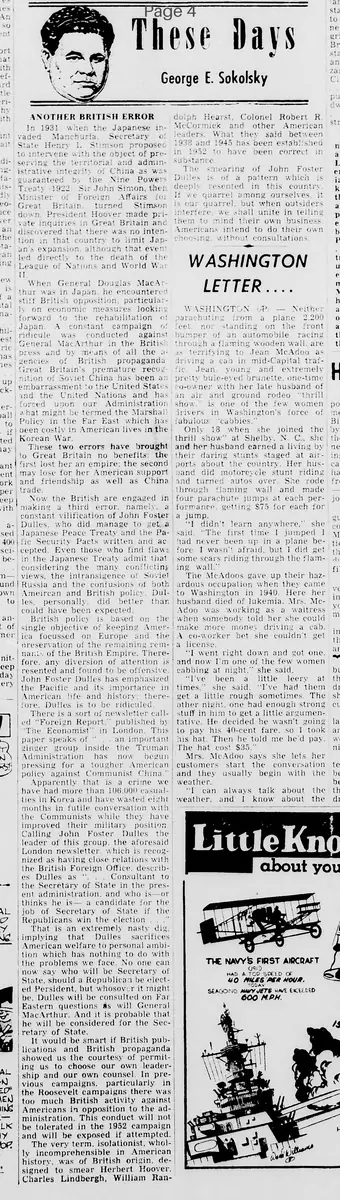
In 1931 when the Japanese invaded Manchuria, Secretary of State Henry L. Stimson proposed to intervene with the object of preserving the territorial and administrative integrity of China as was guaranteed by the Nine Powers Treaty 1922. Sir John Simon, then Minister of Foreign Affairs for Great Britain, turned Stimson down. President Hoover made private inquiries in Great Britain and discovered that there was no intention in that country to limit Japan's expansion, although that event led directly to the death of the League of Nations and World War II.
When General Douglas MacArthur was in Japan he encountered stiff British opposition, particularly on economic measures looking forward to the rehabilitation of Japan. A constant campaign of ridicule was conducted against General MacArthur in the British press and by means of all the agencies of British propaganda.
Great Britain's premature recognition of Soviet China has been an embarrassment to the United States and the United Nations and has forced upon our Administration what might be termed the Marshall Policy in the Far East which has been costly in American lives in the Korean War.
These two errors have brought to Great Britain no benefits: the first lost her an empire; the second may lose for her American support and friendship as well as China trade.
Now the British are engaged in making a third error, namely, a constant vilification of John Foster Dulles, who did manage to get a Japanese Peace Treaty and the Pacific Security Pacts written and accepted. Even those who find flaws in the Japanese Treaty admit that considering the many conflicting views, the intransigence of Soviet Russia and the confusions of both American and British policy, Dulles, personally, did better than could have been expected.
British policy is based on the single objective of keeping America focused on Europe and the preservation of the remaining remnants of the British Empire. Therefore, any diversion of attention is resented and found to be offensive.
John Foster Dulles has emphasized the Pacific and its importance in American life and history, therefore, Dulles is to be ridiculed.
There is a sort of newsletter called "Foreign Report," published by The Economist in London. This paper speaks of "... an important ginger group inside the Truman Administration has now begun pressing for a tougher American policy against Communist China."
Apparently that is a crime we have had more than 106,000 casualties in Korea and have wasted eight months in futile conversation with the Communists while they have improved their military position.
Calling John Foster Dulles the leader of this group, the aforesaid London newsletter, which is recognized as having close relations with the British Foreign Office, describes Dulles as "... Consultant to the Secretary of State in the present administration, and who is--or thinks he is--a candidate for the job of Secretary of State if the Republicans win the election..."
That is an extremely nasty dig, implying that Dulles sacrifices American welfare to personal ambition which has nothing to do with the problems we face. No one can now say who will be Secretary of State, should a Republican be elected President, but whosoever it might be, Dulles will be consulted on Far Eastern questions as will General MacArthur. And it is probable that he will be considered for the Secretary of State.
It would be smart if British publications and British propaganda showed us the courtesy of permitting us to choose our own leadership and our own counsel. In previous campaigns, particularly in the Roosevelt campaigns there was too much British activity against Americans in opposition to the administration. This conduct will not be tolerated in the 1952 campaign and will be exposed if attempted.
The very term, isolationist, wholly incomprehensible in American history, was of British origin, designed to smear Herbert Hoover, Charles Lindbergh, William Randolph Hearst, Colonel Robert R. McCormick and other American leaders. What they said between 1938 and 1945 has been established in 1952 to have been correct in substance.
The smearing of John Foster Dulles is of a pattern which is deeply resented in this country. If we quarrel among ourselves, it is our quarrel, but when outsiders interfere, we shall unite in telling them to mind their own business. Americans intend to do their own choosing, without consultations.
George E. Sokolsky
ANOTHER BRITISH ERROR
In 1931 when the Japanese invaded Manchuria, Secretary of State Henry L. Stimson proposed to intervene with the object of preserving the territorial and administrative integrity of China as was guaranteed by the Nine Powers Treaty 1922. Sir John Simon, then Minister of Foreign Affairs for Great Britain, turned Stimson down. President Hoover made private inquiries in Great Britain and discovered that there was no intention in that country to limit Japan's expansion, although that event led directly to the death of the League of Nations and World War II.
When General Douglas MacArthur was in Japan he encountered stiff British opposition, particularly on economic measures looking forward to the rehabilitation of Japan. A constant campaign of ridicule was conducted against General MacArthur in the British press and by means of all the agencies of British propaganda.
Great Britain's premature recognition of Soviet China has been an embarrassment to the United States and the United Nations and has forced upon our Administration what might be termed the Marshall Policy in the Far East which has been costly in American lives in the Korean War.
These two errors have brought to Great Britain no benefits: the first lost her an empire; the second may lose for her American support and friendship as well as China trade.
Now the British are engaged in making a third error, namely, a constant vilification of John Foster Dulles, who did manage to get a Japanese Peace Treaty and the Pacific Security Pacts written and accepted. Even those who find flaws in the Japanese Treaty admit that considering the many conflicting views, the intransigence of Soviet Russia and the confusions of both American and British policy, Dulles, personally, did better than could have been expected.
British policy is based on the single objective of keeping America focused on Europe and the preservation of the remaining remnants of the British Empire. Therefore, any diversion of attention is resented and found to be offensive.
John Foster Dulles has emphasized the Pacific and its importance in American life and history, therefore, Dulles is to be ridiculed.
There is a sort of newsletter called "Foreign Report," published by The Economist in London. This paper speaks of "... an important ginger group inside the Truman Administration has now begun pressing for a tougher American policy against Communist China."
Apparently that is a crime we have had more than 106,000 casualties in Korea and have wasted eight months in futile conversation with the Communists while they have improved their military position.
Calling John Foster Dulles the leader of this group, the aforesaid London newsletter, which is recognized as having close relations with the British Foreign Office, describes Dulles as "... Consultant to the Secretary of State in the present administration, and who is--or thinks he is--a candidate for the job of Secretary of State if the Republicans win the election..."
That is an extremely nasty dig, implying that Dulles sacrifices American welfare to personal ambition which has nothing to do with the problems we face. No one can now say who will be Secretary of State, should a Republican be elected President, but whosoever it might be, Dulles will be consulted on Far Eastern questions as will General MacArthur. And it is probable that he will be considered for the Secretary of State.
It would be smart if British publications and British propaganda showed us the courtesy of permitting us to choose our own leadership and our own counsel. In previous campaigns, particularly in the Roosevelt campaigns there was too much British activity against Americans in opposition to the administration. This conduct will not be tolerated in the 1952 campaign and will be exposed if attempted.
The very term, isolationist, wholly incomprehensible in American history, was of British origin, designed to smear Herbert Hoover, Charles Lindbergh, William Randolph Hearst, Colonel Robert R. McCormick and other American leaders. What they said between 1938 and 1945 has been established in 1952 to have been correct in substance.
The smearing of John Foster Dulles is of a pattern which is deeply resented in this country. If we quarrel among ourselves, it is our quarrel, but when outsiders interfere, we shall unite in telling them to mind their own business. Americans intend to do their own choosing, without consultations.
What sub-type of article is it?
Foreign Affairs
Partisan Politics
What keywords are associated?
British Foreign Policy
Us Asia Policy
John Foster Dulles
Korean War
Japanese Peace Treaty
Manchuria Invasion
Macarthur Opposition
Isolationist Smear
What entities or persons were involved?
George E. Sokolsky
Henry L. Stimson
Sir John Simon
President Hoover
General Douglas Macarthur
John Foster Dulles
Great Britain
Soviet Russia
League Of Nations
The Economist
Herbert Hoover
Charles Lindbergh
William Randolph Hearst
Colonel Robert R. Mccormick
Editorial Details
Primary Topic
Criticism Of British Foreign Policy Errors In Asia And Interference In Us Politics
Stance / Tone
Strongly Critical Of British Actions And Defensive Of Us Leaders
Key Figures
George E. Sokolsky
Henry L. Stimson
Sir John Simon
President Hoover
General Douglas Macarthur
John Foster Dulles
Great Britain
Soviet Russia
League Of Nations
The Economist
Herbert Hoover
Charles Lindbergh
William Randolph Hearst
Colonel Robert R. Mccormick
Key Arguments
British Refusal To Support Stimson In 1931 Allowed Japanese Expansion Leading To League Of Nations' Death And Wwii
British Opposition And Ridicule Of Macarthur Hindered Japan's Rehabilitation
Premature British Recognition Of Soviet China Embarrassed Us And Led To Costly Marshall Policy And Korean War Casualties
British Vilification Of Dulles Over Japanese Peace Treaty And Pacific Focus Is A Third Error
British Policy Aims To Keep Us Focused On Europe, Resenting Pacific Diversions
British Propaganda Implies Dulles Pursues Personal Ambition, Which Is Resented
British Interference In Us Elections, Like Smearing Isolationists, Will Not Be Tolerated In 1952
Americans Resent Outsider Meddling In Their Leadership Choices