Thank you for visiting SNEWPapers!
Sign up free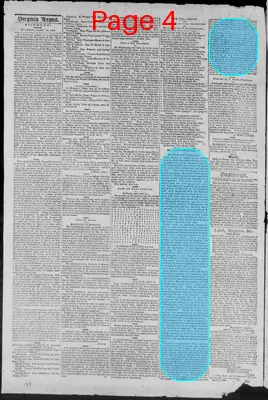
Virginia Argus
Richmond, Virginia
What is this article about?
In the House of Lords on February 15, Lords Auckland, Erskine, and Grenville debated the Orders in Council, criticizing their impact on British-American trade, potential for rupture, and injustice to neutrals, urging revocation to preserve commerce and avoid war.
Clipping
OCR Quality
Full Text
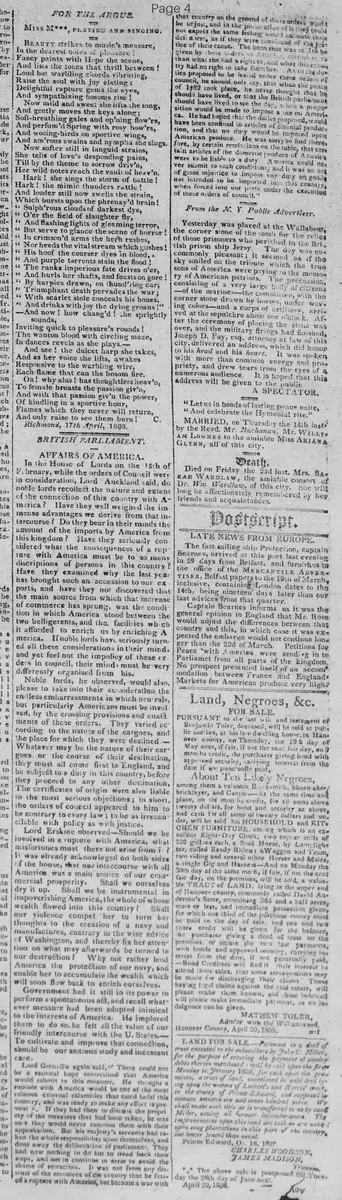
AFFAIRS OF AMERICA.
In the House of Lords on the 15th of February, while the orders of Council were in consideration, Lord Auckland said, do noble lords recollect the nature and extent of the connection of this country with America? Have they well weighed the immense advantages we derive from that intercourse? Do they bear in their minds the amount of the imports by America from this kingdom? Have they seriously considered what the consequences of a rupture with America must be to so many descriptions of persons in this country? Have they examined why the last year has brought such an accession to our exports, and have they not discovered that the main source from which that increase of commerce has sprung, was the condition in which America stood between the two belligerents, and the facilities which it afforded to enrich us by enriching America. If noble lords have seriously turned all these considerations in their mind, and yet feel not the impolicy of these orders in council, their minds must be very differently organised from his.
Noble lords, he observed,—would also, please to take into their consideration the endless embarrassments in which neutrals, but particularly Americans must be involved, by the crossing provisions and enactments of these orders. They varied according to the nature of the cargoes, and the place for which they were destined.—Whatever may be the nature of their cargoes, or the course of their destination, they must all come first to England, and be subject to a duty in this country, before they proceed to any other destination. The certificates of origin were also liable to the most serious objections; in short, the orders of council appeared to him to be contrary to every law; to be as irreconcilable with policy as with justice.
Lord Erskine observed—Should we be involved in a rupture with America, what misfortunes must there not arise from it? It was already acknowledged on both sides of the house, that our intercourse with all America was a main source of our commercial prosperity. Shall we ourselves dry it up. Shall we be instrumental in impoverishing America, the whole of whose wealth flowed into this country? Shall our violence compel her to turn her thoughts to the creation of a navy and manufactures, contrary to the wise advice of Washington, and thereby fix her attention on what may afterwards be turned to our destruction? Why not rather lend America the protection of our navy, and enable her to accumulate the wealth which will soon flow back to enrich ourselves.
Government had it still in its power to perform a spontaneous act, and recall whatever measure had been adopted inimical to the interests of America. He implored them to do so, he felt all the value of our friendly intercourse with the U. States.—To cultivate and improve that connection, should be our anxious study and incessant care.
Lord Grenville again said, "There could not be a rational hope entertained that America would submit to this measure, He thought a rupture with America would be one of the most ruinous external calamities that could befal this country, and was ready to make any effort to prevent it. If they had then to discuss the propriety of the measures that had been taken, he was sure they would never sanction them with their approbation. But his majesty's servants had taken the whole responsibility upon themselves, and done away the deliberation of parliament, They had now nothing to do but to tread back their steps, and not to continue in error to avoid the shame of retraction. It was not from any distrust of the resources of the country that he feared a rupture with America, but because a war with that country on the ground of these orders would be unjust, and in the prosecution of it they could not expect the same feeling would animate their defenders, as if they were convinced of the justice of their cause. The boon that was called to be given by these orders to America, was no more than what she had a right to, and what this country had no right to take from her. As to the duties proposed to be levied under these orders of council, he should only say, that when the peace of 1782 took place, he never thought that he should have lived, or that the British parliament should have lived to see the day, when a proposition would be made to impose a tax on America. He had hoped that the duties proposed, would have been confined to articles of colonial production, and that no duty would be imposed upon American produce. He was sorry to find therefore, by certain resolutions on the table, that certain articles of the domestic produce of America were to be liable to a duty America could never submit to such conditions, and it was an act of gross injustice to impose any duty on goods not intended to be imported into this country, when forced into our ports under the execution of these orders of council."
What sub-type of article is it?
What keywords are associated?
What entities or persons were involved?
Where did it happen?
Foreign News Details
Primary Location
America
Event Date
15th Of February
Key Persons
Outcome
debate expresses strong opposition to orders in council, warning of potential rupture, commercial loss, and unjust war with america; no formal outcome reported.
Event Details
In the House of Lords, Lord Auckland criticized the Orders in Council for endangering British-American trade benefits and involving neutrals in embarrassments through varying provisions, duties, and certificates. Lord Erskine highlighted risks of impoverishing America, prompting her to build navy and manufactures, and urged government to recall inimical measures to preserve friendly intercourse. Lord Grenville deemed the orders unjust, unlikely to be submitted to by America, ruinous if leading to war, and criticized imposing duties on American produce as a tax, contrary to post-1782 peace expectations.