Thank you for visiting SNEWPapers!
Sign up free
Daily National Intelligencer
Washington, District Of Columbia
What is this article about?
A private letter from Paris, dated April 12, 1815, reports widespread discontent against Napoleon's return in France. The population, National Guards, and even parts of the army oppose him due to economic stagnation, fear of war, and conscriptions. Key figures like Ney face execration, while marshals like Macdonald and Oudinot refuse service. Urges allies to declare war immediately to prevent Bonaparte from consolidating power.
Clipping
OCR Quality
Full Text
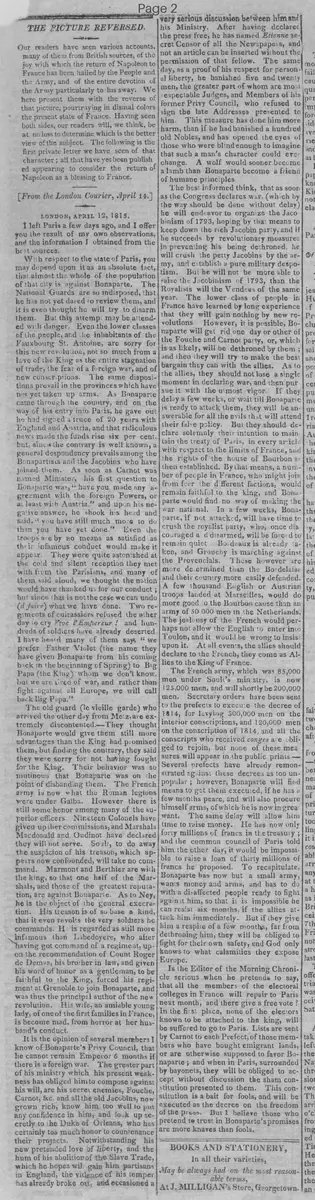
Our readers have seen various accounts, many of them from British sources, of the joy with which the return of Napoleon to France has been hailed by the People and the Army, and of the entire devotion of the Army particularly to his sway. We here present them with the reverse of that picture, pourtraying in dismal colors the present state of France. Having seen both sides, our readers will, we think, be at no loss to determine which is the better view of the subject. The following is the first private letter we have seen of that character; all that have yet been published appearing to consider the return of Napoleon as a blessing to France.
[From the London Courier, April 14.]
LONDON, APRIL 12, 1815.
I left Paris a few days ago, and I offer you the result of my own observations, and the information I obtained from the best sources.
With respect to the state of Paris, you may depend upon it as an absolute fact, that almost the whole of the population of that city is against Bonaparte. The National Guards are so indisposed, that he has not yet dared to review them, and it is even thought he will try to disarm them. But this attempt may be attended with danger. Even the lower classes of the people, and the inhabitants of the Faubourg St. Antoine, are sorry for this new revolution, not so much from a love of the King as the entire stagnation of trade, the fear of a foreign war, and of new conscriptions. The same dispositions prevail in the provinces which have not yet taken up arms. As Bonaparte came through the country, and on the way of his entry into Paris, he gave out he had signed a truce of 20 years with England and Austria, and that ridiculous news made the funds rise six per cent. but, since the contrary is well known, a general despondency prevails among the Bonapartists and the Jacobins who have joined them. As soon as Carnot was named Minister, his first question to Bonaparte was, "have you made any agreement with the foreign Powers, or at least with Austria." and upon his negative answer, he shook his head and said, "you have still much more to do than you have yet done." Even the troops are by no means as satisfied as their infamous conduct would make it appear. They were quite astonished at the cold and silent reception they met with from the Parisians, and many of them said aloud, we thought the nation would have thanked us for our conduct; but since that is not the case we can undo what we have done. Two regiments of cuirassiers refused the other day to cry Vive l'Empereur! and hundreds of soldiers have already deserted. I have heard many of them say "we prefer Father Violet (the name they have given Bonaparte from his coming back in the beginning of Spring) to Big Papa (the King) whom we don't know, but we are tired of war, and rather than fight against all Europe, we will call back Big Papa."
The old guard (la vieille garde) who arrived the other day from Metz, are extremely discontented.--They thought Bonaparte would give them still more advantages than the King had promised them, but finding the contrary, they said they were sorry for not having fought for the King. Their behavior was so mutinous that Bonaparte was on the point of disbanding them. The French army is now what the Roman legions were under Galba. However there is still some honor among many of the superior officers. Nineteen Colonels have given up their commissions, and Marshals Macdonald and Oudinot have declared they will not serve. Soult, to do away the suspicion of his treason, which appears now confounded, will take no command. Marmont and Berthier are with the king, so that one half of the Marshals, and those of the greatest reputation, are against Bonaparte. As to Ney, he is the object of the general execration. His treason is of so base a kind, that it even revolts the very soldiers he commands. He is regarded as still more infamous than Labedoyere, who after having got command of a regiment, upon the recommendation of Count Roger de Damas, his brother in law, and given his word of honor as a gentleman, to be faithful to the King, forced his regiment at Grenoble to join Bonaparte, and was thus the principal author of the new revolution. His wife, an amiable young lady, of one of the first families in France, is become mad, from horror at her husband's conduct.
It is the opinion of several members I know of Bonaparte's Privy Council, that he cannot remain Emperor 6 months if there is a foreign war. The greater part of his ministry which his present weakness has obliged him to compose against his will, are his secret enemies, Fouche, Carnot, &c. and all the old Jacobins, now grown rich, know him too well to put any confidence in him, and look up secretly to the Duke of Orleans, who has certainly too much honor to countenance their projects. Notwithstanding his new pretended love of liberty, and the hum of his abolition of the Slave Trade, which he hopes will gain him partisans in England, the violence of his temper has already broke out, and occasioned a very serious discussion between him and his Ministry. After having declared the press free, he has named Etienne secret Censor of all the Newspapers, and not an article can be inserted without the permission of that fellow. The same day, as a proof of his respect for personal liberty, he banished five and twenty men, the greater part of whom are most respectable Judges, and Members of his former Privy Council, who refused to sign the late Addresses presented to him. This measure has done him more harm, than if he had banished a hundred old Nobles, and has opened the eyes of those who were blind enough to imagine that such a man's character could ever change. A wolf would sooner become a lamb than Bonaparte become a friend of humane principles.
The best informed think, that as soon as the Congress declares war, (which by the way should be done without delay) he will endeavor to organize the Jacobinism of 1793, hoping by that means to keep down the rich Jacobin party, and if he succeeds by revolutionary measures in preventing his being dethroned, he will crush the petty Jacobins by the army, and establish a pure military despotism. But he will not be more able to raise the Jacobinism of 1793, than the Royalists will the Vendeans of the same year. The lower class of people in France have learned by long experience that they will gain nothing by new revolutions. However, it is possible, Bonaparte will get rid one day or other of the Fouche and Carnot party, or, which is as likely, will be dethroned by them; and then they will try to make the best bargain they can with the allies. As to the allies, they should not lose a single moment in declaring war, and then pursue it with the utmost vigor. If they delay a few weeks, or wait till Bonaparte is ready to attack them, they will be answerable for all the evils that will attend their false policy. But they should declare solemnly their intention to maintain the treaty of Paris, in every article with respect to the limits of France, and the rights of the house of Bourbon as then established. By that means, a number of people in France, who might join from fear the different factions, would remain faithful to the king, and Bonaparte would find no way of making the war national. In a few weeks, Bonaparte, if not attacked, will have time to crush the royalist party, who, once discouraged and disarmed, will be forced to remain quiet. Bordeaux is already taken, and Grouchy is marching against the Provencials. These however are more determined than the Bordelais and their country more easily defended. A few thousand English or Austrian troops landed at Marseilles, would do more good to the Bourbon cause than an army of 50,000 men in the Netherlands. The jealousy of the French would perhaps not allow the English to enter into Toulon, and it would be wrong to insist upon it. At all events, the allies should declare to the French, they come as Allies to the King of France.
The French army, which was 85,000 men under Soult's ministry, is now 125,000 men, and will shortly be 200,000 men. Secret orders have been sent to the prefects to execute the decree of 1814, for levying 300,000 men on the interior conscriptions, and 120,000 men on the conscription of 1814, and all the conscripts who received conges are obliged to rejoin, but none of these measures will appear in the public prints. Several prefects have already remonstrated against these decrees as too unpopular; however, Bonaparte will find means to get them executed, if he has a few months peace, and will also procure himself arms, of which he is now in great want. The same delay will allow him time to raise money. He has now only forty millions of francs in the treasury; and the common council of Paris told him the other day, it would be impossible to raise a loan of thirty millions of francs he proposed. To recapitulate, Bonaparte has now but a small army, wants money and arms, and has to do with a disaffected people ready to fight against him, so that it is impossible he can resist six months, if the allies attack him immediately. But if they give him a respite of a few months, far from dethroning him, they will be obliged to fight for their own safety, and God only knows to what calamities they expose Europe.
Is the Editor of the Morning Chronicle serious when he pretends to say, that all the members of the electoral colleges in France will repair to Paris next month, and there give a free vote? In the first place, none of the electors known to be attached to the king, will be suffered to go to Paris. Lists are sent by Carnot to each Prefect, of those members who have bought emigrant lands, or are otherwise supposed to favor Bonaparte; and when in Paris, surrounded by bayonets, they will be obliged to accept without discussion the sham constitution presented to them. This constitution is a bait for fools, and will be executed as the decree on the freedom of the press. But I believe those who pretend to trust in Bonaparte's promises are more knaves than fools.
What sub-type of article is it?
What keywords are associated?
What entities or persons were involved?
Where did it happen?
Foreign News Details
Primary Location
Paris
Event Date
April 12, 1815
Key Persons
Outcome
widespread discontent in paris and provinces; army desertions and mutinies; several marshals and officers refuse service; potential for quick dethronement if allies declare war immediately; secret conscriptions to raise army to 200,000 men.
Event Details
Private letter reports opposition to Napoleon's return: population against him due to trade stagnation, war fears, conscriptions; National Guards undisposed; troops astonished by cold reception, some desert; Old Guard mutinous; key officers resign; Ney execrated; ministry includes secret enemies; urges allies to declare war to exploit Bonaparte's weaknesses in army, funds, and arms.