Thank you for visiting SNEWPapers!
Sign up free
The Daily Gate City And Constitution Democrat
Keokuk, Lee County, Iowa
What is this article about?
Political commentary doubts William Jennings Bryan's return to Democratic prominence, citing his omission from South Dakota's 1920 primary nominations, generational voter changes since 1896, his war stance, and lack of elective office compared to Henry Clay's sustained influence. (248 characters)
Clipping
OCR Quality
Full Text
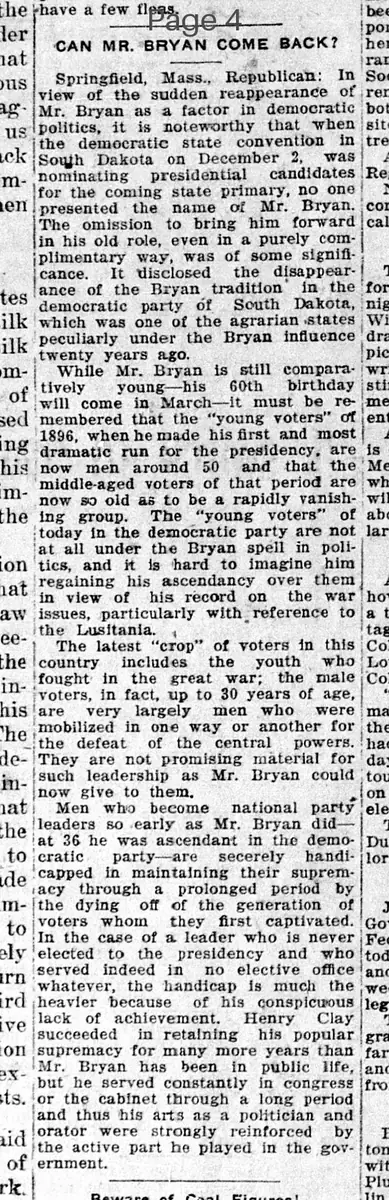
Springfield, Mass., Republican: In view of the sudden reappearance of Mr. Bryan as a factor in democratic politics, it is noteworthy that when the democratic state convention in South Dakota on December 2, was nominating presidential candidates for the coming state primary, no one presented the name of Mr. Bryan. The omission to bring him forward in his old role, even in a purely complimentary way, was of some significance. It disclosed the disappearance of the Bryan tradition in the democratic party of South Dakota, which was one of the agrarian states peculiarly under the Bryan influence twenty years ago.
While Mr. Bryan is still comparatively young—his 60th birthday will come in March—it must be remembered that the "young voters" of 1896, when he made his first and most dramatic run for the presidency, are now men around 50 and that the middle-aged voters of that period are now so old as to be a rapidly vanishing group. The "young voters" of today in the democratic party are not at all under the Bryan spell in politics, and it is hard to imagine him regaining his ascendancy over them in view of his record on the war issues, particularly with reference to the Lusitania.
The latest "crop" of voters in this country includes the youth who fought in the great war; the male voters, in fact, up to 30 years of age, are very largely men who were mobilized in one way or another for the defeat of the central powers. They are not promising material for such leadership as Mr. Bryan could now give to them.
Men who become national party leaders so early as Mr. Bryan did—at 36 he was ascendant in the democratic party—are severely handicapped in maintaining their supremacy through a prolonged period by the dying off of the generation of voters whom they first captivated. In the case of a leader who is never elected to the presidency and who served indeed in no elective office whatever, the handicap is much the heavier because of his conspicuous lack of achievement. Henry Clay succeeded in retaining his popular supremacy for many more years than Mr. Bryan has been in public life, but he served constantly in congress or the cabinet through a long period and thus his arts as a politician and orator were strongly reinforced by the active part he played in the government.
What sub-type of article is it?
What themes does it cover?
What keywords are associated?
What entities or persons were involved?
Where did it happen?
Story Details
Key Persons
Location
South Dakota
Event Date
December 2
Story Details
Article questions if Mr. Bryan can regain influence in Democratic politics, noting his name was omitted from South Dakota state convention nominations, signaling the end of his tradition there. Discusses generational shifts since 1896, his age, war record especially Lusitania, and compares to Henry Clay's longer retention of supremacy through active service.