Thank you for visiting SNEWPapers!
Sign up free
The Ypsilanti Daily Press
Ypsilanti, Washtenaw County, Michigan
What is this article about?
The USS Oklahoma, sunk by Japanese torpedoes during the Pearl Harbor attack on February 7, 1941, was raised after two years and moved to drydock at Pearl Harbor on February 11, 1943, for potential restoration to fighting condition. Commanded by Comdr. Solomon S. Isquith under Rear Adm. William R. Furlong, the damaged battleship was towed into position despite heavy patches and internal hazards.
Clipping
OCR Quality
Full Text
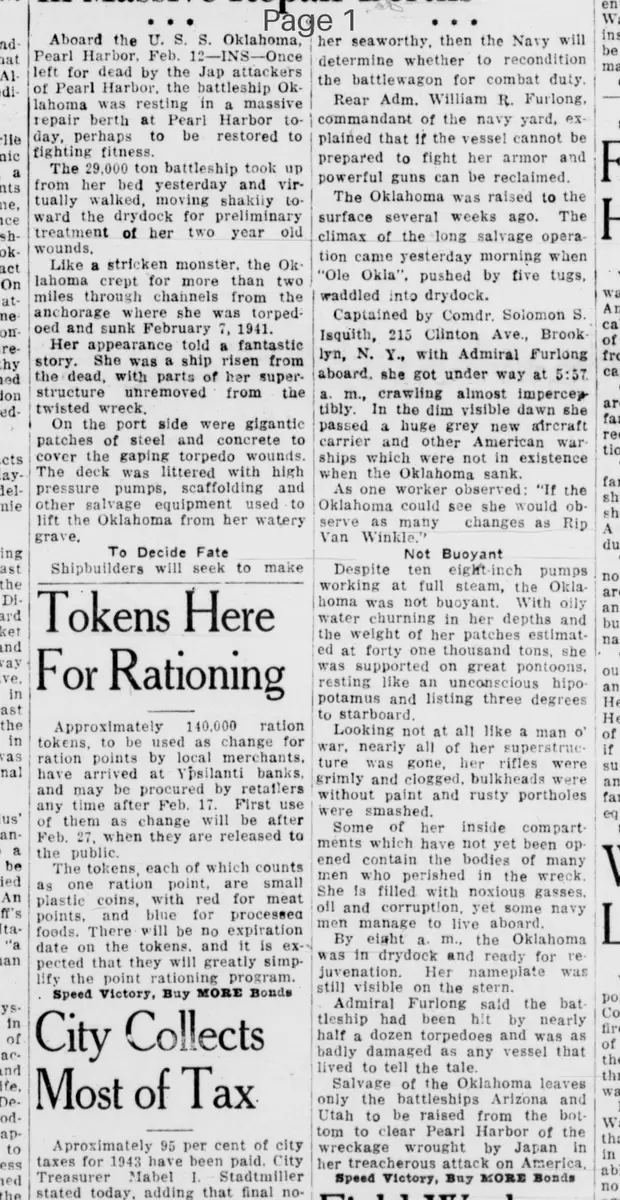
The 29,000 ton battleship took up from her bed yesterday and virtually walked, moving shakily toward the drydock for preliminary treatment of her two year old wounds.
Like a stricken monster, the Oklahoma crept for more than two miles through channels from the anchorage where she was torpedoed and sunk February 7, 1941.
Her appearance told a fantastic story. She was a ship risen from the dead, with parts of her superstructure unremoved from the twisted wreck.
On the port side were gigantic patches of steel and concrete to cover the gaping torpedo wounds. The deck was littered with high pressure pumps, scaffolding and other salvage equipment used to lift the Oklahoma from her watery grave.
To Decide Fate
Shipbuilders will seek to make her seaworthy, then the Navy will determine whether to recondition the battlewagon for combat duty.
Rear Adm. William R. Furlong, commandant of the navy yard, explained that if the vessel cannot be prepared to fight her armor and powerful guns can be reclaimed.
The Oklahoma was raised to the surface several weeks ago. The climax of the long salvage operation came yesterday morning when "Ole Okla", pushed by five tugs, waddled into drydock.
Captained by Comdr. Solomon S. Isquith, 215 Clinton Ave., Brooklyn, N. Y., with Admiral Furlong aboard, she got under way at 5:57 a. m., crawling almost imperceptibly. In the dim visible dawn she passed a huge grey new aircraft carrier and other American warships which were not in existence when the Oklahoma sank.
As one worker observed: "If the Oklahoma could see she would observe as many changes as Rip Van Winkle."
Not Buoyant
Despite ten eight-inch pumps working at full steam, the Oklahoma was not buoyant. With oily water churning in her depths and the weight of her patches estimated at forty one thousand tons, she was supported on great pontoons, resting like an unconscious hippopotamus and listing three degrees to starboard.
Looking not at all like a man o' war, nearly all of her superstructure was gone, her rifles were grimly and clogged, bulkheads were without paint and rusty portholes were smashed.
Some of her inside compartments which have not yet been opened contain the bodies of many men who perished in the wreck. She is filled with noxious gasses, oil and corruption, yet some navy men manage to live aboard.
By eight a. m., the Oklahoma was in drydock and ready for rejuvenation. Her nameplate was still visible on the stern.
Admiral Furlong said the battleship had been hit by nearly half a dozen torpedoes and was as badly damaged as any vessel that lived to tell the tale.
Salvage of the Oklahoma leaves only the battleships Arizona and Utah to be raised from the bottom to clear Pearl Harbor of the wreckage wrought by Japan in her treacherous attack on America.
What sub-type of article is it?
What themes does it cover?
What keywords are associated?
What entities or persons were involved?
Where did it happen?
Story Details
Key Persons
Location
Pearl Harbor
Event Date
Feb. 12, 1943 (Salvage Movement On Feb. 11; Sunk Feb. 7, 1941)
Story Details
The USS Oklahoma, sunk by Japanese torpedoes in the Pearl Harbor attack, was raised after two years and towed over two miles to drydock for assessment and possible repair, despite severe damage and heavy patches.