Thank you for visiting SNEWPapers!
Sign up free
Story
December 17, 1862
Alexandria Gazette
Alexandria, Alexandria County, District Of Columbia
What is this article about?
Union Army of the Potomac under Gen. Burnside evacuates south side of Rappahannock River on Dec. 16, 1862, after failed Fredericksburg campaign, safely recrossing via pontoon bridges undetected by Confederates under Gen. Lee. Wounded cared for; contrabands noted in lines.
Clipping
OCR Quality
98%
Excellent
Full Text
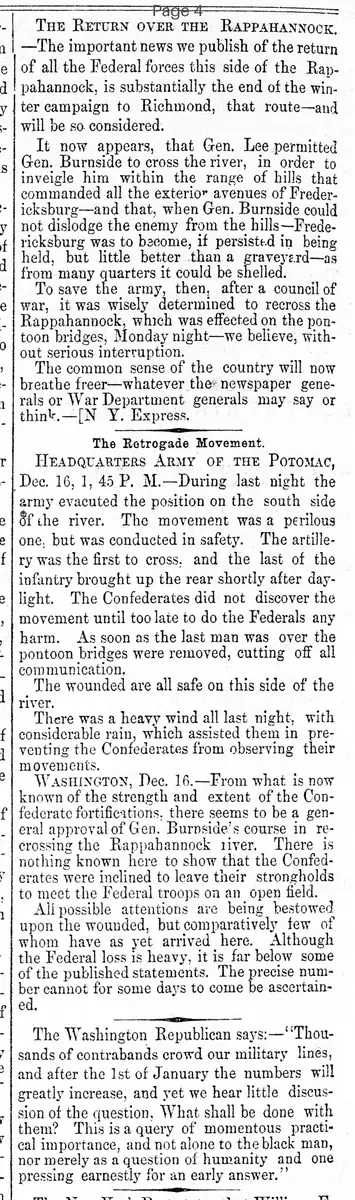
THE RETURN OVER THE RAPPAHANNOCK.
The important news we publish of the return of all the Federal forces this side of the Rappahannock, is substantially the end of the winter campaign to Richmond, that route and will be so considered.
It now appears, that Gen. Lee permitted Gen. Burnside to cross the river, in order to inveigle him within the range of hills that commanded all the exterior avenues of Fredericksburg--and that, when Gen. Burnside could not dislodge the enemy from the hills--Fredericksburg was to become, if persisted in being held, but little better than a graveyard--as from many quarters it could be shelled.
To save the army, then, after a council of war, it was wisely determined to recross the Rappahannock, which was effected on the pontoon bridges, Monday night--we believe, without serious interruption.
The common sense of the country will now breathe freer--whatever the newspaper generals or War Department generals may say or think.--[N Y. Express.
The Retrograde Movement.
HEADQUARTERS ARMY OF THE POTOMAC,
Dec. 16, 1:45 P. M.--During last night the army evacuated the position on the south side of the river. The movement was a perilous one, but was conducted in safety. The artillery was the first to cross, and the last of the infantry brought up the rear shortly after daylight. The Confederates did not discover the movement until too late to do the Federals any harm. As soon as the last man was over the pontoon bridges were removed, cutting off all communication.
The wounded are all safe on this side of the river.
There was a heavy wind all last night, with considerable rain, which assisted them in preventing the Confederates from observing their movements.
WASHINGTON, Dec. 16.--From what is now known of the strength and extent of the Confederate fortifications, there seems to be a general approval of Gen. Burnside's course in recrossing the Rappahannock river. There is nothing known here to show that the Confederates were inclined to leave their strongholds to meet the Federal troops on an open field.
All possible attentions are being bestowed upon the wounded, but comparatively few of whom have as yet arrived here. Although the Federal loss is heavy, it is far below some of the published statements. The precise number cannot for some days to come be ascertained.
The Washington Republican says:--"Thousands of contrabands crowd our military lines, and after the 1st of January the numbers will greatly increase, and yet we hear little discussion of the question, What shall be done with them? This is a query of momentous practical importance, and not alone to the black man, nor merely as a question of humanity and one pressing earnestly for an early answer."
The important news we publish of the return of all the Federal forces this side of the Rappahannock, is substantially the end of the winter campaign to Richmond, that route and will be so considered.
It now appears, that Gen. Lee permitted Gen. Burnside to cross the river, in order to inveigle him within the range of hills that commanded all the exterior avenues of Fredericksburg--and that, when Gen. Burnside could not dislodge the enemy from the hills--Fredericksburg was to become, if persisted in being held, but little better than a graveyard--as from many quarters it could be shelled.
To save the army, then, after a council of war, it was wisely determined to recross the Rappahannock, which was effected on the pontoon bridges, Monday night--we believe, without serious interruption.
The common sense of the country will now breathe freer--whatever the newspaper generals or War Department generals may say or think.--[N Y. Express.
The Retrograde Movement.
HEADQUARTERS ARMY OF THE POTOMAC,
Dec. 16, 1:45 P. M.--During last night the army evacuated the position on the south side of the river. The movement was a perilous one, but was conducted in safety. The artillery was the first to cross, and the last of the infantry brought up the rear shortly after daylight. The Confederates did not discover the movement until too late to do the Federals any harm. As soon as the last man was over the pontoon bridges were removed, cutting off all communication.
The wounded are all safe on this side of the river.
There was a heavy wind all last night, with considerable rain, which assisted them in preventing the Confederates from observing their movements.
WASHINGTON, Dec. 16.--From what is now known of the strength and extent of the Confederate fortifications, there seems to be a general approval of Gen. Burnside's course in recrossing the Rappahannock river. There is nothing known here to show that the Confederates were inclined to leave their strongholds to meet the Federal troops on an open field.
All possible attentions are being bestowed upon the wounded, but comparatively few of whom have as yet arrived here. Although the Federal loss is heavy, it is far below some of the published statements. The precise number cannot for some days to come be ascertained.
The Washington Republican says:--"Thousands of contrabands crowd our military lines, and after the 1st of January the numbers will greatly increase, and yet we hear little discussion of the question, What shall be done with them? This is a query of momentous practical importance, and not alone to the black man, nor merely as a question of humanity and one pressing earnestly for an early answer."
What sub-type of article is it?
Historical Event
Military Action
What themes does it cover?
Misfortune
Survival
What keywords are associated?
Union Retreat
Rappahannock Crossing
Fredericksburg Campaign
Civil War
Burnside Evactuation
Confederate Fortifications
What entities or persons were involved?
Gen. Lee
Gen. Burnside
Where did it happen?
Rappahannock River, Fredericksburg
Story Details
Key Persons
Gen. Lee
Gen. Burnside
Location
Rappahannock River, Fredericksburg
Event Date
Dec. 16
Story Details
Federal forces under Burnside recross Rappahannock after failing to dislodge Confederates from Fredericksburg hills, evacuating safely on pontoon bridges Monday night with weather aid, ending winter campaign; wounded secured, contrabands increase in lines.