Thank you for visiting SNEWPapers!
Sign up free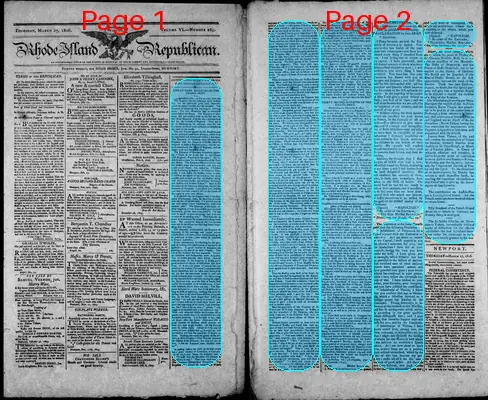
Rhode Island Republican
Newport, Newport County, Rhode Island
What is this article about?
Napoleon's 31st and 32nd Bulletins from Austerlitz describe the French victory over Russian and Austrian forces, immense enemy losses, and interviews with Emperors Francis II and Alexander I leading to an armistice and impending peace. Proclamations announce the Treaty of Pressburg and praise Viennese conduct.
Merged-components note: These components form a continuous article on late foreign intelligence, including bulletins from the Grand Army, proclamations by Napoleon, and related news on the peace of Austerlitz and its aftermath. Original labels for some were 'notice', but content is international reports fitting 'foreign_news'.
Clippings

1 of 2
OCR Quality
Full Text
THIRTY-FIRST BULLETIN OF THE GRAND ARMY.
Austerlitz, 14 Frimaire, year 14.
The Emperor set out yesterday from Austerlitz, for his advanced post near Sautchitz, where he placed himself near his bivouac. The Emperor of Germany was not long in arriving there. The two Monarchs had an interview which lasted two hours. The Emperor of Germany did not conceal both on his side and on that of the Emperor of Russia the contempt they feel for the conduct of England. They are set of shopkeepers, he repeated, who set the Continent on fire in order to secure to themselves the trade of the world.
The two Princes agreed on the Armistice and on the principal conditions of Peace, which is to be negotiated and terminated within a few days.
The Emperor of Germany then informed the Emperor that the Emperor of Russia likewise designed to make a separate peace; that he entirely abandoned the affairs of England, and no longer took any interest in them.
The Emperor of Germany frequently repeated, "There is no doubt but in her dispute with England, France is in the right." He solicited also a truce for the remainder of the Russian Army. The Emperor observed to him that the Russian army was surrounded, and that not a man could escape; but, added he, "I desire to do something agreeable to the Emperor Alexander, I will suffer the Russian Army to pass. I will stop the march of my columns, but your majesty must promise me that the Russian Army will return into Russia and evacuate Germany and Austria and Prussian Poland." Such is the intention of the Emperor Alexander, replied the Emperor of Germany, I can assure you, besides you may convince yourself of it in the course of the night by your own officers.
It is asserted that the Emperor said to the Emperor of Germany, when he asked him to come near the fire of his bivouac, "I receive you in the only palace I have inhabited for these two months past." The Emperor of Germany replied laughing. ("Vous avez si bon parti de cette habitation, qu'elle doit vous plaire") "It has been so much to your advantage that I do not wonder at its pleasing you." This is as near as could be understood the words which dropt from him. The numerous suite of the two princes were not so far distant but that they heard something that was said.
The Emperor accompanied the Emperor of Germany to his carriage, and caused prince Lichtenstein and Gen. prince Schwarzenberg to be presented to him; after which he returned to sleep at Austerlitz.
Every information is collecting for the purpose of writing a fine description of the battle of Austerlitz. A great number of Engineers are drawing up the plan of the field of battle. The loss of the Russians has been immense. General Kutusow and Buxhowden were wounded. Ten or twelve generals were killed. Several aides-de-camp to the Emperor of Russia and a great number of officers of distinction lost their lives. It is not 120 pieces of cannon but 150 which we have taken. The enemy's columns which threw themselves into the lakes were favored by the ice but the cannonade broke it, and two whole columns were drowned. On the evening of the day and for several hours during the night, the Emperor rode over the field of battle, and caused the wounded to be carried away, a horrible spectacle, if ever there was one. The Emperor mounted on a very fleet horse galloped along as swift as lightning; nothing was more affecting than to see those brave fellows recognise him on the field; some forgot their sufferings and said "At least the victory is certain;" others "I have suffered for thee eight hours and since the beginning of the battle I am abandoned, but I have done my duty;" others, "you ought to be satisfied with your soldiers to day."
With each wounded soldier the Emperor left a guard who caused him to be transported into the moveable hospitals. It is horrible to say, that 48 hours after the battle, there were still a great number of Russians whose wounds we were not able to get dressed. All the French were so before night. Instead of forty pair of colors we have already had 45 brought in, and our soldiers still find the remainder of several others. Nothing can equal the gaiety of the soldiers at their bivouacs—They scarcely perceive the Officer of the Emperor, but they cry out to him, "has the Emperor been satisfied with us?"
In passing before the 28th of the line which has a great number of Conscripts of Calvados and of the Lower Seine, the Emperor said to it: "I hope that the Normans will distinguish themselves to day." They kept their word.— The Normans distinguished themselves. The Emperor who knows the composition of each regiment, encouraged them all in the same manner.
Regiment said a few words; these few words arrived and spoke to the hearts of those to whom they were addressed, and became their rallying signal in the midst of the fight. He said to the 67th, "Recollect that it was many years since I named you the Terrible." It would be necessary to name all the regiments of the army. There was not one which did not show prodigies of bravery and intrepidity. Here indeed it might be said that Death fled affrighted before our ranks to throw himself into those of the enemy. Not a corps made a retrograde movement. The Emperor said, "I have fought 30 battles such as this, but I never saw one where the victory was more decisive, and the chances of little balanced." The Foot Guards of the Emperor were not engaged. They wept with rage. When they asked to be employed, the Emperor said to them, "Rejoice that you have not yet been in the action; you are to fall on as a reserve. So much the better if you are not wanted today."
Three Colonels of the Imperial Russian Guard were taken with the General who commanded them. The Horse of this guard made a charge on the division of Caffarelli. This charge cost them 300 men who remained on the field of battle. The French cavalry showed itself superior and acquitted itself admirably well.
At the end of the action the Emperor sent Colonel Dallemagne with two squadrons of his Guard as partisans, to ride over the field of battle and bring in the runaways. He took several stands of colors and 1,500 prisoners. The guards greatly regret the Colonel of the horse rangers Morland, who was killed with a grape shot, as he was charging the artillery of the Russian Imperial Guards. The artillery was taken; but this brave Colonel found his death. We had not one General killed. Colonel Mazas, of the 14th of the line, a brave man, was killed. Many Chiefs of battalion were wounded. The Voltigeurs vied with the Grenadiers. The 55th, 43d, 14th, 26th, 40th, 17th—but we dare mention no corps; it would be an injustice to the others; they all performed wonders. There was not a single General, an Officer, a Soldier but was determined to conquer or die.
We must not conceal a trait that does honor to the enemy. The commander of the artillery of the Russian Imperial Guards had just lost his cannon. He met the Emperor. "Sire," said he, "get me shot; I have just lost my cannons."
"Young man," answered the Emperor, "I appreciate your tears, but one may be beat by my army and still have a title to glory."
Our advanced posts are arrived at Olmutz. The Empress and the whole court have fled from thence in the greatest haste. Colonel Corvisart, Equerry to the Emperor, Commander of the 2nd regiment of Rangers has 4 horses killed under him; upon the 5th he was wounded himself, after seizing a stand of colors.
Prince Murat bestows great praise on the fine manoeuvres of General Kellermann, on the fine charges of Generals Nansouty & d'Hautpoul, in short on all the Generals, for one knows not whom to name because they should all be named. The soldiers of the train have merited the praise of the army. The artillery made a dreadful havoc among the enemy. When an account was given of it to the Emperor, he said: "Its success gives me pleasure; for I have not forgot that it was in this corps that I began my military career."
The Emperor's aide-de-camp, General Savary, had accompanied the Emperor of Germany after the interview, to know whether the Emperor of Russia adhered to the capitulations. He found the wreck of the Russian army without either artillery or baggage, and in a frightful disorder. It was midnight: General Meerfeld had been repulsed from Goding by Marshal Davout. The Russian army was surrounded; not a man could escape. Prince Czartoriski introduced General Savary to the Emperor. "Tell your master," cried that Prince, "that I am going away; he has wrought many miracles; how this day has increased my admiration of him! He is predestined of Heaven; my army will require a hundred years to equal his; but can I retire with safety?" "Yes, Sire," answered General Savary, "if Your Majesty ratifies what the two Emperors of France and Germany have agreed upon in their interview." "And what is it?"
"That the Russian army shall retire home, by the stages that shall be regulated by the Emperor, and that it shall evacuate Germany and Austrian Poland. Upon this condition, I have the Emperor's orders to repair to our advanced posts, which have already turned you, and to give orders to protect your retreat, as the Emperor wishes to respect the friend of the First Consul."
"What guarantee must I give for that?" "Sire, your Word—I give it you."
This aide-de-camp set off in full gallop to Marshal Davout, to whom he gave orders to cease all movements and to remain quiet.
May this generosity of the Emperor of the French not be so soon forgotten in Russia, as the fine procedure of the Emperor, who sent back 800 men to the Emperor Paul with so much grace and so many tokens of esteem for him.
General Savary conversed an hour with the Emperor of Russia, and found him such a man of heart and sense should be, whatever loss he may have experienced. The Monarch asked him to give him some details of the engagement. "You were inferior to me," said he, "and, however, you were superior in all points of attack." "Sire," answered General Savary, "that is the art of war, and the fruit of 15 years of glory. It is the 40th battle the Emperor has fought." "That is true, he is a great warrior. For my part, it is the first time I have seen fire. I have never had the pretension to measure with him." "Sire, when you have gained experience, you will surpass him perhaps." "I shall now return to my capital. I came to the assistance of the Emperor of Germany. He has made known to me that he is satisfied. I am so too."
On his interview with the Emperor of Germany, the Emperor told him: "M. and Mme. de Colloredo, MM. Page and Palmowski are all one with your Minister Cobenzl. They are the real causes of the war, and if Y. M. continues to abandon yourself to these intriguers, they will ruin all your affairs and alienate the heart of all your subjects, you who have so many qualities to be happy and beloved."
An Austrian Major having presented himself at the advanced posts, with dispatches from M. de Stadion at Vienna, the Emperor said "I will have nothing to do with that man, who has sold himself to England to pay his debts, and who has ruined his house and his nation by following his sister's advice."
The Emperor took the greatest notice of Prince John of Liechtenstein. He frequently said "How is it when one has men of such great distinction that one can suffer himself to be led by fools and intriguers." In fact Prince John of Liechtenstein is one of the most distinguished characters, not only for his military talents, but for his qualities and knowledge.
It is confidentially asserted that the Emperor said after his conference with the Emperor of Germany, "That man has made me commit a fault, for I could have followed up my victory and taken the whole Russian and Austrian armies, but, however, there will be some tears the less shed."
THIRTY SECOND BULLETIN OF THE GRAND ARMY.
Austerlitz December 6 1805,
General Friant, at the battle of Austerlitz, had four horses killed under him. Colonel Conroux and Demontier distinguished themselves. The traits of courage are so numerous that as they were reported to the Emperor he said, "I need all my power to be able to recompense worthily these brave men."
The Russians, in fighting have the habit of laying down their knapsacks; and the whole Russian army having been put to flight they were taken possession of by our soldiers. A great quantity of baggage was also taken, and the soldiers have found in it much money.
General Bertrand, who had been dispatched after the battle with a squadron of the guards, has brought in a great number of prisoners, 19 pieces of cannon, and many baggage waggons well filled. The number of pieces of cannon taken up to this time amounts to 170.
The Emperor testified some dissatisfaction that plenipotentiaries had been sent to him the day before the battle, and that the diplomatic character had been prostituted. It is worthy of M. Cobenzl, whom the whole nation regards as one of the principal authors of all its calamities.
Prince John de Liechtenstein is come to meet the Emperor at the castle of Austerlitz. The Emperor has granted him a conference of several hours. It was remarked that the Emperor conversed freely with this general officer, who has concluded with Marshal Berthier an armistice of the following tenor:
M. Talleyrand is going to Nikolsburg, where the negotiations are to be opened.
Armistice concluded between their Imperial Majesties of France and Austria.
His majesty the Emperor of the French and His majesty the Emperor of Germany desirous to reach the period of definitive negotiations for putting an end to the war which desolates the two states, have agreed as a preliminary to begin by an armistice, which shall continue until the conclusion of a definitive peace, or until the rupture of negotiations; and in this case the armistice shall not cease until fifteen days after that rupture and the cessation of the armistice shall be notified to the plenipotentiaries of both powers, and at the head quarters of both armies.
The conditions of the armistice are:
1. The line of both armies shall be in Moravia, the circle of Iglan, the circle of Znaim, the circle of Brunn, that part of the circle of Olmutz upon the right bank of the small river of Tirschobka opposite to Prensitz as far as it empties itself into the March, and the right bank of the March as far as the mouth of that river into the Danube including however Presburg: but no French or Austrian troops shall be stationed within a circumference of five or six leagues round Holitsch on the right bank of the March.
The line of the two armies shall besides comprehend, in the territory to be occupied by the French army, the whole of Lower and Upper Austria, the Tyrol, the state of Venice, Carinthia, Styria, Carniola, the county of Goritz and Istria; in short, in Bohemia, the circle of Budweis, and all the country on the east of the road from Tabor to Lintz.
2. The Russian army shall evacuate the Austrian States, as well as Polish Austria, viz. Moravia and Hungary within fifteen days and Galicia within a month. The order of its march shall be traced, so that it may be always known where it is, as well as to prevent all misunderstanding.
3. There shall not be made in Hungary any kind of levy en masse, nor insurrections; & in Bohemia no kind of extraordinary levy; no foreign army shall be permitted to enter the territory of the House of Austria.
Negotiators on each side shall meet at Nikolsburg, to proceed immediately on the business of negotiations, in order to establish promptly Peace and harmony between the two Emperors.
Done interchangeably between us the undersigned, the Marshal Berthier, minister of war, major general of the grand army, charged with full powers from his majesty the Emperor of the French and King of Italy; and Prince John de Liechtenstein, lieutenant general, charged with full powers from his majesty the Emperor of Austria, king of Hungary, &c.
At Austerlitz, the 15th Frimaire, year 14 (6th December, 1805.)
Signed
Marshal BERTHIER,
J. Prince de LIECHTENSTEIN, lieut. general.
SCHONEBRUNN, Dec. 29.
Before the Emperor Napoleon left this place, he published the following,
PROCLAMATION TO THE ARMY.
"SOLDIERS,
Peace between me and the EMPEROR of AUSTRIA is signed. You have in this late season of the year made two campaigns; you have performed every thing I expected from you. I am setting out to return to my capital. I have promoted, and distributed rewards to those who have distinguished themselves most; I will perform to you every thing I have promised. You have seen that your Emperor has shared with you all dangers and fatigues; you shall likewise see him surrounded with all that grandeur and splendor which becomes the Sovereign of the first nation in the world. In the beginning of the month of May I will give a grand festival at Paris; you shall all be there; and we shall there see whether we are called by the happiness of our country, and the interest of our glory.
Soldiers, during the three months which are necessary for your return to France, be the example of all armies. You have now to give examples, not of courage and intrepidity, but of strict discipline—may my allies no more have to complain of your behaviour! Conduct yourselves on your arrival in that sacred territory, like children in the bosom of their family. My people will conduct themselves towards you, as they must do towards their heroes and their defenders.
Soldiers, the thought that I shall see you all in less than half a year, assembled round my Palace, is pleasing to my heart; and I feel before-hand the most delightful emotions. We will celebrate the memory of those, who, in these two campaigns, have fallen in the field of honor. The world shall see that we are ready to follow their example, and if necessary, to do still more than we have done, against those who attack our honour, or suffer themselves to be misled by the gold of the eternal enemy of the Continent."
(Signed)
"NAPOLEON."
"By order of the EMPEROR,
"Maj. Gen. Marshal BERTHIER."
"Schonbrunn, 6th Nivose, Dec. 27."
The Emperor at the same likewise published the following Proclamation:
"Inhabitants of Vienna—I have signed a peace with the Emperor of AUSTRIA. As I am about to return to my Capital, I must express to you the esteem I entertain for you, and the satisfaction I have felt at your conduct, during the time you were under my laws. I have given you an example, which hitherto has had no parallel in the history of nations. Ten thousand men of your national guards have remained armed, and have guarded your gates; your whole arsenal has continued in your power, while I have followed the uncertain fortune of war. I have trusted to your honor, your sincerity, your integrity, and you have justified my confidence.
Inhabitants of Vienna, I know that you consider that war as blameable, which a Minister devoted to a foreign power has kindled on the Continent. Young Sovereign is informed of the conduct of that Minister, and has in consequence acted entirely according to the great qualities which distinguish him; and I now hope, that hereafter happier days will arise for you, and for the Continent.
Inhabitants of Vienna, I have shown myself little among you, not from contempt, or vain pride; no, but that I might not diminish the feelings of esteem for that Monarch with whom I was desirous to conclude a speedy peace. As I am now about to leave you, receive from me as a present, your arsenal untouched, which by the laws of war had become my property; make use of it for the maintenance of good order. All the evils you have suffered, you must ascribe to the calamities inseparable from war; and every kind of indulgence with which my armies have treated these countries, to the esteem which you have deserved."
(Signed)
"NAPOLEON."
"By order of the Emperor,
"Major-Gen. Marshal BERTHIER."
"Schonbrunn, 6th Nivose, (Dec. 27.) Year 14."
Among the other changes which are to follow the peace of Presburg, the German Elective Body is to receive an accession of two Members. The Duke of Brunswick, and the Prince of Hesse Darmstadt, are to be exalted to the dignity of Electors.
We should not be surprised, if the King of Prussia should, on the first opportunity, become the head of the Empire. These two new Electors created, no doubt, for that special purpose, will give him a majority, should he be disposed to contest the election of a king of the Romans.
The Wirtemberg newspaper states that upon the request of the Austrian Emperor, Baron Thugut was permitted to be present at the conferences at Presburg; from whence it is inferred, that even a peace between France and England was an object of the deliberations: Baron Thugut having before conducted the negotiations with England, is supposed to have been well acquainted with the subject.
Letters from Vienna, of the 22d inst. confirm the nomination of Count De Stadion, formerly Minister from Austria to St. Petersburgh, as Minister of Foreign Affairs. A Treaty of Alliance offensive and defensive, is said to be on the point of conclusion between Austria and France. Bosnia, Wallachia, and Servia are to indemnify the Emperor for the loss of Venice and the Tyrol. To the Governor of the latter country, his Majesty has written a most impressive letter, lamenting the imperious circumstances that forced him to give up the Sovereignty of that Country.
The contribution on Austria proper is 60,000,000 of francs. All the French conscripts have received orders to return home.
Fifty thousand of the French Grand Army are to remain in Germany until every thing is arranged.
The Archduke Charles, on his return to Vienna, immediately solicited marks of distinction for the officers and soldiers that had signalized themselves under his command in Italy. They were readily granted by his brother.
What sub-type of article is it?
What keywords are associated?
What entities or persons were involved?
Where did it happen?
Foreign News Details
Primary Location
Austerlitz
Event Date
14 Frimaire, Year 14 (December 1805)
Key Persons
Outcome
immense russian losses including 150-170 cannons taken, ten or twelve generals killed, generals kutusow and buxhowden wounded, two russian columns drowned, 45 pairs of colors captured; armistice agreed, russian army to evacuate, peace negotiations to begin at nikolsburg, treaty of pressburg signed ceding territories to france.
Event Details
Napoleon's bulletins detail the decisive French victory at Austerlitz, interviews with Austrian Emperor Francis II agreeing on armistice and peace terms, negotiations with Russian Emperor Alexander I for safe retreat, battle aftermath with care for wounded, praises for French regiments and generals, full armistice terms between France and Austria, proclamations announcing peace and return to France.