Thank you for visiting SNEWPapers!
Sign up free
Daily National Intelligencer
Washington, District Of Columbia
What is this article about?
In a U.S. congressional debate, Mr. Tucker defends the federal government's constitutional authority to purchase property and fund internal improvements like roads and canals for national benefit, citing historical precedents including the Louisiana Purchase and state cessions, while stressing the need for state consent to respect state rights.
Clipping
OCR Quality
Full Text
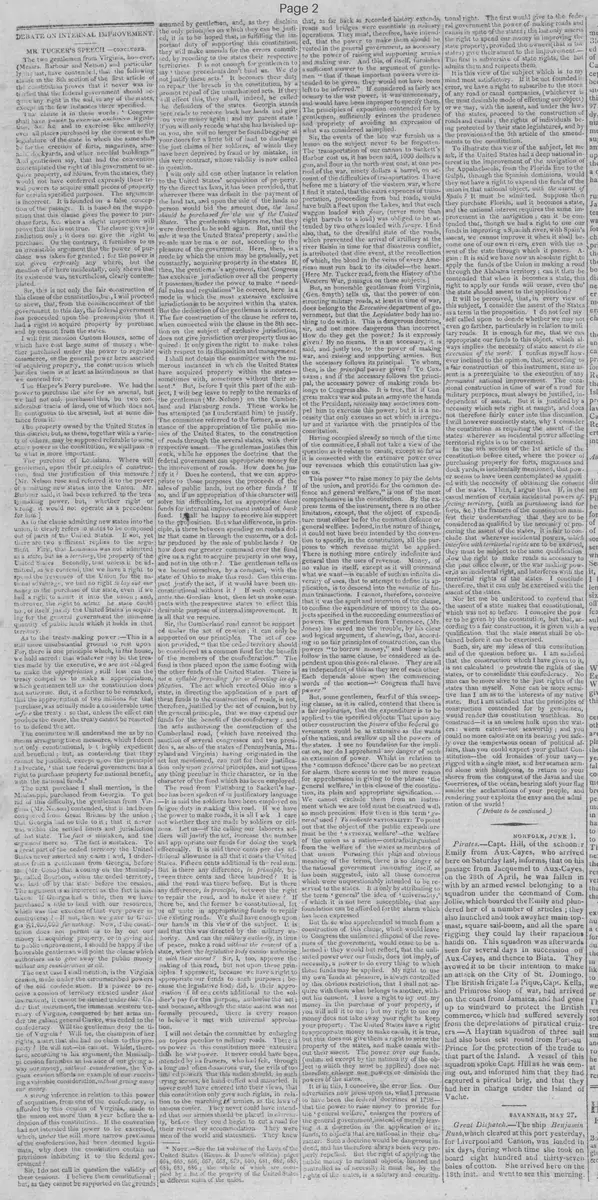
MR. TUCKER'S SPEECH—CONCLUDED.
The two gentlemen from Virginia, however, by the last, have contended, that the following clause in the 8th section of the first article of the constitution proves that it never was intended that the federal government should acquire any right in the soil, in any of the states, except in the few instances there specified. That clause is in these words: "Congress shall have power to exercise exclusive legislation... and to exercise like authority over all places purchased by the consent of the legislature of the state in which the same shall be, for the erection of forts, magazines, arsenals, dock-yards, and other needful buildings."
And gentlemen say, that had the convention contemplated the right of this government to acquire property, ad libitum, from the states, they would not have conferred expressly these trivial powers to acquire small pieces of property for certain specified purposes. The argument is incorrect. It is founded on a false conception of the passage. It is based on the supposition that this clause gives the power to purchase forts, &c. when a slight inspection will prove that this is not true. The clause gives jurisdiction only; it does not give the right to purchase. On the contrary, it furnishes to us an irresistible argument that the power of purchase was taken for granted; for the power is not given expressly anywhere, but the mention of it here incidentally, only shews that its existence was, nevertheless, clearly contemplated.
Sir, this is not only the fair construction of this clause of the constitution, but, I will proceed to shew, that, from the commencement of the government to this day, the federal government has proceeded upon the presumption that it had a right to acquire property by purchase and by cession from the states.
I will first mention Custom Houses, some of which have cost large sums of money; whether purchased under the power to regulate commerce, or the general power here asserted of acquiring property, the construction which justifies them is at least as latitudinous as that we contend for.
The Harper's Ferry purchase. We had the power to purchase the site for an arsenal, but we had not only purchased this, but two considerable tracts of land, one of which does not lie contiguous to the arsenal, but at some distance from it.
The property owned by the United States in this district; but, as these, together with a variety of others, may be supposed referable to some other power in the constitution, we shall pass on to what is more important.
The purchase of Louisiana. Where will gentlemen, upon their principles of construction, find the justification of this measure?
[Mr. Nelson rose and referred it to the power of admitting new states into the Union. Mr. Barbour said, it had been referred to the treaty-making power, but, whether right or wrong, it would not operate as a precedent for him.]
As to the clause admitting new states into the union, it clearly refers to states to be composed out of parts of the United States. If not, yet there are two sufficient replies to the argument. First, that Louisiana was not admitted as a state, but as a territory, the property of the United States. Secondly, that unless it be admitted, as we contend, that we have a right to spend the revenues of the Union for the national advantage, we had no right to lay out our money in the purchase of the state, even if we had a right to admit it into the union; and, moreover, the right to admit the state could no, of itself justify the United States in acquiring for the general government the immense quantity of public lands which it holds in that territory.
As to the treaty-making power: This is a still more unsubstantial ground to rest upon. For, there is one principle which, in this house, we hold sacred: that whatever may be the treaties made by the executive, we are not obliged to make the appropriation; still less can the treaty compel us to make an appropriation, which gentlemen tell us the constitution does not authorise. But, it is further to be remarked, that the appropriation of two millions for that purchase, was actually made a considerable time before the treaty: so that, unless the effect can produce the cause, the treaty cannot be resorted to to defend the act.
The committee will understand me as by no means arraigning these measures, which I deem not only constitutional, but highly expedient and beneficial; but, as contending that they cannot be justified, except upon the principle I advocate, that the federal government has a right to purchase property for national benefit, with the national funds.
The next purchase I shall mention, is the Mississippi, purchased from Georgia. To get rid of this difficulty, the gentleman from Virginia (Mr. Nelson) contended, that it had been conquered from Great Britain by the union; that Georgia had no title to it; that it never was within the settled limits and jurisdiction of that state. The fact is mistaken, and the argument more so. The fact is mistaken. To a great part of the ceded territory the United States never asserted any claim; and, I understand from a gentleman from Georgia, before me (Mr. Cobb) that a county on the Mississippi, called Bourbon, within the ceded territory, was laid off by that state before the cession.
The argument is as incorrect as the fact is mistaken. If Georgia had a title, then we have purchased a title to land with our resources, which was the exercise of that very power in controversy? If not, then we gave to Georgia $1,200,000 for nothing. Now, if the constitution does not permit us to lay out our money in acquiring property, or in giving aid to public improvement, I should be happy if the honorable gentleman will point the clause which authorises us to give away the public money without any consideration at all.
The next case I shall mention, is the Virginia cession, made under the circumscribed powers of the old confederation. If a power to receive a cession of territory existed under that instrument, it cannot be denied under this. Under that instrument, the immense western territory of Virginia, conquered by her arms under the gallant general Clarke, was ceded to the confederacy. Will the gentleman deny the title of Virginia? Will he, the champion of her rights, assert that she had no claim to this property? He will not—he cannot. Whilst, therefore, according to his argument, the Mississippi cession furnishes an instance of our giving away our money, without consideration, the Virginia cession affords an example of our receiving a valuable consideration, without giving away our money.
A strong inference in relation to this power of acquisition, from one of the confederacy, is afforded by this cession of Virginia, made to the union not more than a year before the adoption of this constitution. If the convention had not intended this power to be exercised, which, under the still more narrow provisions of the confederation, had been deemed legitimate, why does the constitution contain no provisions inhibiting it to the federal government?
Sir, I do not call in question the validity of these cessions. I believe them constitutional; but, as they cannot be supported on the grounds assumed by gentlemen, and, as they disclaim the only principles on which they can be justified, it is to be hoped that, in fulfilling the important duty of supporting this constitution, they will make amends for the errors committed, by receding to the states their respective territories. It is not enough for gentlemen to say 'these precedents don't bind us. We do not justify these acts.' It becomes their duty to repair the breach in the constitution, by a prompt repeal of the unauthorised acts. If they will effect this, they shall, indeed, be called the defenders of the states. Georgia stands here ready to receive back her lands and give you your money again: and my parent state! if you will only recede what she has lavished upon you, she will no longer be found begging at your doors for a little bit of land to discharge the just claims of her soldiers, of which they have been deprived by fraud or by mistake, in this very contract, whose validity is now called in question.
I will only add one other instance in relation to the United States' acquisition of property. By the direct tax laws, it has been provided, that wherever there was default in the payment of the land tax, and upon the sale of the lands no person would bid the amount due, the land should be purchased for the use of the United States. The gentleman whispers me, that they were directed to be sold again. But, until the sale it was the United States' property; and the re-sale may be made or not, according to the pleasure of the government. Here, then, is a mode by which the union may be gradually, yet constantly, acquiring property in the states. If, then, the gentleman's argument, that Congress has exclusive jurisdiction over all the property it possesses, under the power to make "needful rules and regulations" be correct, here is a mode in which the most extensive exclusive jurisdiction is to be acquired within the states.
But the deduction of the gentleman is incorrect. The fair construction of the clause he refers to, when connected with the clause in the 8th section on the subject of exclusive jurisdiction, does not give jurisdiction over property thus acquired: It only gives the right to make rules with respect to its disposition and management.
I shall not detain the committee with the numerous instances in which the United States have acquired property within the states—sometimes with, sometimes without their assent.* But, before I quit this part of the subject, I will beg leave to reply to the remarks of the gentleman (Mr. Nelson) on the Cumberland and Plattsburg roads. These works he has attempted (as I understand him) to justify. The committee referred to the former, as an instance of the appropriation of the public monies of the United States, to the construction of roads through the several states, with their respective assent. The gentleman justifies this work, while he opposes the doctrine that the federal government can appropriate money for the improvement of roads. How does he justify it? Does he contend, that we can appropriate to those purposes the proceeds of the sales of public lands, but no other funds? If so, and if an appropriation of this character will solve his difficulties, let us appropriate these funds for internal improvement instead of bank fund. I shall be happy to receive his support to the proposition. But what difference, in principle, is there between spending on roads a dollar that came in through the customs, or a dollar produced by the sale of public lands? Or how does our greater command over the fund give us a right to acquire property in one way, and not in the other? The gentleman tells us we bound ourselves, by a compact, with the state of Ohio to make this road. Can this compact justify the act, if it would have been unconstitutional without it? If such compacts untie the Gordian knot, then let us make compacts with the respective states to effect this desirable purpose of internal improvement. It is all that we require.
Sir, the Cumberland road cannot be supported under the act of cession; it can only be supported on our principles. The act of cession provided, "that the ceded territory should be considered as a common fund for the benefit of the members of the confederation." The fund is thus placed upon the same footing with the other funds of the United States. There is not a syllable providing for or directing its application. The act which erected Ohio into a state, in directing the application of a part of these funds to the construction of roads, is not, therefore, justified by the act of cession, but by the general principle, that we may expend our funds for the benefit of the confederacy: and the acts authorising the construction of the Cumberland road, (which have received the sanction of several congresses and two presidents, as also of the states of Pennsylvania, Maryland and Virginia) having originated in the act last mentioned, can rest for their justification only upon general principles, and not upon any thing peculiar in their character, or in the character of the fund which has been employed.
The road from Plattsburg to Sackett's harbor has been spoken of in justificatory language. It is said the soldiers have been employed on fatigue duty in making this road. If we have the power to make roads, it is all I ask. I care not whether they are made by soldiers or citizens. Let us—if the calling our laborers soldiers will justify the act, increase the number and appropriate our funds for doing the work effectually. It is said three cents per day additional allowance is all that it costs the United States. Fifteen cents additional is the real sum. But is there any difference, in principle, between three cents and three hundred? It is said the road was there before. But is there any difference, in principle, between the right to repair the road, and to make it anew? If there be, and the former be constitutional, let us all unite in appropriating funds to repair the existing roads. We shall have enough upon our hands in this view of the subject. It is said that this was directed by the military authority. And can the military authority, in time of peace, make a road without the consent of a state, when the legislative body cannot authorise it without their assent? Sir, I, too, approve the making of this road, but not upon these principles. I approve it, because we have a right to appropriate our funds to such purposes; because the legislative body did, by their appropriation of fifteen cents additional to the soldier's pay for this purpose, authorise the act; and because, although the state assent was not formally procured, there is every reason to believe it met with universal approbation.
I will not detain the committee by enlarging on topics peculiar to military roads. There is no power in this constitution more extensive than the war power. It never could have been intended by its framers, who had felt, through a long and often disastrous war, the evils of too limited powers that this nation should, in such varying scenes, be hand-cuffed and manacled. It never could have entered into their views, that this constitution only gave such rights, in relation to the marching of armies, as the laws of nations confer. They never could have intended that our armies should be placed in extremity, before they could begin to cut a road for their retreat or accommodation. They were men of the world and statesmen. They knew that, as far back as recorded history extends, roads and bridges were essentials in military operations. They must, therefore, have intended, that the power to make them should be vested in the general government, as accessory to the power of raising and supporting armies and making war. And this, of itself, furnishes a sufficient answer to the argument of gentlemen "that if these important powers were intended to be given, they would not have been left to be inferred." If considered as fairly accessory to the war power, it was unnecessary, and would have been improper to specify them. The principles of exposition contended for by gentlemen, sufficiently evinces the prudence and propriety of avoiding an expression of what was considered as implied.
Sir, the events of the late war furnish us a lesson on the subject never to be forgotten. The transportation of our cannon to Sackett's Harbor cost us, it has been said, 1000 dollars a gun, and flour in the north-west cost, at one period of the war, ninety dollars a barrel, on account of the difficulties of transportation. I have before me a history of the western war, where I find it stated, that the extra expences of transportation, proceeding from bad roads, would have built a fleet upon the Lakes, and that each waggon loaded with flour, (never more than eight barrels to a load) was obliged to be attended by two others loaded with forage. I find also, that, to the dreadful state of the roads, which prevented the arrival of artillery at the river Raisin in time for that disastrous conflict, is attributed that dire event, at the recollection of which, the blood in the veins of every American must run back to its citadel—the heart.
[Here Mr. Tucker read, from the History of the Western War, passages on these subjects.]
But, an honorable gentleman from Virginia (Gen. Smyth) tells us, that the power of constructing military roads, at least in time of war, does belong to the Executive department of government, but that the Legislative body has nothing to do with it. This is dangerous doctrine, sir, and not more dangerous than incorrect. How do they get the power? Is it expressly given? By no means. It is an accessory, it is said, and justly too, to the power of making war, and raising and supporting armies. But the accessory follows its principal. To whom, then, is the principal power given? To Congress; and if the accessory follows the principal, the accessory power of making roads belongs to Congress also. It is true, that if Congress makes war and puts an army into the hands of the President, necessity may sometimes compel him to exercise this power; but it is a necessity that only excuses an act which is irregular and at variance with the principles of the constitution.
Having occupied already so much of the time of the committee, I shall not take a view of the question as it relates to canals, except so far as it is connected with the extensive power over our revenues which this constitution has given us.
This power "to raise money to pay the debts of the union, and provide for the common defence and general welfare," is one of the most comprehensive in the constitution. By the express terms of the instrument, there is no other limitation, except, that the object of expenditure must either be for the common defence or general welfare. Indeed, in the nature of things, it could not have been intended by the convention to specify, in the constitution, all the purposes to which revenue might be applied. There is nothing more entirely indefinite and general than the uses of revenue. Money, of no value in itself, except as it will command what we want—is capable of such an infinite diversity of uses, that to attempt to define its application, is to descend into the minutiæ of human transactions. I cannot, therefore, conceive that it was the spirit and intention of the clause, to confine the expenditure of money to the objects specified in the succeeding enumeration of powers. The gentleman from Tennessee, (Mr. Jones) has saved me the trouble, by his clear and logical argument, of shewing, that, according to no fair principles of construction, can the powers "to borrow money," and those which follow in the same clause, be considered as dependent upon this general clause. They are all as independent of this as they are of each other. Each depends alone upon the commencing words of the section—"Congress shall have power"
But, some gentlemen, fearful of this sweeping clause, as it is called, contend that there is a fair implication, that the expenditure is to be applied to the specified objects: That upon any other construction the powers of the federal government would be as extensive as the wants of the nation, and swallow up all the powers of the states. I see no foundation for the implication, nor do I apprehend any danger of such an extension of power. Whilst in relation to the 'common defence' there can be no pretext for alarm there seems to me not more reason for apprehension in giving to the phrase the 'general welfare,' in this clause of the constitution, its plain and appropriate signification. We cannot exclude them from an instrument which we are told must be construed with so much precision. How then is this term 'general' used? To indicate NATIONALITY: To point out that the object of the public expenditure must be the 'NATIONAL welfare'—the welfare of the union as a nation—contradistinguished from the welfare of the states as members of that union. Pursuing this plain and obvious meaning of the terms, there is no danger of the national government insinuating itself, as has been suggested, into all those concerns which were unquestionably intended to be reserved to the states. It is only by attributing to the term 'general' the idea of 'universality,' of which it is not here susceptible, that any foundation can be afforded for the alarm which has been expressed.
But those who apprehend so much from a construction of this clause, which would leave to Congress the unlimited disposal of the revenues of the government, would cease to be alarmed if they would but reflect, that the unlimited power over our funds, does not imply, of necessity, a power to do every thing to which these funds may be applied. My right to use my own funds at pleasure, is always controlled by this obvious restriction, that I shall not acquire with them what belongs to another, without his consent. I have a right to lay out my money in the purchase of your property, if you will sell it to me; but my right to use my money does not take away your right to keep your property. The United States have a right to appropriate money to make canals, it is true, but this does not give them a right to seize the property of the states, and make canals without their assent. The power over our funds, (unlimited except by the nationality of the object to which they must be applied) does not therefore enlarge our powers or diminish the powers of the states.
It is in this, I conceive, the error lies. Our adversaries now press upon us, what I presume to have been the federal 'doctrines of 1798'—that the power to raise money to provide for the 'general welfare,' enlarges the powers of the general government, instead of merely leaving it a discretion in the application of its funds, to objects that are national in their character. Such a doctrine would be dangerous indeed, and has therefore always been very properly repelled. But the right of applying the public money to national objects, limited and controlled as of necessity it must be, by the rights of the states, is a salutary and constitutional right. The first would give to the federal government the power of making roads and canals in spite of the states; the last only asserts the right to spend our money in improving the state property, provided the owners (that is the states) give their assent to the improvement.—The first is subversive of state rights, the last admits them and respects them.
It is this view of the subject which is to my mind most satisfactory. If it be not founded in error, we have a right to subscribe to the stock of any road or canal companies, (whichever is the most desirable mode of effecting our object) or we may, with the assent, and under the laws of the states, proceed to the construction of roads and canals: the rights of individuals being protected by their state legislatures, and by the provisions of the 5th article of the amendments to the constitution.
To illustrate this view of the subject, let me ask, if the United States had a deep national interest in the improvement of the navigation of the Apalachicola, from the Florida line to the Gulph, through the Spanish dominions, would they not have a right to expend the funds of the union in that national object, with the assent of Spain? It must be admitted. Suppose then they purchase Florida, and it becomes a state, and the national interest requires the same improvement in the navigation; can it be contended that, though we had a right to use our funds in improving a Spanish river, with Spain's assent, we cannot improve it when it shall become one of our own rivers, even with the assent of the state through which it passes? Again: It is said we have now an absolute right to apply the funds of the Union in making a road through the Alabama territory; can it then be contended that when it becomes a state, this right to apply our funds will cease, even tho' the state should assent to the application?
It will be perceived, that, in every view of this subject, I consider the assent of the States as a term in the proposition. I do not feel myself called upon to decide whether we may not even go farther, particularly in relation to military roads. It is enough for me, that we can appropriate our funds to this object, which always implies the necessity of state assent to the execution of the work. I confess myself however inclined to the opinion, that, according to a fair construction of this instrument, state assent is a prerequisite to the execution of any permanent national improvement. The occasional construction in time of war of a road for military purposes, must always be justified, independent of assent. But it is justified by a necessity which sets right at naught, and does not therefore fairly enter into this discussion.
I will however succinctly state, why I consider the constitution as requiring the assent of the states wherever an incidental power affecting territorial rights is to be exerted.
In the 8th section of the 1st article of the constitution before cited, where the power of purchasing property for forts, magazines and dock yards, is incidentally mentioned, that power seems to have been contemplated as qualified with the necessity of obtaining the consent of the states. Then, I argue thus. If, in the casual mention of certain incidental powers affecting territory, (such as purchasing land for forts, &c.) the framers of the constitution manifest their understanding that they are to be considered as qualified by the necessity of procuring the assent of the states, it is fair to conclude that wherever incidental powers, which interfere with territorial rights are to be exerted, they must be subject to the same qualification.
Now the right to make roads as accessory to the post office clause, or the war making power, is an incidental right, and interferes with the territorial rights of the states. I conclude therefore, that it can only be exercised with the assent of the states.
Nor let me be understood to contend that the assent of a state makes that constitutional, which was not so before. I conceive the power to be given by the constitution, but that, according to a fair construction, it is given with a qualification that the state assent shall be obtained before it can be exercised.
Such, sir, are my ideas of this constitution and of the question before us. I am satisfied that the construction which I have given to it, is not calculated to prostrate the rights of the states, or to consolidate this confederacy. No man can be more alive to the just rights of the states than myself. None can be more sensitive than I am as to the interests of my native state. But I am satisfied that the principles of construction contended for by gentlemen, would render this constitution worthless. So construed—it is an useless hulk upon the waters: worm eaten—not seaworthy; and you could no more calculate on its bearing you safely over the tempestuous ocean of political affairs, than you could expect your gallant Constitution—the old Ironsides of your navy—rigged with a single mast, and her seamen armed alone with bludgeons, to return to your shores from the conquest of the Javas and the Guerrieres, of the ocean, bearing aloft your flag amidst the acclamations of your people, and rendering your exploits the envy and the admiration of the world!
(Debate to be continued.)
What sub-type of article is it?
What themes does it cover?
What keywords are associated?
What entities or persons were involved?
Where did it happen?
Story Details
Key Persons
Location
United States Congress
Story Details
Mr. Tucker argues in a congressional debate that the U.S. Constitution grants the federal government the power to acquire property by purchase or cession from states for national benefit, including internal improvements like roads and canals, provided state assent is obtained. He refutes opponents' narrow interpretations by citing precedents such as the Louisiana Purchase, Mississippi cession from Georgia, Virginia cession, and military roads, emphasizing the broad power to raise and spend revenues for the general welfare without infringing state rights.