Thank you for visiting SNEWPapers!
Sign up free
Daily Kennebec Journal
Augusta, Kennebec County, Maine
What is this article about?
A farmer on sandy loam soil applied well-rotted manure in early February on snow for corn planting, yielding 160 bushels per acre, compared to 120 bushels when applied just before planting. Based on nearly 30 years' experience.
Clipping
OCR Quality
Full Text
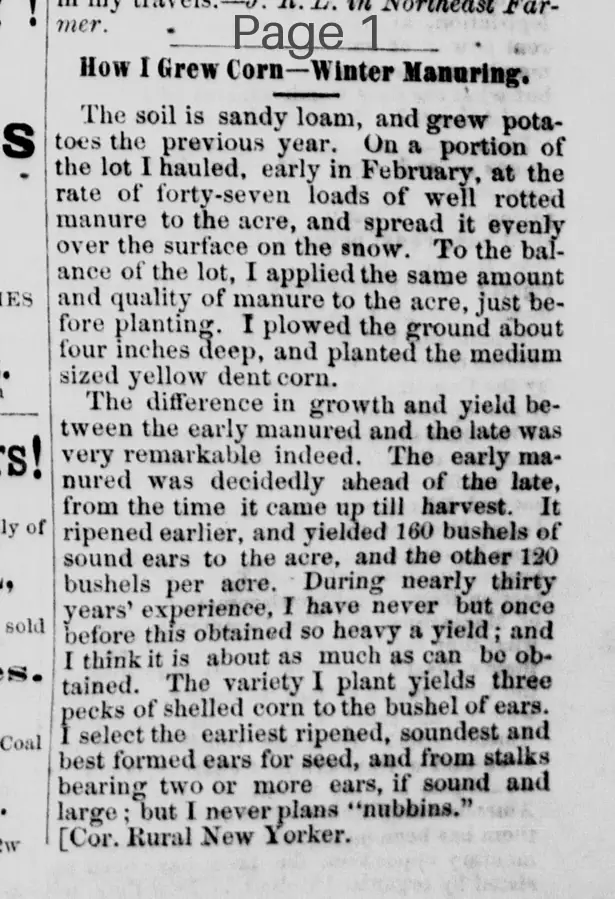
The soil is sandy loam, and grew potatoes the previous year. On a portion of the lot I hauled, early in February, at the rate of forty-seven loads of well rotted manure to the acre, and spread it evenly over the surface on the snow. To the balance of the lot, I applied the same amount and quality of manure to the acre, just before planting. I plowed the ground about four inches deep, and planted the medium sized yellow dent corn.
The difference in growth and yield between the early manured and the late was very remarkable indeed. The early manured was decidedly ahead of the late, from the time it came up till harvest. It ripened earlier, and yielded 160 bushels of sound ears to the acre, and the other 120 bushels per acre. During nearly thirty years' experience, I have never but once before this obtained so heavy a yield; and I think it is about as much as can be obtained. The variety I plant yields three pecks of shelled corn to the bushel of ears.
I select the earliest ripened, soundest and best formed ears for seed, and from stalks bearing two or more ears, if sound and large; but I never plant "nubbins."
[Cor. Rural New Yorker.
What sub-type of article is it?
What keywords are associated?
Domestic News Details
Outcome
early winter manuring yielded 160 bushels of sound ears per acre; late manuring yielded 120 bushels per acre.
Event Details
On sandy loam soil previously used for potatoes, manure was applied early in February on snow at 47 loads per acre for one portion, and just before planting for the other. Ground plowed 4 inches deep, planted medium sized yellow dent corn. Early manured portion grew ahead, ripened earlier, higher yield. Variety yields 3 pecks shelled corn per bushel ears. Selects earliest, soundest ears from multi-ear stalks for seed, avoids nubbins. Based on nearly 30 years experience.