Thank you for visiting SNEWPapers!
Sign up free
Republican Herald
Providence, Providence County, Rhode Island
What is this article about?
At a Democratic convention in Nashville, Tennessee, General Carroll criticizes William Henry Harrison's military record in a speech, accusing him of poor leadership, retreats, and failures in battles like Tippecanoe, River Raisin, Fort Stephenson, and Thames, while questioning his presidential qualifications.
Clipping
OCR Quality
Full Text
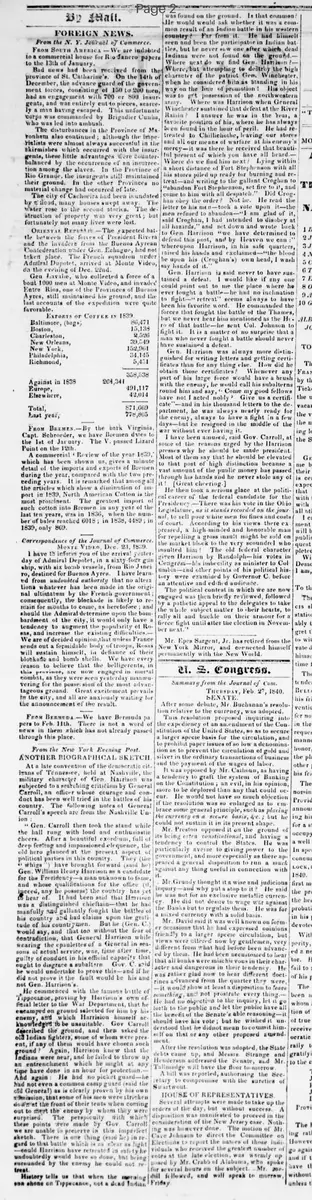
ANOTHER BIOGRAPHICAL SKETCH.
At a late convention of the democratic citizens of Tennessee, held at Nashville, the military character of Gen. Harrison was subjected to a searching criticism by General Carroll, an officer whose courage and conduct has been well tried in the battles of his country. The following notes of General Carroll's speech are from the Nashville Union:
"Gen. Carroll then took the stand while the hall rung with loud and enthusiastic cheers. After a beautiful exordium, full of deep feeling and impassioned eloquence, the old hero glanced at the present aspect of political parties in this country. They (the "whigs") have brought forward (said he) Gen. William Henry Harrison as a candidate for the Presidency—a man unknown to fame, and whose qualifications for the office (if, indeed, any he possess) the country has yet to hear of. It had been said that Harrison was a distinguished chieftain—that he had manfully and gallantly fought the battles of his country and had claims upon the gratitude of his countrymen. But he (Gen. C.) would say, and that too without the fear of contradiction, that General Harrison while wearing the epaulettes of a General in seasons of actual service, was, time after time, guilty of conduct in his official capacity that ought to disgrace a subaltern. Gov. C. said he would undertake to prove this—and if he did not prove it the fault would be his and not Gen. Harrison's.
He commenced with the famous battle of Tippecanoe, proving by Harrison's own official letter to the War Department, that he encamped on ground selected for him by his enemy, and which Harrison himself acknowledged to be unsuitable. Gov. Carroll described the ground, and then asked the old Indian fighters, some of whom were present, if any of them would have chosen such ground? Again, Harrison knew that the Indians were near, and he failed to throw up an entrenchment which he might at any time have done in an hour for protection.—And again: He had no picket guard—he had not even a common camp guard (said the old General) as is clearly proven by his own admission, that some of his men were stricken down at the front of their tents when coming out to meet the enemy by whom they were surprised. The perspicuity with which these points were made by Gov. Carroll we are unable to preserve in this imperfect sketch. There is one thing (said he) in regard to that battle which is as clear as light—could Harrison have retreated in safety he undoubtedly would have so done, but being surrounded by the enemy he could not retreat.
History tells us that when the morning sun shone on Tippecanoe, not a dead Indian was found on the ground. Is that common? He would ask whether it was a common result of an Indian battle in his western country? Far from it. He had himself seen and been the participator in Indian battles, but he never saw one after which dead Indians were not found on the ground.—
Where next do we find Gen. Harrison?—Where, but attempting to destroy the high character of the patriot Gen. Winchester, when he considered him as standing in his way on the line of promotion! His object was to get possession of the northwestern army.
Where was Harrison when General Winchester sustained that defeat at the River Raisin? I answer he was in the rear, a favorite position of his, where he has always been found in the hour of peril. He had retreated to Chillicothe, leaving our stores and all our means of warfare at his enemy's mercy—it was there he received that beautiful present of which you have all heard.—
Where do we find him next? Lying within a short distance of Fort Stephenson with all his stores piled up ready for burning and retreat—and writing to the gallant Croghan to "abandon Fort Stephenson, set fire to it, and come to him with all despatch." Did Croghan obey the order? Not he. He read the letter to his men—took a vote upon it—the men refused to abandon—"I am glad of it," said Croghan, "I had intended to disobey at all hazards." and set down and wrote back to Gen. Harrison "we have determined to defend this post, and by heaven we can:" whereupon Harrison, in his safe quarters, raised his hands and exclaimed—“the blood be upon his (Croghan's) own head, I wash my hands of it."
Gen. Harrison is said never to have sustained a defeat. I would like if any one could point out to me the place where he ever fought a battle—he had no inclination to fight—“retreat" seems always to have been his favorite word. He commanded the forces that fought the battle of the Thames, but we never hear him mentioned as the hero of that battle—he sent Col. Johnson to fight it. It is a matter of no surprise that a man who never fought a battle should never have sustained a defeat.
Gen. Harrison was always more distinguished for writing letters and getting certificates than for any thing else. How did he obtain those certificates? Whenever any part of his large force would have a brush with the enemy, he would call his subalterns round him and say, "Come my good fellows have not I acted nobly? Give us a certificate"—and in his thousand letters to the department, he was always nearly ready for the enemy, always to have a fight in a few days—but he resigned in the middle of the war without ever having it.
I have been amused, said Gov. Carroll, at some of the reasons urged by the Harrison presses why he should be made president. Most of them say that he should be elevated to that post of high distinction because a vast amount of the public money has passed through his hands and he never stole any of it! [Great cheering.]
He then took a serious glance at the political career of the federal candidate for the Presidency.—There was his vote in the Ohio Legislature, as it stands recorded on the journal, to sell poor white men for fines and costs of court. According to his views there expressed, a high-minded and honorable man for repelling a gross insult might be sold on the market block to the very scoundrel who insulted him! The old federal character given Harrison by Randolph—his votes in Congress—his imbecility as minister to Columbia—and other points of his political history were examined by Governor C. before an attentive and edified audience.
The political contest in which we are now engaged was then briefly reviewed, followed by a pathetic appeal to the delegates to take the whole subject matter to their hearts, to rally all and buckle on their armour for a fierce fight until after the election in November next.
What sub-type of article is it?
What themes does it cover?
What keywords are associated?
What entities or persons were involved?
Where did it happen?
Story Details
Key Persons
Location
Nashville, Tennessee
Event Date
Late Convention ... Election In November Next
Story Details
General Carroll delivers a critical speech at a Democratic convention in Nashville, detailing Harrison's alleged military failures at Tippecanoe, River Raisin, Fort Stephenson, and Thames, accusing him of retreats, poor decisions, and seeking undeserved praise, while also critiquing his political record.