Thank you for visiting SNEWPapers!
Sign up free
The New Hampshire Gazette And Historical Chronicle
Portsmouth, Greenland, Rockingham County, New Hampshire
What is this article about?
An essay on human folly, drawing from Aristotle's views on wisdom and folly, with historical anecdotes of rulers like Xerxes, the Cham of Tartary, and Caligula's pampering of his horse Incitatus. It critiques follies in fashion and false wit, includes Rochester's verse on cultivated foolishness, and a Latin proverb.
Merged-components note: Merged as these components continue the same essay on 'Ridiculous Follies' with sequential reading order and coherent topic flow.
Clippings
1 of 2
OCR Quality
Full Text
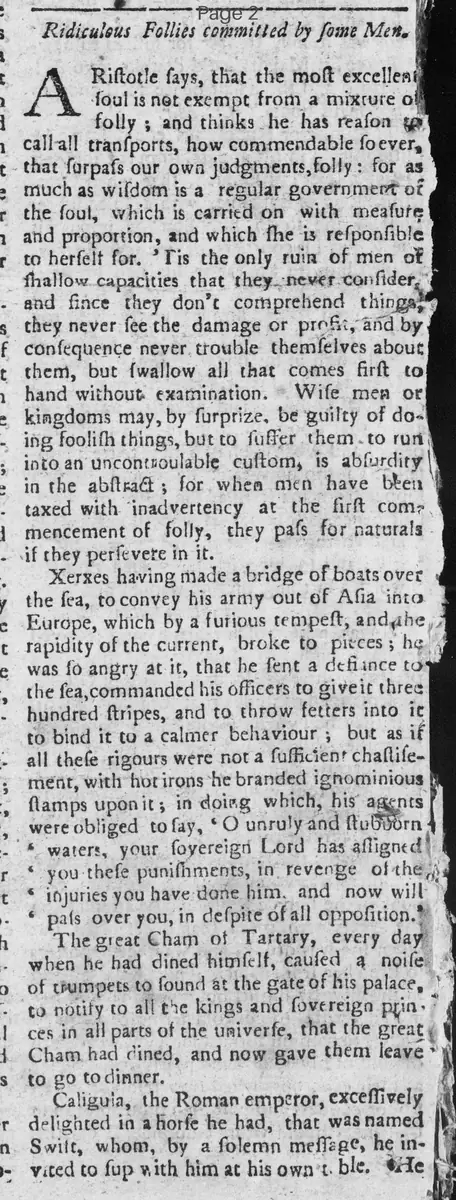
Aristotle says, that the most excellent soul is not exempt from a mixture of folly: and thinks he has reason to call all transports, how commendable so ever, that surpass our own judgments, folly: for as much as wisdom is a regular government of the soul, which is carried on with measure and proportion, and which she is responsible to herself for. Tis the only ruin of men of shallow capacities that they never consider, and since they don't comprehend things, they never see the damage or profit, and by consequence never trouble themselves about them, but swallow all that comes first to hand without examination. Wise men or kingdoms may, by surprize, be guilty of doing foolish things, but to suffer them to run into an uncontroulable custom, is absurdity in the abstract: for when men have been taxed with inadvertency at the first commencement of folly, they pass for naturals if they persevere in it.
Xerxes having made a bridge of boats over the sea, to convey his army out of Asia into Europe, which by a furious tempest, and the rapidity of the current, broke to pieces; he was so angry at it, that he sent a defiance to the sea, commanded his officers to give it three hundred stripes, and to throw fetters into it to bind it to a calmer behaviour; but as if all these rigours were not a sufficient chastisement, with hot irons he branded ignominious stamps upon it; in doing which, his agents were obliged to say, O unruly and stubborn waters, your sovereign Lord has assigned you these punishments, in revenge of the injuries you have done him, and now will pass over you, in despite of all opposition.
The great Cham of Tartary, every day when he had dined himself, caused a noise of trumpets to sound at the gate of his palace, to notify to all the kings and sovereign princes in all parts of the universe, that the great Cham had dined, and now gave them leave to go to dinner.
Caligula, the Roman emperor, excessively delighted in a horse he had, that was named Incitatus, whom, by a solemn message, he invited to sup with him at his own table. He caused his Oats to be given him in a vessel of gold, and wine in basons of the same metal. swore by his health and fortune. promised to make him consul of Rome, and was vain enough to have done it, if the horse had lived to the next election. He made the horse a priest, and colleague with him in the empire; his stable was a sumptuous palace built with marble; his manger was made of ivory: his harness purple, with a jewel of precious stones hanging at his breast; and had a family, servants, and his house richly furnish'd.
From these kinds of folly it will be expected I should give examples of the folly of both sexes in their clothes, and setting up for wits, which, tho' they are comprized under their distinct heads, yet, to oblige the reader, I shall take the liberty to say something here, since both sexes strive who shall outdo one another in the art of foppery. Few consider what is fit, but think this or that piece of ridiculous finery is necessary for them, because other people have it: which is setting reason upon its head, by carrying the rule from things to persons, and appealing from what is right to every fool that is in the wrong. The word necessary is miserably applied; it disorders families, and overturns governments by being so abused. Remember, says my author, that children and fools want every thing, because they want wit to distinguish: And therefore there is no stronger evidence of a crazy understanding, than the making too large a catalogue of things necessary, when, in truth, there are so very few things that have a right to be placed in it.
To see some persons set up for wits, is enough to move a wise man's compassion; because they take pains to make themselves ridiculous, and lay out their time to appear a master piece in buffoonery.
--- Folly we attain.
By studious search and labour of the brain,
By observation, counsel, and deep thought;
God never made a coxcomb worth a groat:
We owe that name to industry and arts;
An eminent fool must be a man of parts.
ROCHESTER.
No man is free from sometimes doing and speaking foolish things: but the worst on't is, when a man studies to play the fool, and instead of disguising his faults, discovers his weakness:
Ne sutor ultra crepidam.
The man in troth, with much ado,
Has prov'd that one and one is two.
What sub-type of article is it?
What themes does it cover?
What keywords are associated?
Literary Details
Title
Ridiculous Follies Committed By Some Men.
Form / Style
Satirical Essay With Historical Examples And Verse
Key Lines