Thank you for visiting SNEWPapers!
Sign up free
Literary
September 18, 1890
The Prison Mirror
Stillwater, Washington County, Minnesota
What is this article about?
The Question Table provides answers to 12 questions on political economy from The Mirror of September 4, 1890, covering ethics in economics, definitions, methods, natural laws, scientific basis, religious influence, production-consumption relations, natures of economic life, effects of luxury, and the fallacy of liquor expenditures benefiting farmers.
Clipping
OCR Quality
98%
Excellent
Full Text
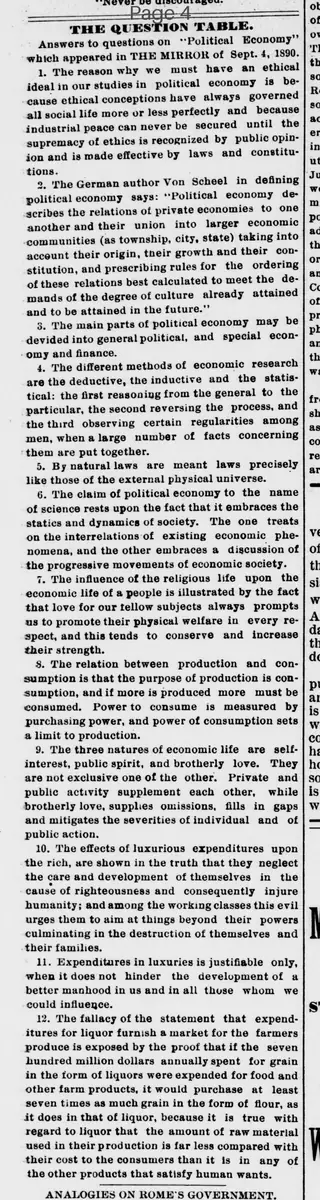
THE QUESTION TABLE.
Answers to questions on Political Economy which appeared in THE MIRROR of Sept. 4, 1890.
1. The reason why we must have an ethical ideal in our studies in political economy is because ethical conceptions have always governed all social life more or less perfectly and because industrial peace can never be secured until the supremacy of ethics is recognized by public opinion and is made effective by laws and constitutions.
2. The German author Von Scheel in defining political economy says: “Political economy describes the relations of private economies to one another and their union into larger economic communities (as township, city, state) taking into account their origin, their growth and their constitution, and prescribing rules for the ordering of these relations best calculated to meet the demands of the degree of culture already attained and to be attained in the future.”
3. The main parts of political economy may be divided into general political, and special economy and finance.
4. The different methods of economic research are the deductive, the inductive and the statistical: the first reasoning from the general to the particular, the second reversing the process, and the third observing certain regularities among men, when a large number of facts concerning them are put together.
5. By natural laws are meant laws precisely like those of the external physical universe.
6. The claim of political economy to the name of science rests upon the fact that it embraces the statics and dynamics of society. The one treats on the interrelations of existing economic phenomena, and the other embraces a discussion of the progressive movements of economic society.
7. The influence of the religious life upon the economic life of a people is illustrated by the fact that love for our fellow subjects always prompts us to promote their physical welfare in every respect, and this tends to conserve and increase their strength.
8. The relation between production and consumption is that the purpose of production is consumption, and if more is produced more must be consumed. Power to consume is measured by purchasing power, and power of consumption sets a limit to production.
9. The three natures of economic life are self-interest, public spirit, and brotherly love. They are not exclusive one of the other. Private and public activity supplement each other, while brotherly love supplies omissions, fills in gaps and mitigates the severities of individual and of public action.
10. The effects of luxurious expenditures upon the rich, are shown in the truth that they neglect the care and development of themselves in the cause of righteousness and consequently injure humanity; and among the working classes this evil urges them to aim at things beyond their powers culminating in the destruction of themselves and their families.
11. Expenditures in luxuries is justifiable only, when it does not hinder the development of a better manhood in us and in all those whom we could influence.
12. The fallacy of the statement that expenditures for liquor furnish a market for the farmers produce is exposed by the proof that if the seven hundred million dollars annually spent for grain in the form of liquors were expended for food and other farm products, it would purchase at least seven times as much grain in the form of flour, as it does in that of liquor, because it is true with regard to liquor that the amount of raw material used in their production is far less compared with their cost to the consumers than it is in any of the other products that satisfy human wants.
Answers to questions on Political Economy which appeared in THE MIRROR of Sept. 4, 1890.
1. The reason why we must have an ethical ideal in our studies in political economy is because ethical conceptions have always governed all social life more or less perfectly and because industrial peace can never be secured until the supremacy of ethics is recognized by public opinion and is made effective by laws and constitutions.
2. The German author Von Scheel in defining political economy says: “Political economy describes the relations of private economies to one another and their union into larger economic communities (as township, city, state) taking into account their origin, their growth and their constitution, and prescribing rules for the ordering of these relations best calculated to meet the demands of the degree of culture already attained and to be attained in the future.”
3. The main parts of political economy may be divided into general political, and special economy and finance.
4. The different methods of economic research are the deductive, the inductive and the statistical: the first reasoning from the general to the particular, the second reversing the process, and the third observing certain regularities among men, when a large number of facts concerning them are put together.
5. By natural laws are meant laws precisely like those of the external physical universe.
6. The claim of political economy to the name of science rests upon the fact that it embraces the statics and dynamics of society. The one treats on the interrelations of existing economic phenomena, and the other embraces a discussion of the progressive movements of economic society.
7. The influence of the religious life upon the economic life of a people is illustrated by the fact that love for our fellow subjects always prompts us to promote their physical welfare in every respect, and this tends to conserve and increase their strength.
8. The relation between production and consumption is that the purpose of production is consumption, and if more is produced more must be consumed. Power to consume is measured by purchasing power, and power of consumption sets a limit to production.
9. The three natures of economic life are self-interest, public spirit, and brotherly love. They are not exclusive one of the other. Private and public activity supplement each other, while brotherly love supplies omissions, fills in gaps and mitigates the severities of individual and of public action.
10. The effects of luxurious expenditures upon the rich, are shown in the truth that they neglect the care and development of themselves in the cause of righteousness and consequently injure humanity; and among the working classes this evil urges them to aim at things beyond their powers culminating in the destruction of themselves and their families.
11. Expenditures in luxuries is justifiable only, when it does not hinder the development of a better manhood in us and in all those whom we could influence.
12. The fallacy of the statement that expenditures for liquor furnish a market for the farmers produce is exposed by the proof that if the seven hundred million dollars annually spent for grain in the form of liquors were expended for food and other farm products, it would purchase at least seven times as much grain in the form of flour, as it does in that of liquor, because it is true with regard to liquor that the amount of raw material used in their production is far less compared with their cost to the consumers than it is in any of the other products that satisfy human wants.
What sub-type of article is it?
Essay
What themes does it cover?
Political
Moral Virtue
Commerce Trade
What keywords are associated?
Political Economy
Ethics
Production Consumption
Luxury Expenditures
Economic Methods
Religious Influence
Liquor Fallacy
Literary Details
Title
The Question Table.
Subject
Answers To Questions On Political Economy Which Appeared In The Mirror Of Sept. 4, 1890.
Key Lines
The Reason Why We Must Have An Ethical Ideal In Our Studies In Political Economy Is Because Ethical Conceptions Have Always Governed All Social Life More Or Less Perfectly...
Political Economy Describes The Relations Of Private Economies To One Another And Their Union Into Larger Economic Communities...
The Three Natures Of Economic Life Are Self Interest, Public Spirit, And Brotherly Love.
The Fallacy Of The Statement That Expenditures For Liquor Furnish A Market For The Farmers Produce Is Exposed By The Proof That...