Thank you for visiting SNEWPapers!
Sign up free
The National Intelligencer And Washington Advertiser
Washington, District Of Columbia
What is this article about?
Literary and philosophical intelligence from Great Britain covers upcoming publications on physical geography, poetry, lunar observations, Ceylon, Methodists, French history, chemistry, sermons; scientific notes on wine adulteration, spring wheat culture, blowpipe invention, currant cure for consumption, muscular motion lecture, and wheat analysis.
Merged-components note: Continuation of article on literary and philosophical intelligence from Great Britain, including analysis of wheat varieties which fits under foreign commercial intelligence.
Clippings
1 of 2
OCR Quality
Full Text
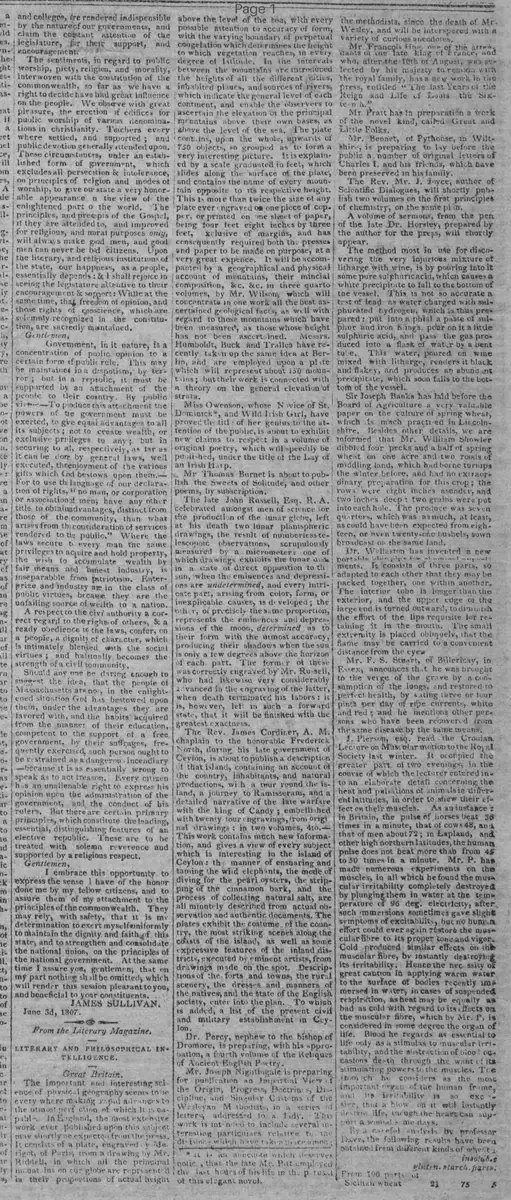
LITERARY AND PHILOSOPHICAL INTELLIGENCE.
Great Britain.
The important and interesting science of physical geography seems to be everywhere making rapid advances to the utmost perfection of which it is capable. In England, the most extensive work ever published upon this subject may shortly be expected from the press. It consists of a plate, engraved by Mr. Rigot of Paris, from a drawing by Mr. Riddel, in which all the principal mountains on our globe are represented in their proportions of actual height above the level of the sea, with every possible attention to accuracy of form, with the varying boundary of perpetual congelation which determines the height to which vegetation reaches in every degree of latitude. In the intervals between the mountains are introduced the heights of all the different cities, inhabited places, and sources of rivers, which indicate the general level of each continent, and enable the observers to ascertain the elevation of the principal mountains above their own bases, as above the level of the sea. The plate contains, upon the whole, upwards of 750 objects, so grouped as to form a very interesting picture. It is explained by a scale graduated in feet, which slides along the surface of the plate, and contains the name of every mountain opposite to its respective height. This is more than twice the size of any plate ever engraved on one piece of copper, or printed on one sheet of paper, being four feet eight inches by three feet, exclusive of margins, and has consequently required both the presses and paper to be made on purpose, at a very great expense. It will be accompanied by a geographical and physical account of mountains, their mineral composition, &c. &c. in three quarto volumes, by Mr. Wilson, which will concentrate in one work all the best ascertained geological facts, as well with regard to those mountains which have been measured, as those whose height has not been ascertained. Messrs. Humboldt, Buck and Tralles have recently taken up the same idea at Berlin, and are employed upon a plate which will represent about 150 mountains; but their work is connected with a theory on the general elevation of strata.
Miss Owenson, whose Narrative of St. Domingo, and Wild Irish Girl, have proved the title of her genius to the attention of the public, is about to exhibit new claims to respect in a volume of original poetry, which will speedily be published under the title of the Lay of an Irish Harp.
Mr. Thomas Burnet is about to publish the Sweets of Solitude, and other poems, by subscription.
The late John Russell, Esq. R.A. celebrated amongst men of science for the production of the lunar globe, left at his death two lunar planispheric drawings, the result of numberless telescopic observations, scrupulously measured by a micrometer: one of which drawings exhibits the lunar disk in a state of direct opposition to the sun, when the eminences and depressions are undetermined, and every intricate part arising from color, form, or inexplicable causes, is developed: the other, of precisely the same proportion, represents the eminences and depressions of the moon, determined as to their form with the utmost accuracy, producing their shadows when the sun is only a few degrees above the horizon of each part. The former of these was correctly engraved by Mr. Russell, who had likewise very considerably advanced in the engraving of the latter, when death terminated his labors: it is, however, left in such a forward state that it will be finished with the greatest exactness.
The Rev. James Cordiner A.M. chaplain to the honorable Frederick North, during his late government of Ceylon, is about to publish a description of that island, containing an account of the country's inhabitants, and natural productions, with a tour round the island, a journey to Ramisseran, and a detailed narrative of the late warfare with the king of Candy; embellished with twenty-four engravings, from original drawings: in two volumes, 4to. This work contains much new information, and gives a view of every subject which is interesting in the island of Ceylon: the manner of ensnaring and taming the wild elephants, the mode of diving for the pearl oysters, the stripping of the cinnamon bark, and the process of collecting natural salt, are all minutely described from actual observation and authentic documents. The plates exhibit the costume of the country, the most striking scenes along the coasts of the island, as well as some expressive features of the inland districts, executed by eminent artists from drawings made on the spot. Descriptions of the forts and towns, the rural scenery, the dresses and manners of the natives, and the state of the English society, enter into the plan. To which is added, a list of the present civil and military establishment in Ceylon.
Dr. Percy, nephew to the bishop of Dromore, is preparing, with his approbation, a fourth volume of the Reliques of Ancient English Poetry.
Mr. Joseph Nightingale is preparing for publication an Impartial View of the Origin, Progress, Doctrines, Discipline, and Singular Customs of the Wesleyan Methodists in a series of letters addressed to a lady. This work is intended to include several interesting particulars relative to the divisions which have taken place among the methodists since the death of Mr. Wesley, and will be interspersed with a variety of curious anecdotes.
* It is an anecdote which deserves notice, that the late Mr. Pitt employed the last hours of his life in the perusal of this elegant novel.
Mr. Francois Hue, one of the attendants on the late king of France, and who, after the 10th of August, was selected by his majesty to remain with the royal family, has a new work in the press, entitled "The last Years of the Reign and Life of Louis the Sixteenth."
Mr. Pratt has in preparation a work of the novel kind, called Great and Little Folks.
Mr. Bennet, of Pyt-house, in Wiltshire, is preparing to lay before the public a number of original letters of Charles I. and his friends, which have been preserved in his family.
The Rev. Mr. J. Joyce, author of Scientific Dialogues, will shortly publish two volumes on the first principles of chemistry, on the same plan.
A volume of sermons, from the pen of the late Dr. Horsley, prepared by the author for the press, will shortly appear.
The method most in use for discovering the very injurious mixture of litharge with wine, is by pouring into it some pure sulphuric acid, which causes a white precipitate to fall to the bottom of the vessel. This is not so accurate a test of lead as water charged with sulphurated hydrogen, which is thus prepared: put into a phial a paste of sulphur and iron filings, pour on it a little sulphuric acid, and pass the gas produced into a flask of water by a bent tube. This water, poured on wine mixed with litharge, renders it black and flaky, and produces an abundant precipitate, which soon falls to the bottom of the vessel.
Sir Joseph Banks has laid before the Board of Agriculture a very valuable paper on the culture of spring wheat, which is much practiced in Lincolnshire. Besides other details, we are informed that Mr. William Showler dibbled four pecks and a half of spring wheat on one acre and two roods of middling land, which had borne turnips the winter before, and had no extraordinary preparation for this crop; the rows were eight inches asunder, and two inches deep: two grains were put into each hole. The produce was seven quarters, which was as much, at least, as could have been expected from eighteen, or even twenty-one bushels, sown broadcast on the same land.
Dr. Wollaston has invented a new portable blowpipe for chemical experiments. It consists of three parts, so adapted to each other that they may be packed together, one within another. The interior tube is longer than the exterior, and the upper edge of the large end is turned outward, to diminish the effort of the lips requisite for retaining it in the mouth. The small extremity is placed obliquely, that the flame may be carried to a convenient distance from the eye.
Mr. F. S. Stuart, of Billericay, in Essex, announces that he was brought to the verge of the grave by a consumption of the lungs, and restored to perfect health by eating three or four pints per day of ripe currants, white and red; and he mentions other persons who have been recovered from the same disease by the same means.
J. Pierson, esq. read the Croonian Lecture on Muscular motion to the Royal Society last winter. It occupied the greater part of two evenings, in the course of which the lecturer entered into an elaborate detail concerning the heat and pulsations of animals in different latitudes, in order to show their effect on their muscles. As an instance in Britain, the pulse of horses beat 36 times in a minute, that of cows 48, and that of men about 72; in Lapland, and other high northern latitudes, the human pulse does not beat more than from 45 to 50 times in a minute. Mr. P. has made numerous experiments on the muscles, in all which he found the muscular irritability completely destroyed by plunging them in water at the temperature of 96 degrees. Electricity, after such immersions, sometimes gave slight symptoms of excitability, but no human effort could ever again restore the muscular fiber to its proper tone and vigor. Cold produced similar effects on the muscular fiber by instantly destroying its irritability. Hence the necessity of great caution in applying warm water to the surface of bodies recently immersed in water, in cases of suspended respiration, as heat may be equally as bad as cold with regard to its effects on the muscular fiber, which by Mr. P. is considered in some degree the organ of life. Blood he regards as essential to life only as a stimulus to muscular irritability, and the abstraction of blood occasions death through the want of its stimulating powers to the muscles. The stomach he considers as the most important organ of the human frame, and its irritability is so excessive that a blow on it will instantly take away life, though the heart can support a wound some days.
By a careful analysis by professor Davy, the following results have been obtained from different kinds of wheat:
Insoluble gluten, starch, fibrina.
From 100 parts
Sicilian wheat
Do. of spring wheat
of 1801
Da. of good English
wheat of 1803
Dn, if blighted do.
of 1804..
Hence it may be deduced, that bread
made of flour of spring wheat is more
nutritious than that made of winter
wheat, because spring wheat contains a
larger proportion of the gluten or half
animalized matter; and, also, that a
miller ought not to deduct from the
price of spring wheat more than two
per cent. on the money price of winter
wheat of the same weight, as the excess
of the weight of insoluble matter,
or bran, is no more than two per cent.
when compared with good English
wheat. Bread made of spring wheat is
less white than that made of the better
sort of winter wheat; but it is more
palatable; qualities probably owing to
the excess of gluten contained in it.
What sub-type of article is it?
What keywords are associated?
What entities or persons were involved?
Where did it happen?
Foreign News Details
Primary Location
Great Britain
Key Persons
Event Details
Reports on upcoming publications and scientific advancements in Great Britain, including a large engraved plate and volumes on mountains by Mr. Wilson; poetry by Miss Owenson, Mr. Burnet; lunar drawings by John Russell; description of Ceylon by Rev. Cordiner; Reliques volume by Dr. Percy; Methodist history by Nightingale; Louis XVI book by Hue; novel by Pratt; Charles I. letters by Bennet; chemistry by Joyce; sermons by Horsley; wine testing method; spring wheat culture by Banks; blowpipe by Wollaston; currant cure by Stuart; muscular motion lecture by Pierson; wheat analysis by Davy.