Thank you for visiting SNEWPapers!
Sign up free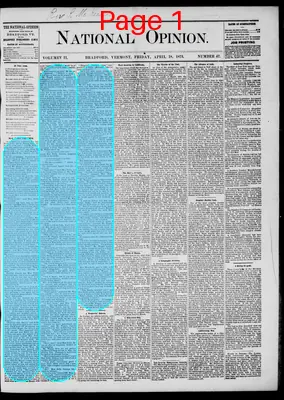
Literary
April 18, 1873
National Opinion
Bradford, Orange County, Vermont
What is this article about?
Humorous short story of widower David Wiggin proposing to spinster Miss Dolly after 30 years, encouraged by her brother James Blount. Miss Dolly, who raised her brothers, cleverly deflects his advances until finally cornered by his persistence.
Clipping
OCR Quality
82%
Good
Full Text
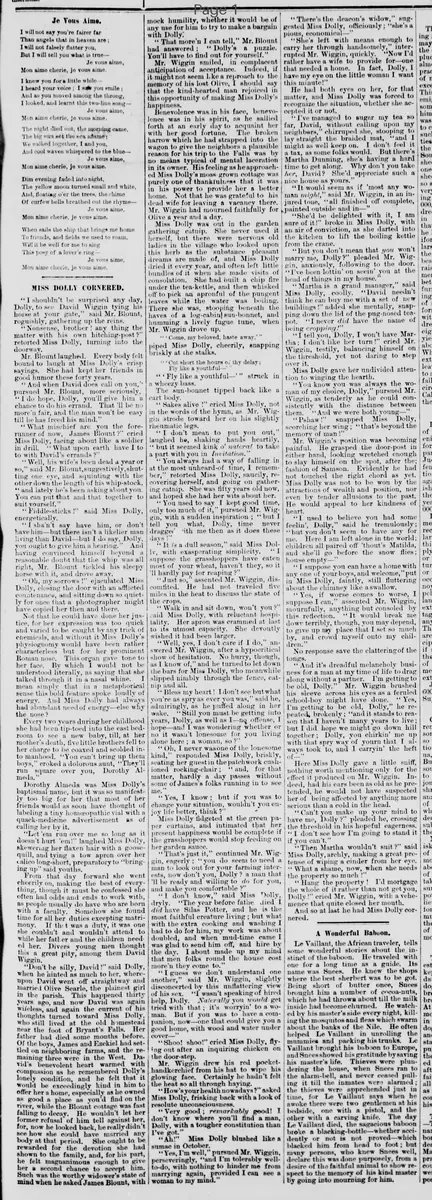
MISS DOLLY CORNERED
"I shouldn't be surprised any day,
Dolly, to see David Wiggin tying his
horse at your gate," said Mr. Blount,
roguishly, gathering up the reins.
"Nonsense, brother! anything the
matter with his own hitching-post?"
retorted Miss Dolly, turning into the
doorway.
Mr. Blount laughed. Everybody felt
bound to laugh at Miss Dolly's crisp
sayings. She had kept her friends in
good humor these forty years.
"And when David does call on you,"
pursued Mr. Blount, more seriously.
"I do hope, Dolly, you'll give him a
chance to do his errand. That'll be no
more'n fair, and the man won't be easy
till he has freed his mind."
"What mischief are you the fore-
runner of now, James Blount?" cried
Miss Dolly, facing about like a soldier
in drill. "What upon earth have I to
do with David's errands?"
"Well, his wife's been dead a year or
so," said Mr. Blount, suggestively, shut-
ting one eye, and squinting with the
other down the length of his whip-stock,
"and lately he's been asking about you.
You can put that and that together to
suit yourself."
"Fiddle-sticks!" said Miss Dolly,
energetically.
"I sha'n't say have him, or don't
have him—but there isn't a likelier man
living than David—but I do say, Dolly,
you ought to give him a hearing." And
having convinced himself beyond a
reasonable doubt that the whip was all
right, Mr. Blount tickled his sleepy
horse with it, and drove away.
"Oh, my sorrows!" ejaculated Miss
Dolly, closing the door with an afflicted
countenance, and sitting down so quiet-
ly for once that a photographer might
have copied her then and there.
Not that he could have done her jus-
tice, for her expression was too quick
and varied to be caught by any trick of
chemicals, and without it Miss Dolly's
physiognomy would have been rather
characterless but for her prominent
Roman nose. This organ gave tone to
her face. By which I would not be
understood literally, as saying that she
talked through it in a nasal whine. I
mean simply that in a metaphorical
sense this bold feature spoke loudly of
energy. And Miss Dolly had always
had abundant need of energy—else why
the nose?
Every two years during her childhood
she had been tip-toed into the east bed-
room to see a new baby, till, at her
mother's death, five little brothers fell to
her charge to be coaxed and scolded in-
to manhood. "You can't bring up them
boys," croaked a dolorous aunt, "They'll
run square over you, Dorothy Al-
meda."
Dorothy Almeda was Miss Dolly's
baptismal name, but it was so manifest-
ly too big for her that most of her
friends would as soon have thought of
labeling a tiny homeopathic vial with a
quack-medicine advertisement as of
calling her by it.
"Let'em run over me so long as it
doesn't hurt 'em!" laughed Miss Dolly,
skewering her flaxen hair with a goose-
quill, and tying a tow apron over her
calico long-short, preparatory to "bring-
ing up" said youths.
From that day forward she went
cheerily on, making the best of every-
thing, though it must be confessed she
often had odds and ends to work with,
as people usually do have who are born
with a faculty. Somehow she found
time for all her duties excepting matri-
mony. If that was a duty, it was one
she couldn't and wouldn't attend to
while her father and the children need-
ed her. Divers young men thought
this a great pity, among them David
Wiggin.
"Don't be silly, David!" said Dolly
when he hinted as much to her, where-
upon David went off straightway and
married Olive Searle, the plainest girl
in the parish. This happened thirty
years ago, and now David was again
wifeless, and again the current of his
thoughts turned toward Miss Dolly,
who still lived at the old homestead
near the foot of Bryant's Falls. Her
father had died some months before.
Of the boys, James and Ezekiel had set-
tled on neighboring farms, and the re-
maining three were in the West. Da-
vid's benevolent heart warmed with
compassion as he remembered Dolly's
lonely condition, and he felt that it
would be exceedingly kind in him to
offer her a home, especially as he owned
as good a place as you'd find on the
river, while the Blount cottage was fast
falling to decay. He wouldn't let her
former refusal of him tell against her,
for, now he looked back, he really didn't
see how she could have married any-
body at that period. She ought to be
rewarded for the devotion she had
shown to the family, and, for his part,
he felt magnanimous enough to give
her a second chance to accept him.
Such was the worthy widower's state of
mind when he asked James Blount, with
mock humility, whether it would be of
any use for him to try to make a bargain
with Dolly.
"That more'n I can tell," Mr. Blount
had answered: "Dolly's a puzzle.
You'll have to find out for yourself."
Mr. Wiggin smiled, in complacent
anticipation of acceptance. Indeed, if
it might not seem like a reproach to the
memory of his lost Olive, I should say
that the kind-hearted man rejoiced in
this opportunity of making Miss Dolly's
happiness.
Benevolence was in his face, benevo-
lence was in his spirit, as he sallied
forth at an early day to acquaint her
with her good fortune. The broken
harrow which he had strapped into the
wagon to give the neighbors a plausible
reason for his trip to the Falls was by
no means typical of mental laceration
in its owner. His feeling as he approach-
ed Miss Dolly's moss-grown cottage was
purely one of thankfulness that it was
in his power to provide her a better
home. Not that he was grateful to his
dead wife for leaving a vacancy there.
Mr. Wiggin had mourned faithfully for
Olive a year and a day.
Miss Dolly was out in the garden
gathering catnip. She never used it
herself, but there were nervous old
ladies in the village who looked upon
this herb as the substance pleasant
dreams are made of, and Miss Dolly
dried it every year, and often left little
bundles of it when she made visits of
consolation. She had built a chip fire
under the tea-kettle, and then whisked
off to pick an apronful of the pungent
leaves while the water was boiling.
There she was, stooping beneath the
eaves of a log-cabin sun-bonnet, and
humming a lively fugue tune, when
Mr. Wiggin drove up.
"Come, my beloved, haste away,"
piped Miss Dolly, cheerily, snapping
briskly at the stalks.
"Cut short the hours of thy delay.
Fly like a youthful—"
"Fly like a youthful—" struck in
a wheezy bass.
The sun-bonnet tipped back like a
cart body.
"Sakes alive!" cried Miss Dolly, not
in the words of the hymn, as Mr. Wig-
gin strode toward her on his slightly
rheumatic legs.
"I don't mean to put you out,"
laughed he, shaking hands heartily.
"but it seemed kind o' natural to take
a part with you in Invitation."
"You always had a way of falling in
at the most unheard-of time. I remem-
ber," retorted Miss Dolly, saucily, re-
covering herself, and going on gather-
ing catnip. She was fifty years old now,
and hoped she had her wits about her.
"You used to say I kept good time,
only too much of it," pursued Mr. Wig-
gin, with a sudden inspiration: "but I
tell you what, Dolly, time never
dragged with me then as it does these
days!"
"It is a dull season," said Miss Dol-
ly, with exasperating simplicity. "I
suppose the grasshoppers have eaten
most of your wheat, haven't they, so it'll
hardly pay for reaping?"
"Just so," assented Mr. Wiggin, dis-
comfited. He had not traveled five
miles in the heat to discuss the state of
the crops.
"Walk in and sit down, won't you?"
said Miss Dolly, with reluctant hospi-
tality. Her apron was crammed at last
to its utmost capacity. She devoutly
wished it had been larger.
"Well, yes, I don't care if I do," an-
swered Mr. Wiggin, after a hypocritical
show of hesitation. "No hurry, though,
as I know of," and he turned to let down
the bars for Miss Dolly, who meanwhile
slipped nimbly through the fence, cat-
nip and all.
"Bless my heart! I don't see but what
you're as spry as ever you was," said he,
admiringly, as he puffed along in her
wake. "Still you must be getting into
years, Dolly, as well as I—no offense, I
hope—and I was wondering whether or
no it wasn't lonesome for you living
alone here: a woman, so?"
"Oh, I never was one of the lonesome
kind," responded Miss Dolly, briskly,
seating her guest in the patchwork cush-
ioned rocking-chair: "and, for that
matter, hardly a day passes without
some of James's folks running in to see
me."
"Yes, I know: but if you was to
change your situation, wouldn't you en-
joy life better, think?"
Miss Dolly fidgeted at the green pa-
per curtains, and intimated that her
present happiness would be complete if
the grasshoppers would stop feeding on
her garden sauce.
"That's just it," continued Mr. Wig-
gin, eagerly; "you do seem to need a
man to look out for your farming inter-
ests, now don't you, Dolly? a man that'll
be ready and willing to do for you,
and make you comfortable?"
"I don't know," said Miss Dolly,
dryly. "The year before father died I
did have Silas Potter, and he is the
most faithful creature living: but what
with the extra cooking and washing I
had to do for him, my work was about
doubled, and when mud-time came I
was glad to send him off, and hire by
the day. I about made up my mind
that men folks round the house cost
more'n they come to."
"I guess we don't understand one
another," said Mr. Wiggin, slightly
disconcerted by this unflattering view
of his sex. "I wasn't speaking of hired
help, Dolly. Naturally you would get
tired with that: it's worrying to a wo-
man. But if you was to have a com-
panion, now—one that could give you a
good home, with wood and water under
cover—"
"Shoo! shoo!" cried Miss Dolly, fly-
ing out after an inquiring chicken on
the door-step.
Mr. Wiggin drew his red pocket-
handkerchief from his hat to wipe his
glowing face. Certainly he hadn't felt
the heat so all through haying.
"How's your health nowadays?" asked
Miss Dolly, frisking back with a look of
resolute unconsciousness.
"Very good: remarkably good! I
don't know where you'll find a man,
Dolly, with a tougher constitution than
I've got."
"Ah!" Miss Dolly blushed like a
sumac in October.
"Yes, I'm well," pursued Mr. Wiggin,
perseveringly, "and I'm tolerably well-
to-do, with nothing to hinder me from
marrying again, provided I can see a
woman to my mind."
"There's the deacon's widow," sug-
gested Miss Dolly, officiously; "she's a
pious, economical—"
"She's left with means enough to
carry her through handsomely," inter-
rupted Mr. Wiggin, quickly. "Now I'd
rather have a wife to provide for—one
that needed a home. In fact, Dolly, I
have my eye on the little woman I want
this minute!"
He had both eyes on her, for that
matter, and Miss Dolly was forced to
recognize the situation, whether she ac-
cepted it or not.
"I've managed to sugar my tea so
far, David, without calling upon my
neighbors," chirruped she, stooping to
lay straight the braided mat, "and I
might as well keep on. I don't feel it
a tax, as some folks would. But there's
Martha Dunning, she's having a hard
time to get along. Why don't you take
her, David? She'd appreciate such a
nice house as yours."
"It would seem as if 'most any wo-
man might," said Mr. Wiggin, in an in-
jured tone. "All finished off complete,
painted outside and in—"
"She'd be delighted with it, I am
sure of it!" broke in Miss Dolly, with
an air of conviction, as she darted into
the kitchen to lift the boiling kettle
from the crane.
"But you don't mean that you won't
marry me, Dolly?" pleaded Mr. Wig-
gin, anxiously, following to the door.
"I've been lotting on seeing you at the
head of things in my house."
"Martha is a grand manager," said
Miss Dolly, coolly. "David needn't
think he can buy me with a set of new
buildings!" added she mentally, snap-
ping down the lid of the pug-nosed tea-
pot. "I never did have the name of
being cheap!"
"I tell you, Dolly, I won't have Mar-
tha: I don't like her turn!" cried Mr.
Wiggin, testily, balancing himself on
the threshold, yet not daring to step
over it.
Miss Dolly gave her undivided atten-
tion to sweeping the hearth.
"You know you was always the wo-
man of my choice, Dolly," pursued Mr.
Wiggin, as tenderly as he could con-
sistently with the distance between
them. "And we were both young—"
"Pshaw!" snapped Miss Dolly,
scorching her fingers; "that's beyond the
memory of man!"
Mr. Wiggin's position was becoming
painful. He grasped the door-post in
either hand, looking wretched enough
to slay himself on the spot, after the
fashion of Samson. Evidently he had
not touched the right chord as yet.
Miss Dolly was not to be won by the
attractions of wealth and position, nor
even by tender allusions to the past.
He would appeal to her kindness of
heart.
"I used to believe you had some
feelin', Dolly," said he tremulously:
"but you don't seem to have any for
me. Here I am left alone in the world,
children all paired off 'thout's Matilda,
and she'll go before the snow flies;
house empty—"
"I suppose you can have a home with
any one of your boys, and welcome," put
in Miss Dolly, faintly, still fluttering
about the chimney like a swallow.
"Yes, if worse comes to worse, I
suppose I can," assented Mr. Wiggin,
mournfully, anything but consoled by
this reflection. "It would break me
down terribly, though, you may depend,
to give up my place that I set so much
by, and crowd myself onto my chil-
dren."
No response save the clattering of the
tongs.
"And it's dreadful melancholy busi-
ness for a man at my time of life to drag
along without a partner. I'm getting to
be old, Dolly." Mr. Wiggin brushed
his sleeve across his eyes as a feruled
school-boy might have done. "Yes,
I'm getting to be old, Dolly," he re-
peated, brokenly; "and it stands to rea-
son that I haven't many years to live:
but I did hope we might go down hill
together; Dolly, you chirkin' me up
with that spry way of yourn that I al-
ways took to, and I carryin' the heft of!"
Here Miss Dolly gave a little sniff—
nothing worth mentioning only for the
effect it produced on Mr. Wiggin. In-
Indeed, had his ears been as old as he pre-
tended, he would not have suspected
her of being affected by anything more
serious than a cold in the head.
"Can't you make up your mind to
have me, Dolly?" pleaded he, crossing
the threshold in his hopeful eagerness.
"I don't see how I'm going to stand it
if you can't."
"Then Martha wouldn't suit?" said
Miss Dolly, archly, making a great pre-
tense of wiping a cinder from her eye.
"What a shame, now, when she needs
the property so much!"
"Hang the property! I'd mortgage
the whole of it rather than not get you,
Dolly!" cried Mr. Wiggin, with a vehe-
mence that quite closed her mouth.
And so at last he had Miss Dolly cor-
nered.
"I shouldn't be surprised any day,
Dolly, to see David Wiggin tying his
horse at your gate," said Mr. Blount,
roguishly, gathering up the reins.
"Nonsense, brother! anything the
matter with his own hitching-post?"
retorted Miss Dolly, turning into the
doorway.
Mr. Blount laughed. Everybody felt
bound to laugh at Miss Dolly's crisp
sayings. She had kept her friends in
good humor these forty years.
"And when David does call on you,"
pursued Mr. Blount, more seriously.
"I do hope, Dolly, you'll give him a
chance to do his errand. That'll be no
more'n fair, and the man won't be easy
till he has freed his mind."
"What mischief are you the fore-
runner of now, James Blount?" cried
Miss Dolly, facing about like a soldier
in drill. "What upon earth have I to
do with David's errands?"
"Well, his wife's been dead a year or
so," said Mr. Blount, suggestively, shut-
ting one eye, and squinting with the
other down the length of his whip-stock,
"and lately he's been asking about you.
You can put that and that together to
suit yourself."
"Fiddle-sticks!" said Miss Dolly,
energetically.
"I sha'n't say have him, or don't
have him—but there isn't a likelier man
living than David—but I do say, Dolly,
you ought to give him a hearing." And
having convinced himself beyond a
reasonable doubt that the whip was all
right, Mr. Blount tickled his sleepy
horse with it, and drove away.
"Oh, my sorrows!" ejaculated Miss
Dolly, closing the door with an afflicted
countenance, and sitting down so quiet-
ly for once that a photographer might
have copied her then and there.
Not that he could have done her jus-
tice, for her expression was too quick
and varied to be caught by any trick of
chemicals, and without it Miss Dolly's
physiognomy would have been rather
characterless but for her prominent
Roman nose. This organ gave tone to
her face. By which I would not be
understood literally, as saying that she
talked through it in a nasal whine. I
mean simply that in a metaphorical
sense this bold feature spoke loudly of
energy. And Miss Dolly had always
had abundant need of energy—else why
the nose?
Every two years during her childhood
she had been tip-toed into the east bed-
room to see a new baby, till, at her
mother's death, five little brothers fell to
her charge to be coaxed and scolded in-
to manhood. "You can't bring up them
boys," croaked a dolorous aunt, "They'll
run square over you, Dorothy Al-
meda."
Dorothy Almeda was Miss Dolly's
baptismal name, but it was so manifest-
ly too big for her that most of her
friends would as soon have thought of
labeling a tiny homeopathic vial with a
quack-medicine advertisement as of
calling her by it.
"Let'em run over me so long as it
doesn't hurt 'em!" laughed Miss Dolly,
skewering her flaxen hair with a goose-
quill, and tying a tow apron over her
calico long-short, preparatory to "bring-
ing up" said youths.
From that day forward she went
cheerily on, making the best of every-
thing, though it must be confessed she
often had odds and ends to work with,
as people usually do have who are born
with a faculty. Somehow she found
time for all her duties excepting matri-
mony. If that was a duty, it was one
she couldn't and wouldn't attend to
while her father and the children need-
ed her. Divers young men thought
this a great pity, among them David
Wiggin.
"Don't be silly, David!" said Dolly
when he hinted as much to her, where-
upon David went off straightway and
married Olive Searle, the plainest girl
in the parish. This happened thirty
years ago, and now David was again
wifeless, and again the current of his
thoughts turned toward Miss Dolly,
who still lived at the old homestead
near the foot of Bryant's Falls. Her
father had died some months before.
Of the boys, James and Ezekiel had set-
tled on neighboring farms, and the re-
maining three were in the West. Da-
vid's benevolent heart warmed with
compassion as he remembered Dolly's
lonely condition, and he felt that it
would be exceedingly kind in him to
offer her a home, especially as he owned
as good a place as you'd find on the
river, while the Blount cottage was fast
falling to decay. He wouldn't let her
former refusal of him tell against her,
for, now he looked back, he really didn't
see how she could have married any-
body at that period. She ought to be
rewarded for the devotion she had
shown to the family, and, for his part,
he felt magnanimous enough to give
her a second chance to accept him.
Such was the worthy widower's state of
mind when he asked James Blount, with
mock humility, whether it would be of
any use for him to try to make a bargain
with Dolly.
"That more'n I can tell," Mr. Blount
had answered: "Dolly's a puzzle.
You'll have to find out for yourself."
Mr. Wiggin smiled, in complacent
anticipation of acceptance. Indeed, if
it might not seem like a reproach to the
memory of his lost Olive, I should say
that the kind-hearted man rejoiced in
this opportunity of making Miss Dolly's
happiness.
Benevolence was in his face, benevo-
lence was in his spirit, as he sallied
forth at an early day to acquaint her
with her good fortune. The broken
harrow which he had strapped into the
wagon to give the neighbors a plausible
reason for his trip to the Falls was by
no means typical of mental laceration
in its owner. His feeling as he approach-
ed Miss Dolly's moss-grown cottage was
purely one of thankfulness that it was
in his power to provide her a better
home. Not that he was grateful to his
dead wife for leaving a vacancy there.
Mr. Wiggin had mourned faithfully for
Olive a year and a day.
Miss Dolly was out in the garden
gathering catnip. She never used it
herself, but there were nervous old
ladies in the village who looked upon
this herb as the substance pleasant
dreams are made of, and Miss Dolly
dried it every year, and often left little
bundles of it when she made visits of
consolation. She had built a chip fire
under the tea-kettle, and then whisked
off to pick an apronful of the pungent
leaves while the water was boiling.
There she was, stooping beneath the
eaves of a log-cabin sun-bonnet, and
humming a lively fugue tune, when
Mr. Wiggin drove up.
"Come, my beloved, haste away,"
piped Miss Dolly, cheerily, snapping
briskly at the stalks.
"Cut short the hours of thy delay.
Fly like a youthful—"
"Fly like a youthful—" struck in
a wheezy bass.
The sun-bonnet tipped back like a
cart body.
"Sakes alive!" cried Miss Dolly, not
in the words of the hymn, as Mr. Wig-
gin strode toward her on his slightly
rheumatic legs.
"I don't mean to put you out,"
laughed he, shaking hands heartily.
"but it seemed kind o' natural to take
a part with you in Invitation."
"You always had a way of falling in
at the most unheard-of time. I remem-
ber," retorted Miss Dolly, saucily, re-
covering herself, and going on gather-
ing catnip. She was fifty years old now,
and hoped she had her wits about her.
"You used to say I kept good time,
only too much of it," pursued Mr. Wig-
gin, with a sudden inspiration: "but I
tell you what, Dolly, time never
dragged with me then as it does these
days!"
"It is a dull season," said Miss Dol-
ly, with exasperating simplicity. "I
suppose the grasshoppers have eaten
most of your wheat, haven't they, so it'll
hardly pay for reaping?"
"Just so," assented Mr. Wiggin, dis-
comfited. He had not traveled five
miles in the heat to discuss the state of
the crops.
"Walk in and sit down, won't you?"
said Miss Dolly, with reluctant hospi-
tality. Her apron was crammed at last
to its utmost capacity. She devoutly
wished it had been larger.
"Well, yes, I don't care if I do," an-
swered Mr. Wiggin, after a hypocritical
show of hesitation. "No hurry, though,
as I know of," and he turned to let down
the bars for Miss Dolly, who meanwhile
slipped nimbly through the fence, cat-
nip and all.
"Bless my heart! I don't see but what
you're as spry as ever you was," said he,
admiringly, as he puffed along in her
wake. "Still you must be getting into
years, Dolly, as well as I—no offense, I
hope—and I was wondering whether or
no it wasn't lonesome for you living
alone here: a woman, so?"
"Oh, I never was one of the lonesome
kind," responded Miss Dolly, briskly,
seating her guest in the patchwork cush-
ioned rocking-chair: "and, for that
matter, hardly a day passes without
some of James's folks running in to see
me."
"Yes, I know: but if you was to
change your situation, wouldn't you en-
joy life better, think?"
Miss Dolly fidgeted at the green pa-
per curtains, and intimated that her
present happiness would be complete if
the grasshoppers would stop feeding on
her garden sauce.
"That's just it," continued Mr. Wig-
gin, eagerly; "you do seem to need a
man to look out for your farming inter-
ests, now don't you, Dolly? a man that'll
be ready and willing to do for you,
and make you comfortable?"
"I don't know," said Miss Dolly,
dryly. "The year before father died I
did have Silas Potter, and he is the
most faithful creature living: but what
with the extra cooking and washing I
had to do for him, my work was about
doubled, and when mud-time came I
was glad to send him off, and hire by
the day. I about made up my mind
that men folks round the house cost
more'n they come to."
"I guess we don't understand one
another," said Mr. Wiggin, slightly
disconcerted by this unflattering view
of his sex. "I wasn't speaking of hired
help, Dolly. Naturally you would get
tired with that: it's worrying to a wo-
man. But if you was to have a com-
panion, now—one that could give you a
good home, with wood and water under
cover—"
"Shoo! shoo!" cried Miss Dolly, fly-
ing out after an inquiring chicken on
the door-step.
Mr. Wiggin drew his red pocket-
handkerchief from his hat to wipe his
glowing face. Certainly he hadn't felt
the heat so all through haying.
"How's your health nowadays?" asked
Miss Dolly, frisking back with a look of
resolute unconsciousness.
"Very good: remarkably good! I
don't know where you'll find a man,
Dolly, with a tougher constitution than
I've got."
"Ah!" Miss Dolly blushed like a
sumac in October.
"Yes, I'm well," pursued Mr. Wiggin,
perseveringly, "and I'm tolerably well-
to-do, with nothing to hinder me from
marrying again, provided I can see a
woman to my mind."
"There's the deacon's widow," sug-
gested Miss Dolly, officiously; "she's a
pious, economical—"
"She's left with means enough to
carry her through handsomely," inter-
rupted Mr. Wiggin, quickly. "Now I'd
rather have a wife to provide for—one
that needed a home. In fact, Dolly, I
have my eye on the little woman I want
this minute!"
He had both eyes on her, for that
matter, and Miss Dolly was forced to
recognize the situation, whether she ac-
cepted it or not.
"I've managed to sugar my tea so
far, David, without calling upon my
neighbors," chirruped she, stooping to
lay straight the braided mat, "and I
might as well keep on. I don't feel it
a tax, as some folks would. But there's
Martha Dunning, she's having a hard
time to get along. Why don't you take
her, David? She'd appreciate such a
nice house as yours."
"It would seem as if 'most any wo-
man might," said Mr. Wiggin, in an in-
jured tone. "All finished off complete,
painted outside and in—"
"She'd be delighted with it, I am
sure of it!" broke in Miss Dolly, with
an air of conviction, as she darted into
the kitchen to lift the boiling kettle
from the crane.
"But you don't mean that you won't
marry me, Dolly?" pleaded Mr. Wig-
gin, anxiously, following to the door.
"I've been lotting on seeing you at the
head of things in my house."
"Martha is a grand manager," said
Miss Dolly, coolly. "David needn't
think he can buy me with a set of new
buildings!" added she mentally, snap-
ping down the lid of the pug-nosed tea-
pot. "I never did have the name of
being cheap!"
"I tell you, Dolly, I won't have Mar-
tha: I don't like her turn!" cried Mr.
Wiggin, testily, balancing himself on
the threshold, yet not daring to step
over it.
Miss Dolly gave her undivided atten-
tion to sweeping the hearth.
"You know you was always the wo-
man of my choice, Dolly," pursued Mr.
Wiggin, as tenderly as he could con-
sistently with the distance between
them. "And we were both young—"
"Pshaw!" snapped Miss Dolly,
scorching her fingers; "that's beyond the
memory of man!"
Mr. Wiggin's position was becoming
painful. He grasped the door-post in
either hand, looking wretched enough
to slay himself on the spot, after the
fashion of Samson. Evidently he had
not touched the right chord as yet.
Miss Dolly was not to be won by the
attractions of wealth and position, nor
even by tender allusions to the past.
He would appeal to her kindness of
heart.
"I used to believe you had some
feelin', Dolly," said he tremulously:
"but you don't seem to have any for
me. Here I am left alone in the world,
children all paired off 'thout's Matilda,
and she'll go before the snow flies;
house empty—"
"I suppose you can have a home with
any one of your boys, and welcome," put
in Miss Dolly, faintly, still fluttering
about the chimney like a swallow.
"Yes, if worse comes to worse, I
suppose I can," assented Mr. Wiggin,
mournfully, anything but consoled by
this reflection. "It would break me
down terribly, though, you may depend,
to give up my place that I set so much
by, and crowd myself onto my chil-
dren."
No response save the clattering of the
tongs.
"And it's dreadful melancholy busi-
ness for a man at my time of life to drag
along without a partner. I'm getting to
be old, Dolly." Mr. Wiggin brushed
his sleeve across his eyes as a feruled
school-boy might have done. "Yes,
I'm getting to be old, Dolly," he re-
peated, brokenly; "and it stands to rea-
son that I haven't many years to live:
but I did hope we might go down hill
together; Dolly, you chirkin' me up
with that spry way of yourn that I al-
ways took to, and I carryin' the heft of!"
Here Miss Dolly gave a little sniff—
nothing worth mentioning only for the
effect it produced on Mr. Wiggin. In-
Indeed, had his ears been as old as he pre-
tended, he would not have suspected
her of being affected by anything more
serious than a cold in the head.
"Can't you make up your mind to
have me, Dolly?" pleaded he, crossing
the threshold in his hopeful eagerness.
"I don't see how I'm going to stand it
if you can't."
"Then Martha wouldn't suit?" said
Miss Dolly, archly, making a great pre-
tense of wiping a cinder from her eye.
"What a shame, now, when she needs
the property so much!"
"Hang the property! I'd mortgage
the whole of it rather than not get you,
Dolly!" cried Mr. Wiggin, with a vehe-
mence that quite closed her mouth.
And so at last he had Miss Dolly cor-
nered.
What sub-type of article is it?
Prose Fiction
Satire
What themes does it cover?
Love Romance
Social Manners
What keywords are associated?
Courtship
Widower
Spinster
Rural Life
Proposal
Humor
Family Duty
Literary Details
Title
Miss Dolly Cornered
Key Lines
"Fiddle Sticks!" Said Miss Dolly, Energetically.
"Don't Be Silly, David!" Said Dolly When He Hinted As Much To Her, Whereupon David Went Off Straightway And Married Olive Searle, The Plainest Girl In The Parish.
"I Never Did Have The Name Of Being Cheap!"
"Hang The Property! I'd Mortgage The Whole Of It Rather Than Not Get You, Dolly!" Cried Mr. Wiggin, With A Vehemence That Quite Closed Her Mouth.
And So At Last He Had Miss Dolly Cornered.