Thank you for visiting SNEWPapers!
Sign up free
Editorial
September 17, 1918
Daily Capital Journal
Salem, Marion County, Oregon
What is this article about?
S. W. Straus discusses wartime thrift through British salvage of U-boat-sunk ships, recovering valuable vessels and cargoes at low cost, exemplified by dramatic rescues preserving millions in assets and tons of food.
Clipping
OCR Quality
98%
Excellent
Full Text
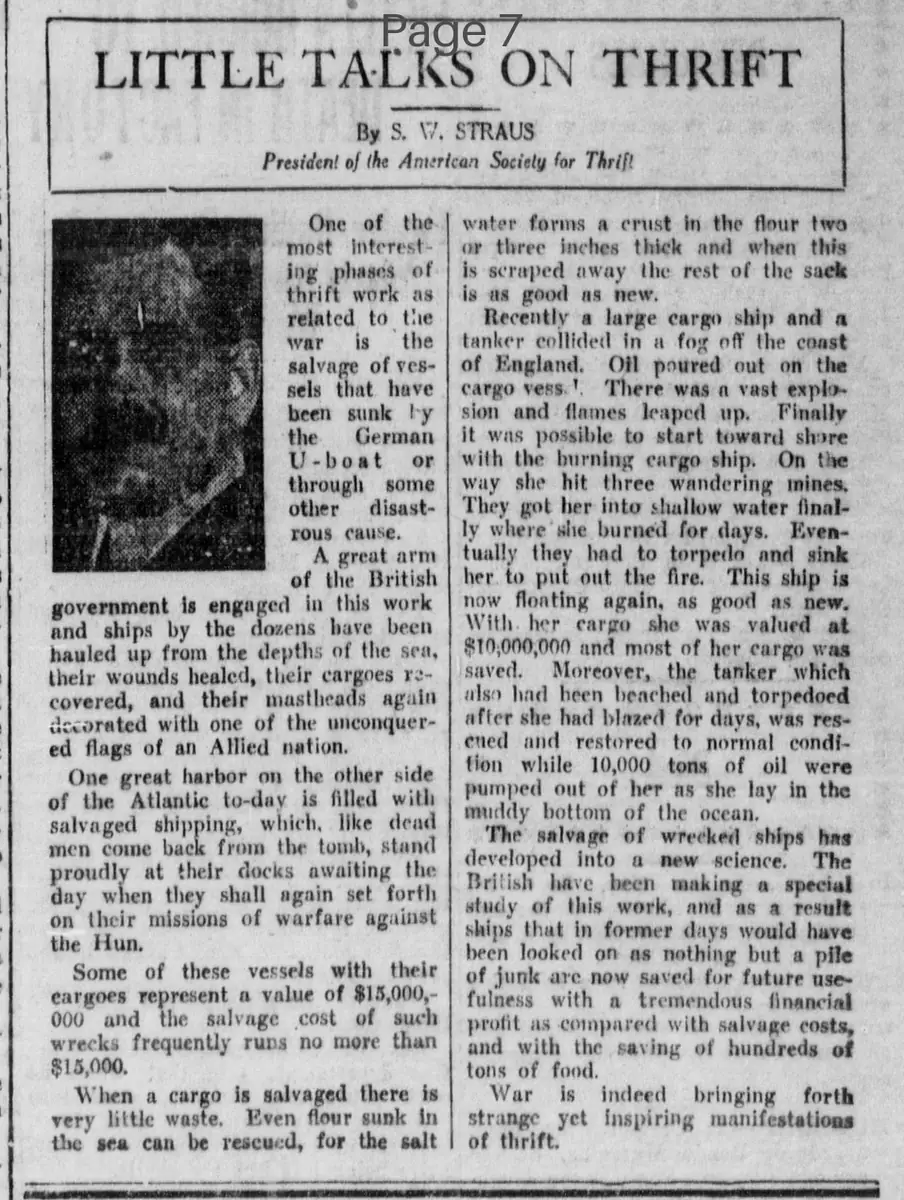
LITTLE TALKS ON THRIFT By S. W. STRAUS President of the American Society for Thrift
One of the most interesting phases of thrift work as related to the war is the salvage of vessels that have been sunk by the German U-boat or through some other disastrous cause.
A great arm of the British government is engaged in this work and ships by the dozens have been hauled up from the depths of the sea, their wounds healed, their cargoes recovered, and their mastheads again decorated with one of the unconquered flags of an Allied nation.
One great harbor on the other side of the Atlantic to-day is filled with salvaged shipping, which, like dead men come back from the tomb, stand proudly at their docks awaiting the day when they shall again set forth on their missions of warfare against the Hun.
Some of these vessels with their cargoes represent a value of $15,000,000 and the salvage cost of such wrecks frequently runs no more than $15,000.
When a cargo is salvaged there is very little waste. Even flour sunk in the sea can be rescued, for the salt water forms a crust in the flour two or three inches thick and when this is scraped away the rest of the sack is as good as new.
Recently a large cargo ship and a tanker collided in a fog off the coast of England. Oil poured out on the cargo vessel. There was a vast explosion and flames leaped up. Finally it was possible to start toward shore with the burning cargo ship. On the way she hit three wandering mines. They got her into shallow water finally where she burned for days. Eventually they had to torpedo and sink her to put out the fire. This ship is now floating again, as good as new. With her cargo she was valued at $10,000,000 and most of her cargo was saved. Moreover, the tanker which also had been beached and torpedoed after she had blazed for days, was rescued and restored to normal condition while 10,000 tons of oil were pumped out of her as she lay in the muddy bottom of the ocean.
The salvage of wrecked ships has developed into a new science. The British have been making a special study of this work, and as a result ships that in former days would have been looked on as nothing but a pile of junk are now saved for future usefulness with a tremendous financial profit as compared with salvage costs, and with the saving of hundreds of tons of food.
War is indeed bringing forth strange yet inspiring manifestations of thrift.
One of the most interesting phases of thrift work as related to the war is the salvage of vessels that have been sunk by the German U-boat or through some other disastrous cause.
A great arm of the British government is engaged in this work and ships by the dozens have been hauled up from the depths of the sea, their wounds healed, their cargoes recovered, and their mastheads again decorated with one of the unconquered flags of an Allied nation.
One great harbor on the other side of the Atlantic to-day is filled with salvaged shipping, which, like dead men come back from the tomb, stand proudly at their docks awaiting the day when they shall again set forth on their missions of warfare against the Hun.
Some of these vessels with their cargoes represent a value of $15,000,000 and the salvage cost of such wrecks frequently runs no more than $15,000.
When a cargo is salvaged there is very little waste. Even flour sunk in the sea can be rescued, for the salt water forms a crust in the flour two or three inches thick and when this is scraped away the rest of the sack is as good as new.
Recently a large cargo ship and a tanker collided in a fog off the coast of England. Oil poured out on the cargo vessel. There was a vast explosion and flames leaped up. Finally it was possible to start toward shore with the burning cargo ship. On the way she hit three wandering mines. They got her into shallow water finally where she burned for days. Eventually they had to torpedo and sink her to put out the fire. This ship is now floating again, as good as new. With her cargo she was valued at $10,000,000 and most of her cargo was saved. Moreover, the tanker which also had been beached and torpedoed after she had blazed for days, was rescued and restored to normal condition while 10,000 tons of oil were pumped out of her as she lay in the muddy bottom of the ocean.
The salvage of wrecked ships has developed into a new science. The British have been making a special study of this work, and as a result ships that in former days would have been looked on as nothing but a pile of junk are now saved for future usefulness with a tremendous financial profit as compared with salvage costs, and with the saving of hundreds of tons of food.
War is indeed bringing forth strange yet inspiring manifestations of thrift.
What sub-type of article is it?
Moral Or Religious
War Or Peace
What keywords are associated?
Thrift
War Salvage
Ship Recovery
Vessel Restoration
Wartime Economy
Resource Conservation
British Salvage Efforts
What entities or persons were involved?
S. W. Straus
American Society For Thrift
British Government
Allied Nations
German U Boat
Editorial Details
Primary Topic
Salvage Of Sunken Ships As Wartime Thrift
Stance / Tone
Inspirational Promotion Of Thrift
Key Figures
S. W. Straus
American Society For Thrift
British Government
Allied Nations
German U Boat
Key Arguments
Salvage Of Sunk Vessels Heals Wounds And Recovers Cargoes For Reuse In War
One Harbor Filled With Restored Ships Awaiting Redeployment
Vessels Valued At $15,000,000 Salvaged For $15,000
Minimal Waste In Salvaged Cargoes, Even Flour Usable After Scraping Salt Crust
Example Of Cargo Ship And Tanker Collision, Fire, Mines, Yet Fully Restored With Most Cargo Saved
Salvage Developed Into A Science, Saving Ships, Food, And Finances