Thank you for visiting SNEWPapers!
Sign up free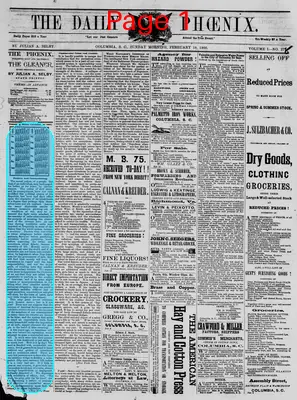
The Daily Phoenix
Columbia, Richland County, South Carolina
What is this article about?
An 1866 editorial laments how the U.S. Civil War's frequent oaths eroded public morals, leading to widespread perjury in revenue returns and casual passing of counterfeit currency, calling for wiser legislation to remedy the decline.
Merged-components note: Image bbox overlaps significantly with story bbox and adjacent reading order, indicating the image is embedded within the story component.
Clipping

OCR Quality
Full Text
Perjury and Counterfeiting.
The moral nature of a people, like that of an individual, may be changed, for better or for worse, by circumstances. The ordeal of civil strife, and its consequences, have not only modified the political system of the Republic, but have had their effect upon the character of its inhabitants to a degree that perhaps they themselves have not yet realized. Among the many deplorable results of extreme measures growing out of a condition of war, may be instanced the light value attached to the sanctity of oaths administered for the purpose of securing the observance of the revenue laws. At one time during hostilities oaths were imposed so frequently in some of the States that the whole system became a mockery. Doctors were compelled to swear allegiance before visiting patients, lawyers before practicing, ministers before preaching, lovers before marrying. To swear, and sometimes swear falsely, became a necessity of life. Human nature is the same all over the world, and if its subtleties are not taken into consideration by legislators when they frame laws for the government of men, they will find that society will train its conscience to regard only the legal responsibility, and not the moral guilt, of evading laws that conflict with pecuniary interest. The masses soon cease to appreciate the solemnity of an act that they are called upon repeatedly to perform in the routine of business; and if by some slight evasion or misrepresentation in fulfilling what they consider merely a technical obligation, they can avoid a pecuniary sacrifice without fear of legal penalties, conscientious scruples will soon, by the force of habit, have very little weight in the balance. This may seem severe criticism upon human nature, but is it not just? Does any one suppose that the returns of Internal Revenue assessors exhibit a correct record of the incomes of the members of our communities? In many cases the returns are known to be false, and the system that seeks to exact an unprofitable truth from every household under the imposition of an oath, simply educates the people to the habit of false swearing. A few years ago, no American citizen who valued his reputation would attempt to pass a counterfeit coin or bill. If such came into their possession, it was destroyed or put aside as so much lost. How is it to-day? The land is flooded with counterfeit currency, but it passes from hand to hand without any qualms of conscience and no questions asked. There are very few persons now-a-days who have the sublime virtue to destroy a counterfeit fifty cent currency bill, unless it is a very bad one. If it fails to pass at one counter, it goes back into the pocket-book and, of course, always through forgetfulness or negligence, is finally disposed of. We deprecate this condition of affairs, but, 'Tis true, 'tis pity, pity 'tis 'tis true.' Are we becoming a nation of perjurers and utterers of counterfeit money? If so, statesmanship must find the remedy in wiser legislation.
New York News.
What sub-type of article is it?
What themes does it cover?
What keywords are associated?
Where did it happen?
Story Details
Location
United States
Event Date
1866
Story Details
Civil War's frequent oaths led to moral decline, habitual perjury in revenue oaths, and widespread acceptance of passing counterfeit currency without conscience, urging legislative reform.