Thank you for visiting SNEWPapers!
Sign up free
Story
July 24, 1891
The Mccook Tribune
Mccook, Red Willow County, Nebraska
What is this article about?
Geo. A. Stockwell from Rhode Island explains farmers' unease amid hard times and changing opportunities, sympathizing with their discontent but warning against abandoning New England farms for the western prairies, where unwise migrations often lead to greater poverty and failure.
Clipping
OCR Quality
98%
Excellent
Full Text
Uneasy Farmers.
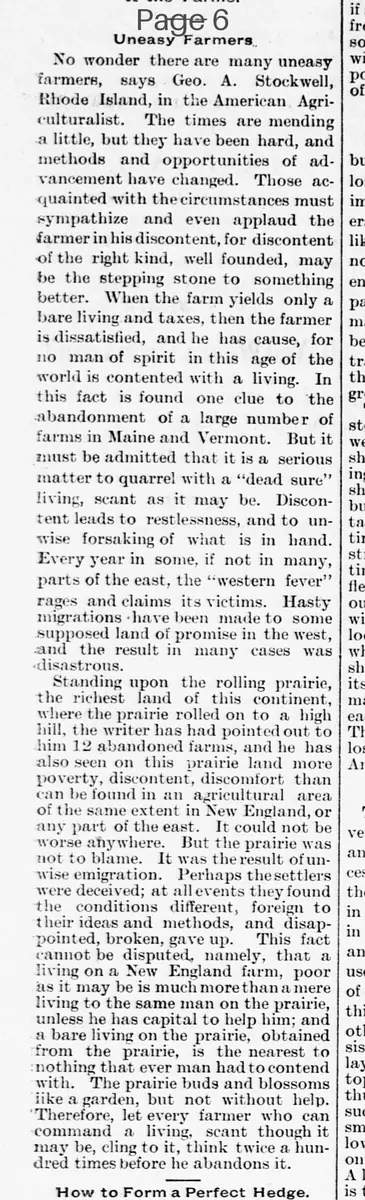
No wonder there are many uneasy farmers, says Geo. A. Stockwell, Rhode Island, in the American Agriculturalist. The times are mending a little, but they have been hard, and methods and opportunities of advancement have changed. Those acquainted with the circumstances must sympathize and even applaud the farmer in his discontent, for discontent of the right kind, well founded, may be the stepping stone to something better. When the farm yields only a bare living and taxes, then the farmer is dissatisfied, and he has cause, for no man of spirit in this age of the world is contented with a living. In this fact is found one clue to the abandonment of a large number of farms in Maine and Vermont. But it must be admitted that it is a serious matter to quarrel with a "dead sure" living, scant as it may be. Discontent leads to restlessness, and to unwise forsaking of what is in hand. Every year in some, if not in many, parts of the east, the "western fever" rages and claims its victims. Hasty migrations have been made to some supposed land of promise in the west, and the result in many cases was disastrous.
Standing upon the rolling prairie the richest land of this continent, where the prairie rolled on to a high hill, the writer has had pointed out to him 12 abandoned farms, and he has also seen on this prairie land more poverty, discontent, discomfort than can be found in an agricultural area of the same extent in New England, or any part of the east. It could not be worse anywhere. But the prairie was not to blame. It was the result of unwise emigration. Perhaps the settlers were deceived; at all events they found the conditions different, foreign to their ideas and methods, and disappointed, broken, gave up. This fact cannot be disputed, namely, that a living on a New England farm, poor as it may be is much more than a mere living to the same man on the prairie unless he has capital to help him; and a bare living on the prairie, obtained from the prairie, is the nearest to nothing that ever man had to contend with. The prairie buds and blossoms like a garden, but not without help. Therefore, let every farmer who can command a living, scant though it may be, cling to it, think twice a hundred times before he abandons it.
No wonder there are many uneasy farmers, says Geo. A. Stockwell, Rhode Island, in the American Agriculturalist. The times are mending a little, but they have been hard, and methods and opportunities of advancement have changed. Those acquainted with the circumstances must sympathize and even applaud the farmer in his discontent, for discontent of the right kind, well founded, may be the stepping stone to something better. When the farm yields only a bare living and taxes, then the farmer is dissatisfied, and he has cause, for no man of spirit in this age of the world is contented with a living. In this fact is found one clue to the abandonment of a large number of farms in Maine and Vermont. But it must be admitted that it is a serious matter to quarrel with a "dead sure" living, scant as it may be. Discontent leads to restlessness, and to unwise forsaking of what is in hand. Every year in some, if not in many, parts of the east, the "western fever" rages and claims its victims. Hasty migrations have been made to some supposed land of promise in the west, and the result in many cases was disastrous.
Standing upon the rolling prairie the richest land of this continent, where the prairie rolled on to a high hill, the writer has had pointed out to him 12 abandoned farms, and he has also seen on this prairie land more poverty, discontent, discomfort than can be found in an agricultural area of the same extent in New England, or any part of the east. It could not be worse anywhere. But the prairie was not to blame. It was the result of unwise emigration. Perhaps the settlers were deceived; at all events they found the conditions different, foreign to their ideas and methods, and disappointed, broken, gave up. This fact cannot be disputed, namely, that a living on a New England farm, poor as it may be is much more than a mere living to the same man on the prairie unless he has capital to help him; and a bare living on the prairie, obtained from the prairie, is the nearest to nothing that ever man had to contend with. The prairie buds and blossoms like a garden, but not without help. Therefore, let every farmer who can command a living, scant though it may be, cling to it, think twice a hundred times before he abandons it.
What sub-type of article is it?
Agricultural Commentary
Migration Warning
What themes does it cover?
Misfortune
Survival
Fortune Reversal
What keywords are associated?
Uneasy Farmers
Western Fever
Abandoned Farms
Prairie Poverty
Agricultural Discontent
What entities or persons were involved?
Geo. A. Stockwell
Where did it happen?
New England, Western Prairies
Story Details
Key Persons
Geo. A. Stockwell
Location
New England, Western Prairies
Story Details
Stockwell sympathizes with discontented farmers in hard times but cautions against 'western fever' migrations, citing observed abandoned farms and poverty on prairies versus scant but sure livings in New England.