Thank you for visiting SNEWPapers!
Sign up free
Editorial
August 24, 1813
The Enquirer
Richmond, Henrico County, Virginia
What is this article about?
The editorial defends the Executive against the failed 'Websterian attack' by the opposition, criticizing their slanders and misinterpretations of the Committee of Foreign Relations report, which approved the Executive's conduct in foreign affairs.
Clipping
OCR Quality
95%
Excellent
Full Text
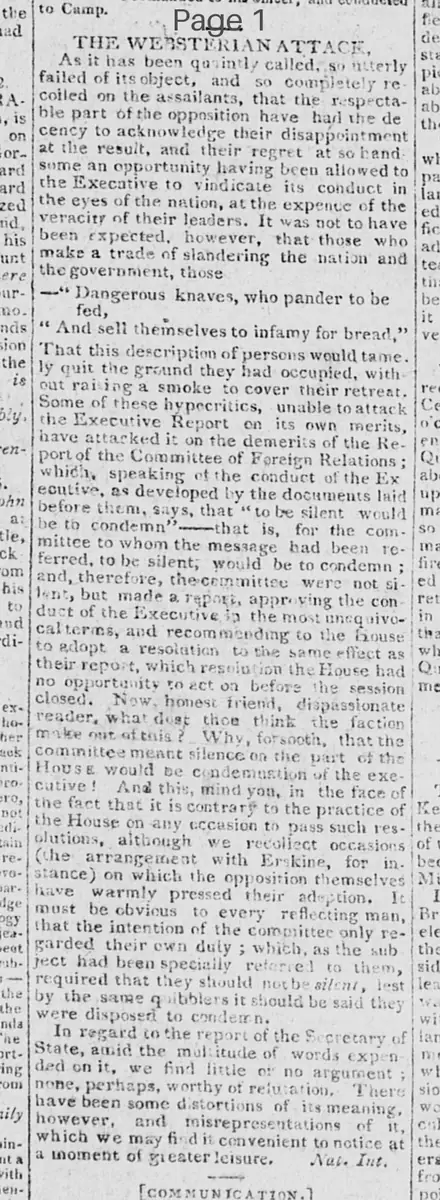
THE WEBSTERIAN ATTACK.
As it has been quaintly called, so utterly failed of its object, and so completely recoiled on the assailants, that the respectable part of the opposition have had the decency to acknowledge their disappointment at the result, and their regret at so handsome an opportunity having been allowed to the Executive to vindicate its conduct in the eyes of the nation, at the expence of the veracity of their leaders. It was not to have been expected, however, that those who make a trade of slandering the nation and the government, those
--" Dangerous knaves, who pander to be fed,
"And sell themselves to infamy for bread,"
That this description of persons would tamely quit the ground they had occupied, without raising a smoke to cover their retreat.
Some of these hypocrites, unable to attack the Executive Report on its own merits, have attacked it on the demerits of the Report of the Committee of Foreign Relations; which, speaking of the conduct of the Executive, as developed by the documents laid before them, says, that "to be silent would be to condemn".-that is, for the committee to whom the message had been referred, to be silent; would be to condemn; and, therefore, the committee were not silent, but made a report, approving the conduct of the Executive in the most unequivocal terms, and recommending to the house to adopt a resolution to the same effect as their report, which resolution the House had no opportunity to act on before the session closed. Now, honest friend, dispassionate reader, what dost thou think the faction make out of this? _ Why, forsooth, that the committee meant silence on the part of the House would be condemnation of the executive! And this, mind you, in the face of the fact that it is contrary to the practice of the House on any occasion to pass such resolutions, although we recollect occasions (the arrangement with Erskine, for instance) on which the opposition themselves have warmly pressed their adoption. It must be obvious to every reflecting man, that the intention of the committee only regarded their own duty; which, as the subject had been specially referred to them, required that they should not be silent, lest by the same quibblers it should be said they were disposed to condemn.
In regard to the report of the Secretary of State, amid the multitude of words expended on it, we find little or no argument; none, perhaps, worthy of remark. There have been some distortions of its meaning, however, and misrepresentations of it, which we may find it convenient to notice at a moment of greater leisure. Nat. Int.
As it has been quaintly called, so utterly failed of its object, and so completely recoiled on the assailants, that the respectable part of the opposition have had the decency to acknowledge their disappointment at the result, and their regret at so handsome an opportunity having been allowed to the Executive to vindicate its conduct in the eyes of the nation, at the expence of the veracity of their leaders. It was not to have been expected, however, that those who make a trade of slandering the nation and the government, those
--" Dangerous knaves, who pander to be fed,
"And sell themselves to infamy for bread,"
That this description of persons would tamely quit the ground they had occupied, without raising a smoke to cover their retreat.
Some of these hypocrites, unable to attack the Executive Report on its own merits, have attacked it on the demerits of the Report of the Committee of Foreign Relations; which, speaking of the conduct of the Executive, as developed by the documents laid before them, says, that "to be silent would be to condemn".-that is, for the committee to whom the message had been referred, to be silent; would be to condemn; and, therefore, the committee were not silent, but made a report, approving the conduct of the Executive in the most unequivocal terms, and recommending to the house to adopt a resolution to the same effect as their report, which resolution the House had no opportunity to act on before the session closed. Now, honest friend, dispassionate reader, what dost thou think the faction make out of this? _ Why, forsooth, that the committee meant silence on the part of the House would be condemnation of the executive! And this, mind you, in the face of the fact that it is contrary to the practice of the House on any occasion to pass such resolutions, although we recollect occasions (the arrangement with Erskine, for instance) on which the opposition themselves have warmly pressed their adoption. It must be obvious to every reflecting man, that the intention of the committee only regarded their own duty; which, as the subject had been specially referred to them, required that they should not be silent, lest by the same quibblers it should be said they were disposed to condemn.
In regard to the report of the Secretary of State, amid the multitude of words expended on it, we find little or no argument; none, perhaps, worthy of remark. There have been some distortions of its meaning, however, and misrepresentations of it, which we may find it convenient to notice at a moment of greater leisure. Nat. Int.
What sub-type of article is it?
Partisan Politics
Foreign Affairs
What keywords are associated?
Websterian Attack
Executive Vindication
Opposition Slander
Foreign Relations Committee
Executive Report
House Resolution
Erskine Arrangement
What entities or persons were involved?
Executive
Opposition
Committee Of Foreign Relations
Secretary Of State
Erskine
Editorial Details
Primary Topic
Defense Against The Websterian Attack On The Executive
Stance / Tone
Strongly Supportive Of The Executive And Critical Of The Opposition
Key Figures
Executive
Opposition
Committee Of Foreign Relations
Secretary Of State
Erskine
Key Arguments
The Websterian Attack Failed And Recoiled On The Assailants
Respectable Opposition Acknowledges Disappointment And Regrets The Opportunity Given To The Executive
Slanderers Of The Nation And Government Refuse To Quit Without Raising Smoke
Opposition Misinterprets The Committee Of Foreign Relations Report To Suggest House Silence Would Condemn The Executive
The Committee's Report Approved The Executive's Conduct Unequivocally
The House Had No Opportunity To Act On The Resolution Before Session Closed
It Is Contrary To House Practice To Pass Such Resolutions, Though Opposition Pressed For Them Previously
The Committee's Intention Regarded Their Own Duty To Report Rather Than Be Silent