Thank you for visiting SNEWPapers!
Sign up free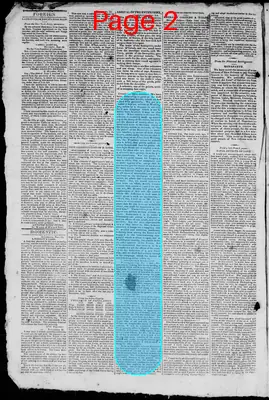
Editorial
November 24, 1821
Winchester Gazette
Winchester, Virginia
What is this article about?
Editorial critiques a Washington letter implying President Monroe will remove long-serving officials under 1820 law to favor needy office-seekers amid 1824 presidential campaign preparations, advocating retention of competent incumbents unless misconduct proven.
Clipping

OCR Quality
95%
Excellent
Full Text
Crumbs for Office-Seekers.—We have been endeavoring to guess at the drift of the subjoined article, which we find copied very generally. We are persuaded it was not written at Washington, unless by a stranger to our city, for it uses language which is not familiar here, however it may be elsewhere. What relates to the next Presidency, is evidently made up according to the fancy of the writer, but without the shadow of reality about it, to serve as a cover to the main object of the letter—which is, in truth, to feel the pulse of the Executive, to ascertain whether, by means of these fudge letters, occasionally thrown out and eagerly snapped at as News from Washington, the President cannot be seduced into a belief that public opinion requires honest and faithful public officers to be thrust out of employ to make room for those who are more needy, & of course more greedy, than the present incumbents. For our parts, we think it a good reason for keeping a man in office, that no complaint can be made against him, except that he has discharged the duties of his station for many years, without any other objection than the length of his service. In all cases of misconduct, neglect, or insolence in the discharge of public duties, we admit that removals should be made. But, we would remove no man from an office, merely because another man covets it; and if we mistake not, Mr. Monroe will give to all applications of that sort the answer which Mr. Jefferson is said once to have given to such an application.—"Well, Sir, I will cause Mr. A's accounts to be examined; and if it appears that he has been an unfaithful officer, one shall be appointed to succeed him."
These letters from Washington are seldom written without an object. Sometimes it is to make a Postmaster—at others a Collector—now an officer of one grade, now of another. But the most objectionable view of this letter is, that, however intended, it hangs out a tempting lure to avarice and ambition, insidiously enlisting them among the forces to be engaged in the 'electioneering campaign,' which is about to open, not at Washington exactly, but almost in every other quarter of the Union. Let it be understood that there is to be a Scramble for all the offices of the country on the induction of a new President, and we shall find activity enough in the campaign which the writer of the following letter refers to.
LETTER FROM WASHINGTON,
Washington city, Nov. 5, 1821.—Preparations are making here for the meeting of Congress, which will be in less than a month. The grand Electioneering Campaign, it is said, will be opened as soon after the meeting as time will afford for feeling the pulses of the members—a large proportion of whom are new ones.—The prominent candidates for the next Presidency now spoken of, being on the spot, a pretty active campaign is expected. No one has any idea of a Congressional Caucus—it would damn any cause which should adopt one.—Of course, individual exertion must be the greater, and the campaign begin earlier.
It is intimated, that many of the incumbents in office, some of whom have held lucrative appointments from fifteen to thirty years, will be invited to fold up their robes, and retire with decency. By the law of May, 1820, limiting the term of office of certain officers, all commissions or appointments made prior to the 1st of October, 1816, are to cease after the 30th September last: and all others four years from their dates. The object of the law was to enable the President to get clear of old and rich incumbents, without the disagreeable course of absolute removal. It will be recollected, that the law in question refers to District Attorneys, Collectors of Customs, Navy Agents, Registers of Land Offices, &c. &c. if the spirit of the law is executed, as it is said it will be, you may easily conceive of the excitement it will create among the veteran office holders, and the activity it will occasion among the office seekers.
As far as the public voice on this subject has been ascertained, it is loud in favour of the execution of the law in its spirit, and that the present time is the best to make the experiment. The President, it is suggested, will readily hearken to the general voice, when ascertained from the members. If there are honors and emoluments in the public offices, they ought to be shared by the community, and not by any perpetuitists, if the public service will admit of it; and if labor and duties are to be performed, they ought to be divided.—Boston Centinel.
These letters from Washington are seldom written without an object. Sometimes it is to make a Postmaster—at others a Collector—now an officer of one grade, now of another. But the most objectionable view of this letter is, that, however intended, it hangs out a tempting lure to avarice and ambition, insidiously enlisting them among the forces to be engaged in the 'electioneering campaign,' which is about to open, not at Washington exactly, but almost in every other quarter of the Union. Let it be understood that there is to be a Scramble for all the offices of the country on the induction of a new President, and we shall find activity enough in the campaign which the writer of the following letter refers to.
LETTER FROM WASHINGTON,
Washington city, Nov. 5, 1821.—Preparations are making here for the meeting of Congress, which will be in less than a month. The grand Electioneering Campaign, it is said, will be opened as soon after the meeting as time will afford for feeling the pulses of the members—a large proportion of whom are new ones.—The prominent candidates for the next Presidency now spoken of, being on the spot, a pretty active campaign is expected. No one has any idea of a Congressional Caucus—it would damn any cause which should adopt one.—Of course, individual exertion must be the greater, and the campaign begin earlier.
It is intimated, that many of the incumbents in office, some of whom have held lucrative appointments from fifteen to thirty years, will be invited to fold up their robes, and retire with decency. By the law of May, 1820, limiting the term of office of certain officers, all commissions or appointments made prior to the 1st of October, 1816, are to cease after the 30th September last: and all others four years from their dates. The object of the law was to enable the President to get clear of old and rich incumbents, without the disagreeable course of absolute removal. It will be recollected, that the law in question refers to District Attorneys, Collectors of Customs, Navy Agents, Registers of Land Offices, &c. &c. if the spirit of the law is executed, as it is said it will be, you may easily conceive of the excitement it will create among the veteran office holders, and the activity it will occasion among the office seekers.
As far as the public voice on this subject has been ascertained, it is loud in favour of the execution of the law in its spirit, and that the present time is the best to make the experiment. The President, it is suggested, will readily hearken to the general voice, when ascertained from the members. If there are honors and emoluments in the public offices, they ought to be shared by the community, and not by any perpetuitists, if the public service will admit of it; and if labor and duties are to be performed, they ought to be divided.—Boston Centinel.
What sub-type of article is it?
Partisan Politics
What keywords are associated?
Office Seekers
Presidential Campaign
Office Rotation
Monroe Administration
Washington Letters
1820 Law
What entities or persons were involved?
Mr. Monroe
Mr. Jefferson
Congress
Incumbents
Office Seekers
Boston Centinel
Editorial Details
Primary Topic
Critique Of Office Seeking Letters Influencing Presidential Appointments
Stance / Tone
Critical Of Manipulative Letters And Office Rotation For Personal Gain; Supportive Of Retaining Competent Officials
Key Figures
Mr. Monroe
Mr. Jefferson
Congress
Incumbents
Office Seekers
Boston Centinel
Key Arguments
Washington Letters Often Aim To Secure Specific Appointments
Retain Officers Unless Proven Unfaithful
Oppose Removals Solely Due To Others' Covetousness
Such Letters Tempt Avarice For Electioneering
1820 Law Enables Term Limits Without Direct Removals
Public Favors Sharing Offices Among Community