Thank you for visiting SNEWPapers!
Sign up free
Lynchburg Virginian
Lynchburg, Virginia
What is this article about?
In 1827, R. T. Morrison of Christ Church Parish shares his effective method for storing slip potatoes in a ventilated cellar to prevent rot, based on 13 years of success with minimal losses.
Clipping
OCR Quality
Full Text
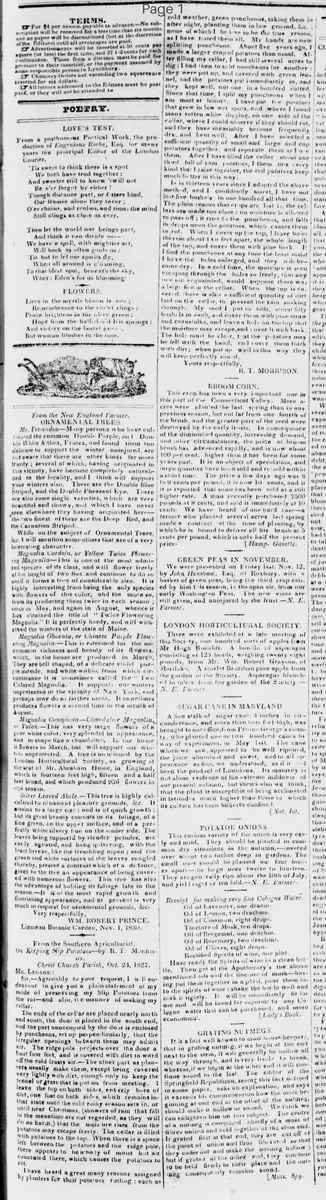
On Keeping Slip Potatoes—by R. T. Morrison.
ON.
Christ Church Parish, Oct. 24, 1827.
Mr. Legare:
Sir,—Agreeably to your request, I will endeavour to give you a plain statement of my mode of preserving my Slip Potatoes from the rot—and also, the manner of making my cellar.
The ends of the cellar are placed nearly north and south, the door is placed in the south end, and the part unoccupied by the door is enclosed by puncheons, set up perpendicularly, that the irregular openings between them may admit air. The ridge pole projects over the door about four feet, and is covered with dirt to ward off the cold frosty air.—The other part as planters usually make them, except being covered very lightly with dirt, enough only to keep the fennel or grass that is put on from meeting. I leave the top on both sides, entirely bare of dirt, one foot on both sides, which remains in that state until the cold rainy season sets in, or until near Christmas, (showers of rain that fall in the meantime are not regarded, as they will do no harm,) that the moisture rises from the potatoes may escape freely. The cellar is filled with potatoes to the top. When there is a space left between the potatoes and the ridge pole, there appears to be a body of moist hot air concealed there, which causes the potatoes to rot.
I have heard a great many reasons assigned by planters for their potatoes rotting; such as cold weather, green puncheons, taking them in after night, planting them in low ground, &c. none of which I believe to be the true reason, as I have tested them all. My hands are now splitting puncheons. About five years ago, I made a larger crop of potatoes than usual. After filling my cellar, I had still several acres to dig: I had then to split puncheons for another: they were put up, and covered with green fennel, and the potatoes put immediately in, and they kept well, not one in a hundred rotted. Since that time, I split my puncheons when I am most at leisure. I have put the potatoes that grew in low wet spots, and where I found many rotten while digging, on one side of the cellar, where I could observe if they should rot. and they have invariably become frequently dry, and kept well. After I have selected a sufficient quantity of small and large and cup potatoes together, and separate them as I use them. After I have filled the cellar about one third full of yam potatoes, I then mix every kind that I raise together, the red potatoes keep much better in this way.
It is thirteen years since I adopted the above method, and I confidently assert, I have not lost five bushels in one hundred all that time. The plain reason that crops are lost is, the cellars are made too close: no moisture is allowed to pass off; it rises to the puncheons, and falls in drops upon the potatoes, which causes them to rot. When I cover up the top, I leave holes therein about two feet apart, the whole length of the top, and cover them with pine bark. If I find the puncheons at any time the least moist I have the holes enlarged, and they will become dry. In a cold time, the moisture is seen escaping through the holes so freely, that any one not acquainted, would suppose there was a large fire in the cellar. When the top is covered, there is also a sufficient quantity of dirt laid on the cellar, to prevent the rain soaking through. My seed I put in hills, about fifty bushels in each, and cover them with pine straw and cornstalks, and leave a hole on the top that the moisture may escape, and cover it with bark. The hole must be clear, that the potatoes may be felt with the hand, and cover them thick with dirt; when put up well in this way they will keep perfectly sound.
Yours respectfully,
R. T. MORRISON.
What sub-type of article is it?
What keywords are associated?
What entities or persons were involved?
Where did it happen?
Domestic News Details
Primary Location
Christ Church Parish
Event Date
Oct. 24, 1827
Key Persons
Outcome
successful preservation method adopted for thirteen years, with not more than five bushels lost in one hundred.
Event Details
R. T. Morrison describes his method of building a potato cellar with ventilation to prevent rot, including leaving sides bare for moisture escape, using split puncheons, mixing potato varieties, and covering with dirt and bark only when necessary. He refutes common causes of rot and shares experience from testing various conditions.