Thank you for visiting SNEWPapers!
Sign up free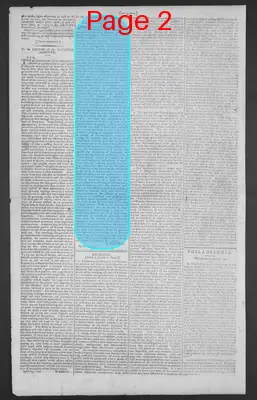
National Gazette
Philadelphia, Philadelphia County, Pennsylvania
What is this article about?
A letter urging Philadelphia's freemen to welcome French ambassador Mr. Genet with public demonstrations of joy, despite government prohibition, to affirm support for French republicanism and U.S. gratitude for alliance aid during the Revolution. Criticizes officials' aristocratic leanings and warns against diminishing interest in France's cause.
Clipping
OCR Quality
Full Text
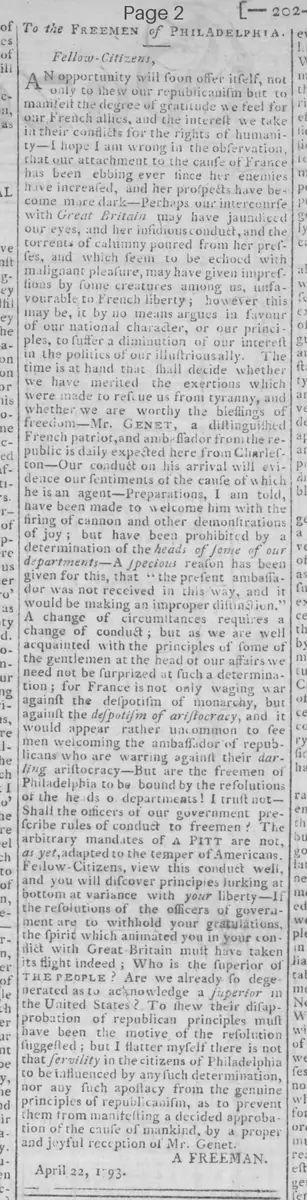
Fellow-Citizens,
An opportunity will soon offer itself, not only to show our republicanism but to manifest the degree of gratitude we feel for our French allies, and the interest we take in their conflicts for the rights of humanity—I hope I am wrong in the observation, that our attachment to the cause of France has been ebbing ever since her enemies have increased, and her prospects have become more dark—Perhaps our intercourse with Great Britain may have jaundiced our eyes, and her insidious conduct, and the torrents of calumny poured from her presses, and which seem to be echoed with malignant pleasure, may have given impressions by some creatures among us, unfavourable to French liberty; however this may be, it by no means argues in favour of our national character, or our principles, to suffer a diminution of our interest in the politics of our illustrious ally. The time is at hand that shall decide whether we have merited the exertions which were made to rescue us from tyranny, and whether we are worthy the blessings of freedom—Mr. GENET, a distinguished French patriot, and ambassador from the republic is daily expected here from Charleston—Our conduct on his arrival will evidence our sentiments of the cause of which he is an agent—Preparations, I am told, have been made to welcome him with the firing of cannon and other demonstrations of joy; but have been prohibited by a determination of the heads of some of our departments—A specious reason has been given for this, that "the present ambassador was not received in this way, and it would be making an improper distinction." A change of circumstances requires a change of conduct; but as we are well acquainted with the principles of some of the gentlemen at the head of our affairs we need not be surprised at such a determination; for France is not only waging war against the despotism of monarchy, but against the despotism of aristocracy, and it would appear rather uncommon to see men welcoming the ambassador of republicans who are warring against their darling aristocracy—But are the freemen of Philadelphia to be bound by the resolutions of the heads of departments! I trust not—Shall the officers of our government prescribe rules of conduct to freemen? The arbitrary mandates of A PITT are not, as yet, adapted to the temper of Americans.
Fellow-Citizens, view this conduct well, and you will discover principles lurking at bottom at variance with your liberty—If the resolutions of the officers of government are to withhold your gratulations, the spirit which animated you in your conflict with Great-Britain must have taken its flight indeed; Who is the superior of THE PEOPLE? Are we already so degenerated as to acknowledge a superior in the United States?. To show their disapprobation of republican principles must have been the motive of the resolution suggested; but I flatter myself there is not that servility in the citizens of Philadelphia to be influenced by any such determination, nor any such apostasy from the genuine principles of republicanism, as to prevent them from manifesting a decided approbation of the cause of mankind, by a proper and joyful reception of Mr. Genet.
A FREEMAN.
April 22, 1793
What sub-type of article is it?
What themes does it cover?
What keywords are associated?
What entities or persons were involved?
Letter to Editor Details
Author
A Freeman
Recipient
Freemen Of Philadelphia
Main Argument
philadelphia's freemen should defy government prohibition and welcome french ambassador mr. genet with public celebrations to demonstrate unwavering support for french republicanism and u.s. gratitude for revolutionary aid, rejecting aristocratic influences in american leadership.
Notable Details